|
VOOZH | about |
|
VOOZH | about |
TrueFoundry recognized in Gartner Hype Cycle for Platform Engineering 2026. Read the full report →
Join our VAR & VAD ecosystem — deliver enterprise AI governance across LLMs, MCPs & Agents. Become a Partner →
Get instant access to a live TrueFoundry environment. Deploy models, route LLM traffic, and explore the full platform — your sandbox is ready in seconds, no credit card required.
Blazingly fast way to build, track and deploy your models!
A 2025 study from MIT's NANDA initiative reported that 95% of generative AI pilots fail to deliver measurable ROI. Model quality is rarely the cause. The more common pattern: the AI agent platform chosen during prototyping cannot handle the governance, security, and operational weight that production imposes once a real customer is on the other end.
Choosing the right AI agent platform in 2026 means choosing three things at the same time: The environment in which custom agents are built. The infrastructure governing what they can do. The accountability layer that satisfies a compliance team when an auditor asks what an AI system accessed and why.
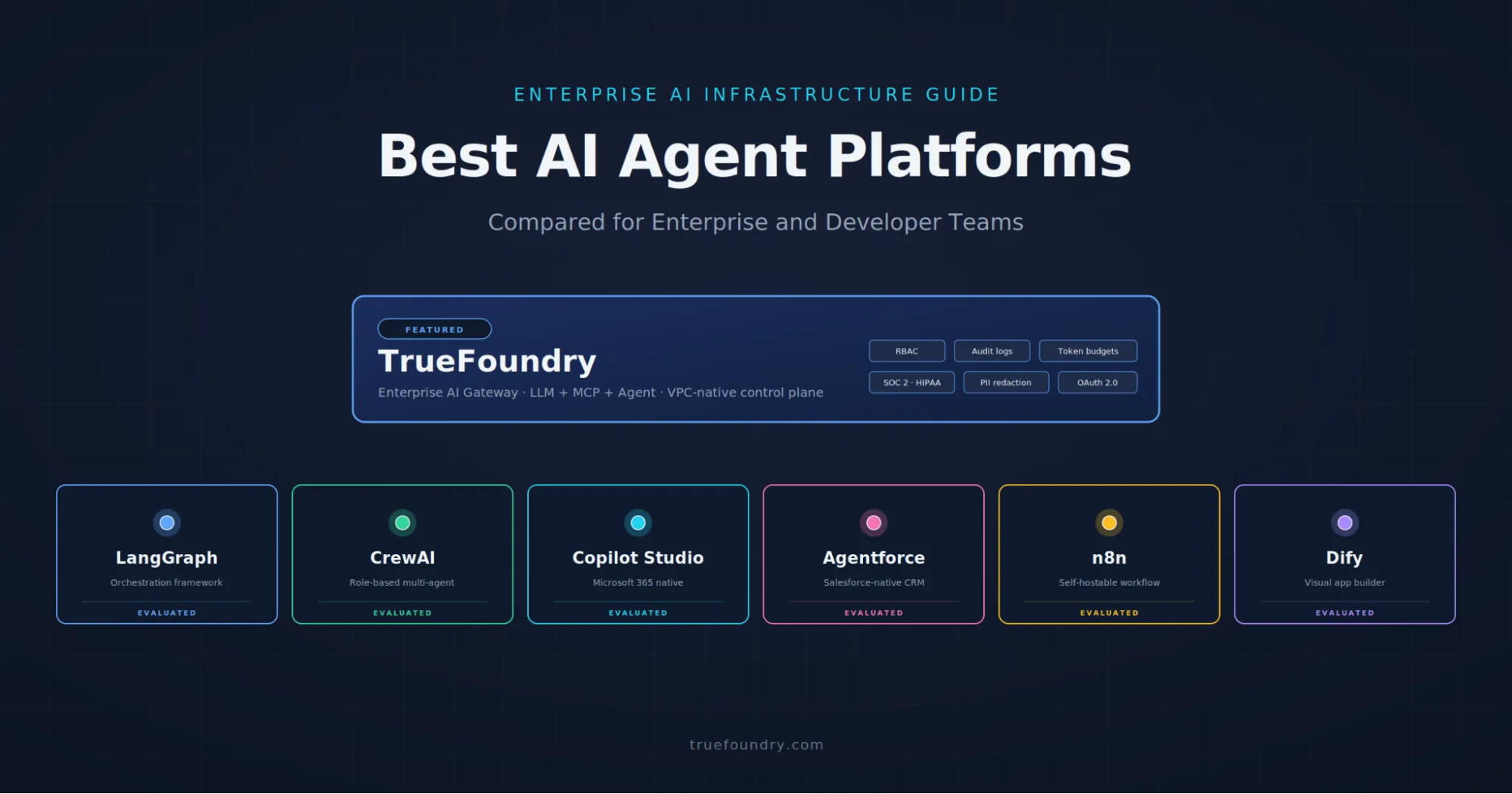
This guide compares the leading best AI agent platforms across the aspects that matter at enterprise scale. The list opens with TrueFoundry, the platform that addresses what the others leave unresolved at the infrastructure and governance layer, and works through the field from there.
The line between AI agent tools and AI agent platforms shapes procurement decisions more than any feature comparison.
An AI agent tool is a focused instrument. It is a framework for agent building, a workflow automation product, a visual workflow builder for wiring models to specific tasks. Each solves a defined problem within a narrow scope.
An AI agent platform sits at a different level. It is the broader environment where organizations build, deploy, govern, and scale agent solutions across teams, models, and use cases from a shared infrastructure foundation.
The best AI agent platforms pair agent development capabilities with operational controls required for production. Access management, observability, cost governance, and compliance evidence must apply uniformly across every workload running on top.
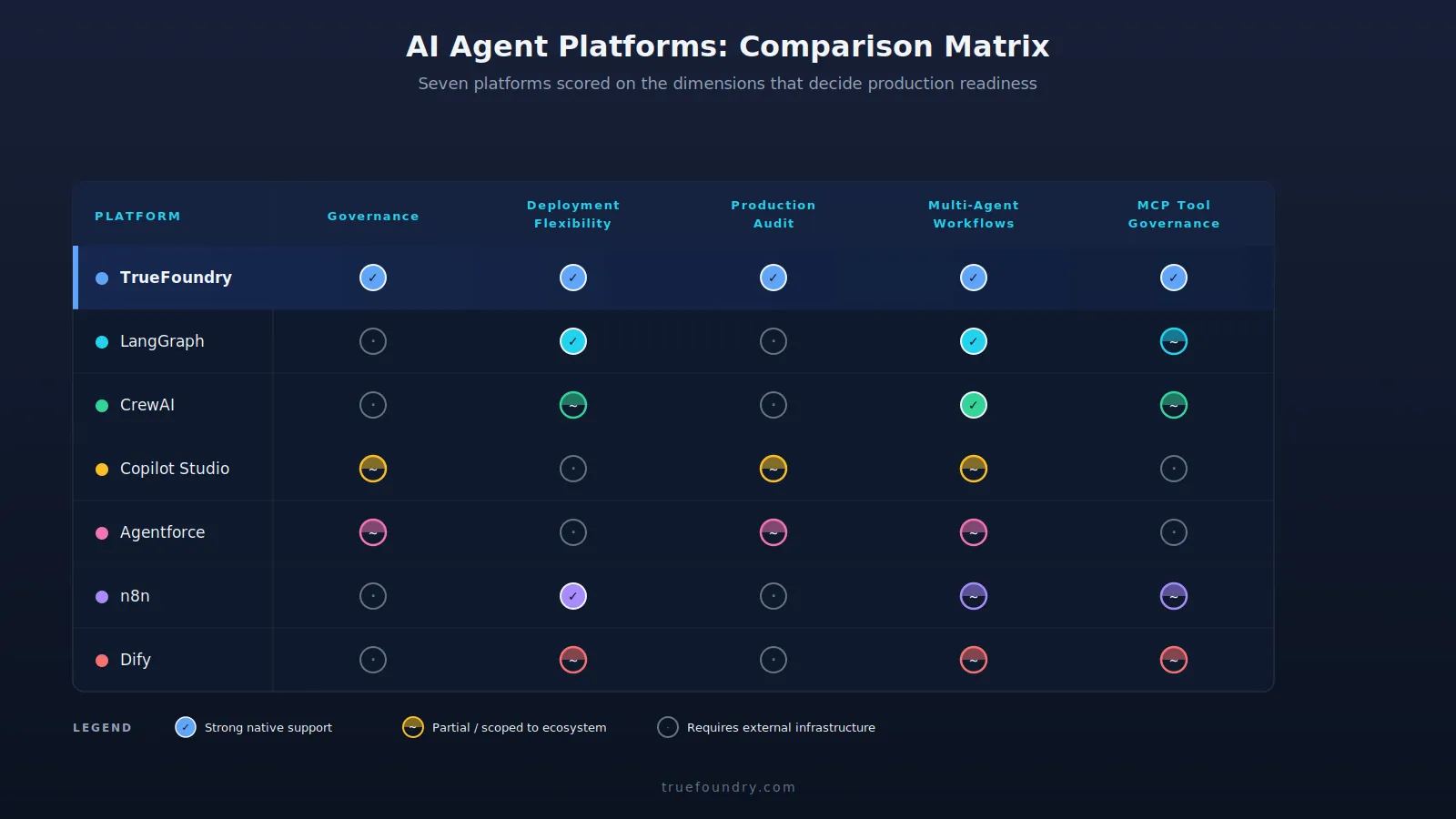
Choosing from the best AI agent platforms depends on your team size, technical depth, governance requirements, and deployment model. Here is a quick comparison:
| Platform | Best For | Deployment | Governance Depth |
|---|---|---|---|
| TrueFoundry | Large enterprises needing VPC-native AI agent governance | AWS, GCP, Azure (VPC) | Full: RBAC, audit logs, cost controls |
| LangGraph | Technical teams building stateful, complex task workflows | Self-hosted | Framework-level only |
| CrewAI | Small teams prototyping role-based agentic AI | Cloud or self-hosted | Minimal |
| Microsoft Copilot Studio | Business users inside Microsoft 365 | Microsoft Cloud | Microsoft-scoped |
| Salesforce Agentforce | Sales teams and customer service on Salesforce | Salesforce Cloud | Salesforce-scoped |
| n8n | Technical teams needing visual workflow builder with self-hosting | Self-hosted | Workflow-level |
| Dify | Smaller teams doing AI agent development with RAG | Cloud or self-hosted | Minimal |
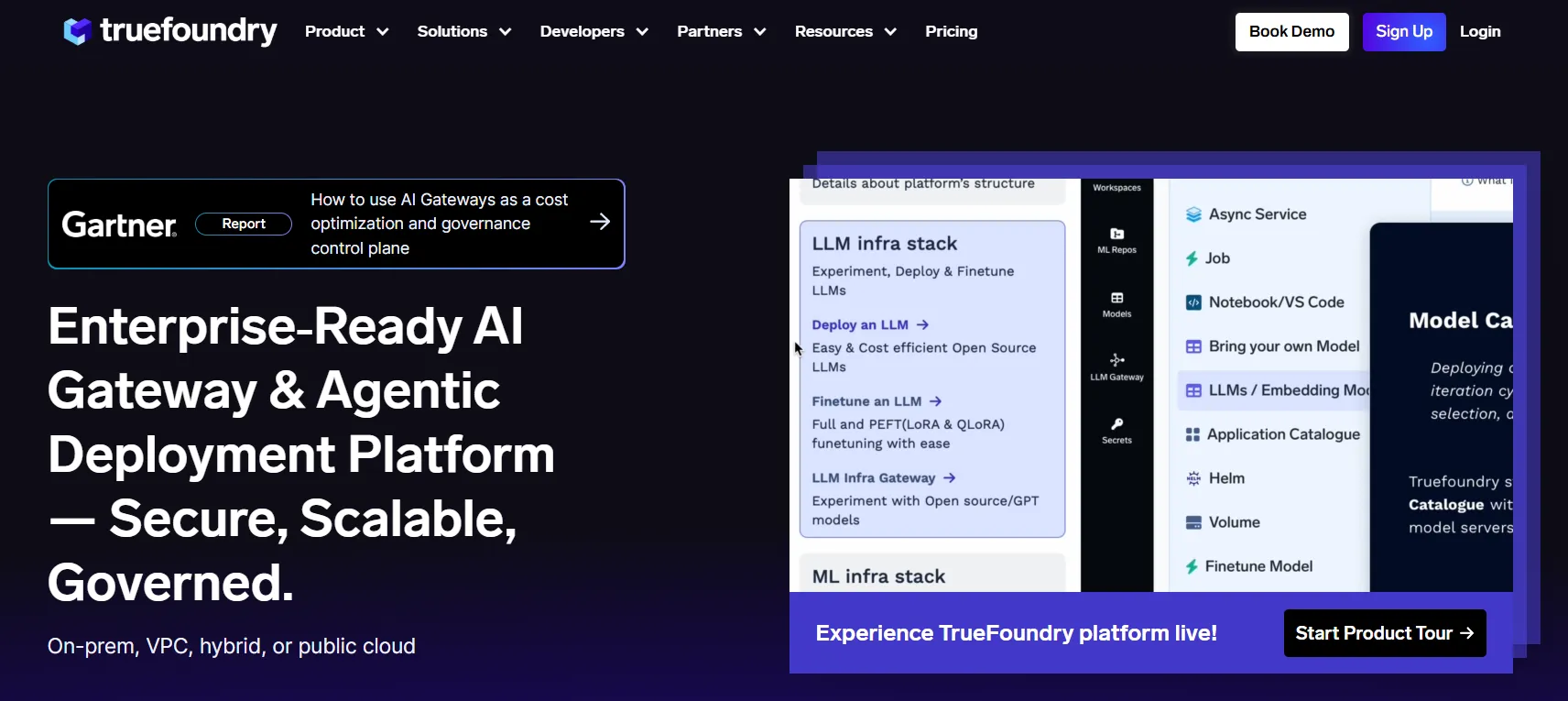
TrueFoundry is an enterprise-grade AI agent platform and AI gateway recognized in the 2025 Gartner Market Guide for AI Gateways. It governs every AI agent, model call, and tool connection from a single VPC-native control plane. It deploys entirely inside your own AWS, GCP, or Azure account, keeping all sensitive data and inference traffic within your network boundary. All these features make it one of the best AI agent platforms.
TrueFoundry offers four pricing tiers:
TrueFoundry is built for enterprise technical teams and platform engineering groups that need AI agent governance enforced at the infrastructure layer across models, agents, and data sources. It is one of the best AI agent platforms for large enterprises in regulated industries, multi-cloud deployments, and organizations where data sovereignty and full control over compliance evidence are non-negotiable.
LangGraph is a graph-based orchestration framework for building stateful, multi-step AI agent workflows. It gives technical teams deterministic control over every execution transition and conditional branch in complex tasks.
| Pros | Cons |
|---|---|
| Deterministic, auditable execution | Steeper learning curve for new users |
| Strong fault tolerance and recovery | Verbose setup for simple specific tasks |
| Active open-source community | Governance requires external AI gateway |
LangGraph is a powerful agent builder framework for complex tasks, but it provides no access controls, cost limits, or compliance audit trails out of the box. TrueFoundry's AI gateway platform adds the governance layer above LangGraph, applying RBAC, token budgets, and immutable logs to every AI agent workflow LangGraph builds.
CrewAI is a role-based agent builder framework that models multi-agent systems as teams with defined roles, goals, and AI agent tool sets. Teams frequently cite its ability to compress agent building from days to hours for standard business processes.
| Pros | Cons |
|---|---|
| Fastest time to working prototype | High token consumption per task |
| Intuitive role-based mental model | Limited branching control at scale |
| Active open source community | Governance requires external layer |
CrewAI accelerates AI agent development for small teams but provides no native access controls, cost attribution, or audit trails for enterprise platforms. TrueFoundry governs every CrewAI-built agent from the gateway layer, applying the same RBAC, cost limits, and compliance logging that large enterprises require without touching the agent code.
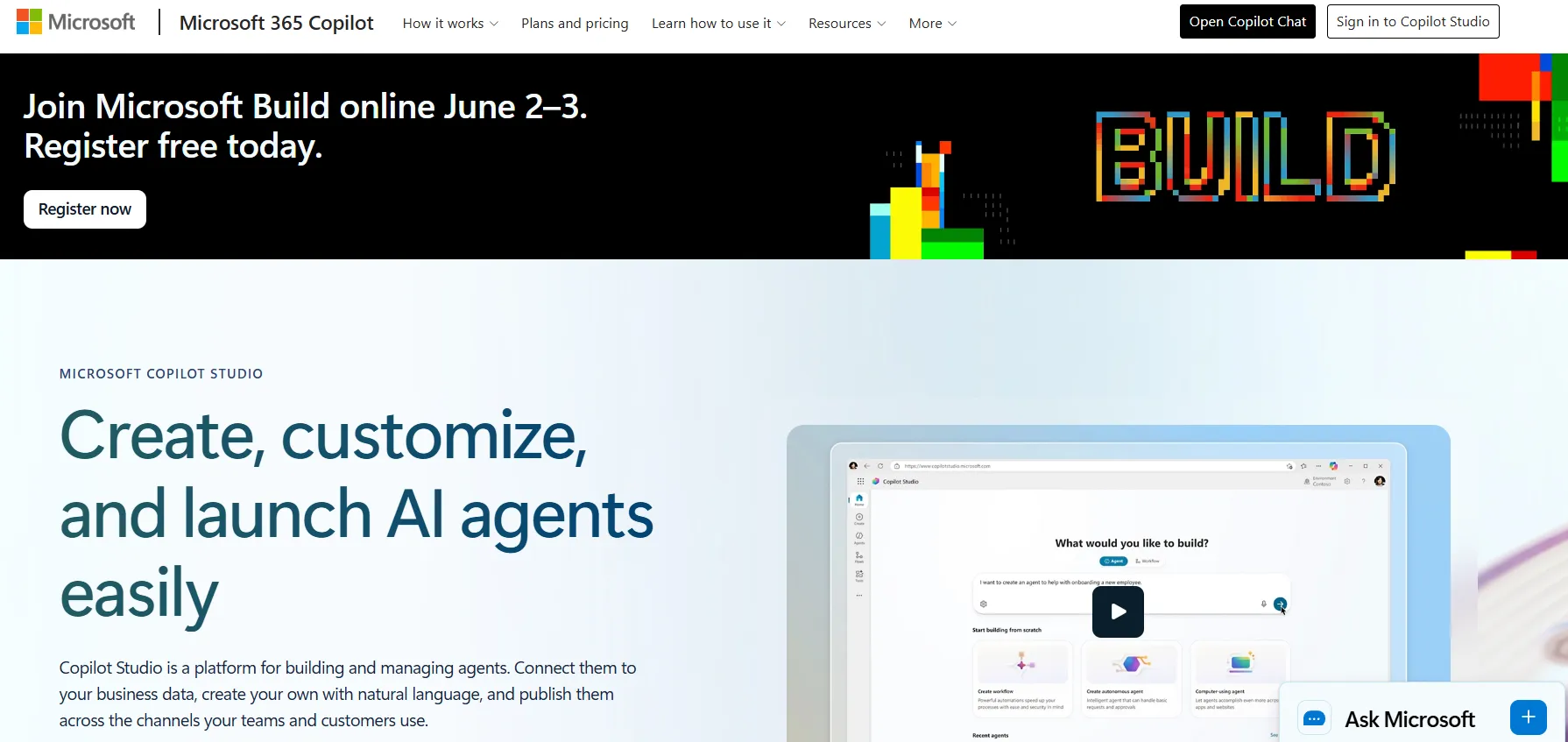
Microsoft Copilot Studio is the low-code AI agent builder inside the Microsoft 365 ecosystem. It provides native connections to SharePoint, Teams, Dynamics, and Azure OpenAI Service. Business teams and business users can build custom agents without deep technical expertise.
| Pros | Cons |
|---|---|
| Zero integration overhead for Microsoft shops | Governance scoped to Microsoft cloud only |
| Accessible for business users | Limited multi-cloud agent capabilities |
| Fast first agent deployment | External AI agent tools require custom work |
Microsoft Copilot Studio governs custom agents only within the Microsoft boundary. TrueFoundry's AI gateway extends governance uniformly across Microsoft, Google Cloud, AWS, and self-hosted models. This makes TrueFoundry the right choice for large enterprises running AI agent platforms across mixed cloud environments.
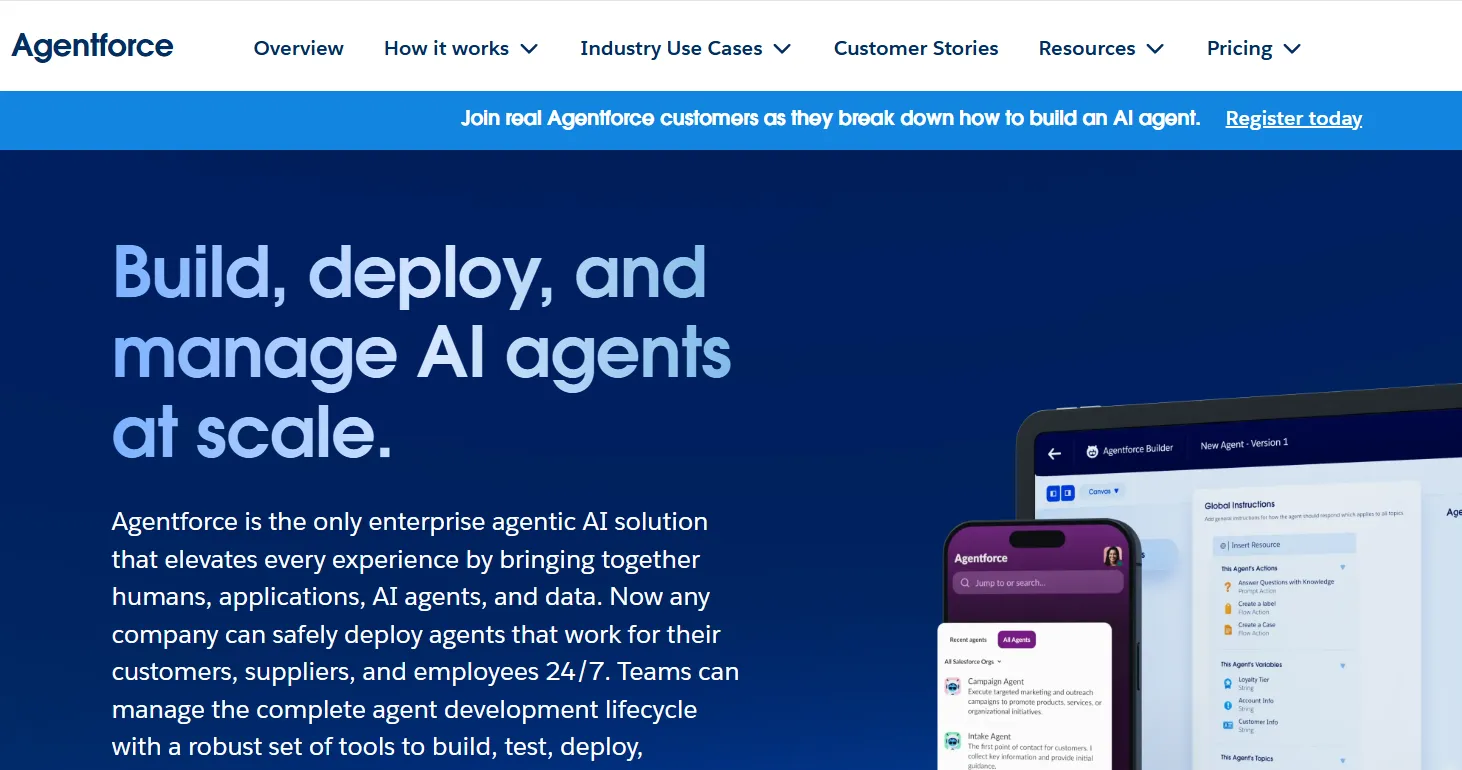
Salesforce Agentforce integrates AI agent capabilities directly into Salesforce Data Cloud, Sales Cloud, and Service Cloud. Sales teams, customer service teams, and support teams benefit from agents that run on live CRM data without requiring custom integrations.
| Pros | Cons |
|---|---|
| Deep CRM data access at launch | Expensive at scale for small businesses |
| No integration overhead for Salesforce teams | Scoped to Salesforce data sources only |
Agentforce is excellent within Salesforce but cannot govern AI agent workloads spanning enterprise systems beyond the Salesforce boundary. TrueFoundry's Agent gateway governs agents across CRM, ERP, internal APIs, and external tools from one control plane. This gives large companies complete control that Salesforce-scoped AI agent platforms cannot provide.
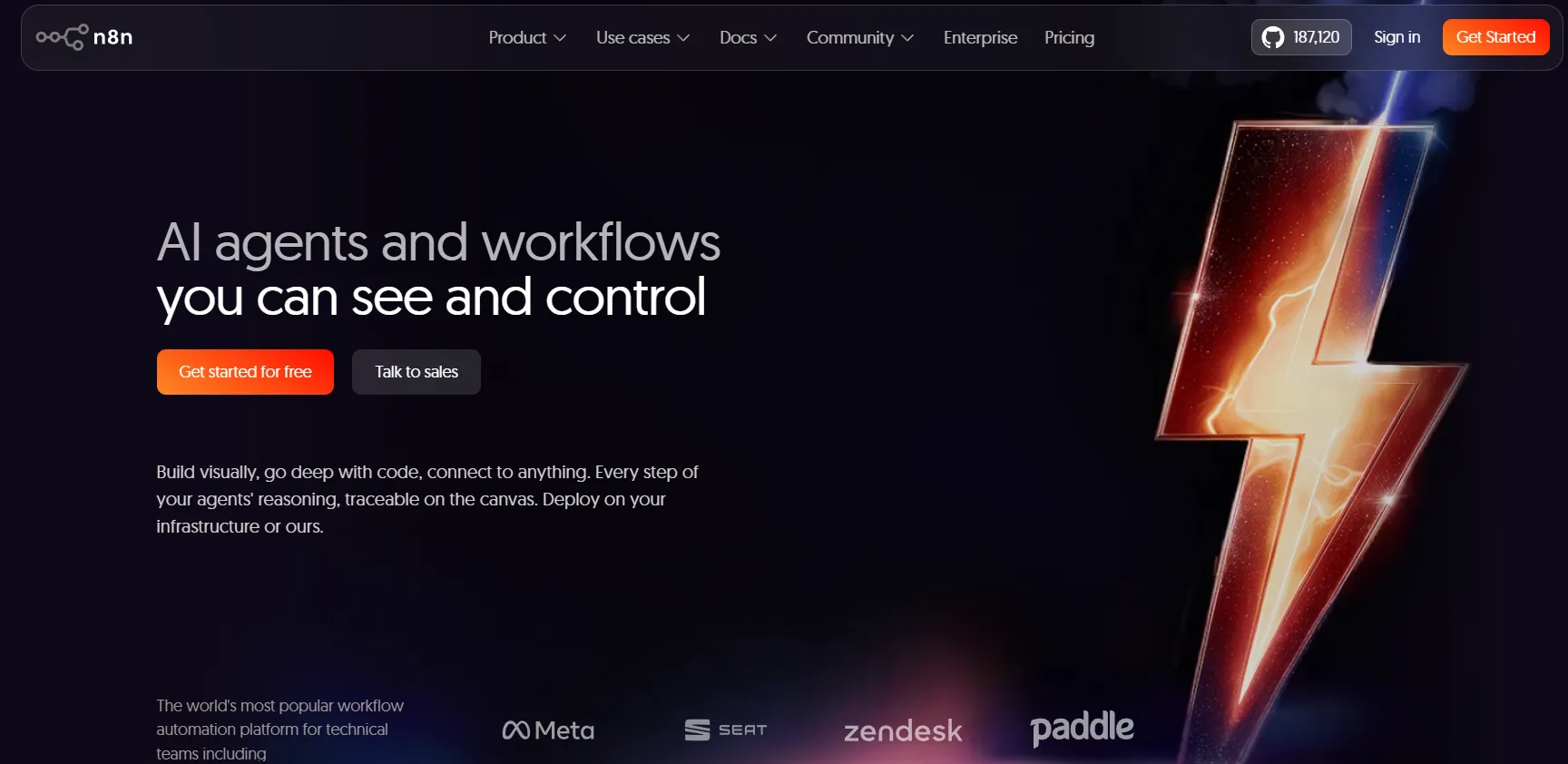
n8n is a visual workflow builder and workflow automation platform with native AI agent capabilities. It supports over 400 integrations and runs on a self-hostable architecture. It is a flexible AI agent tool for technical teams that need control over their infrastructure and sensitive data handling.
| Pros | Cons |
|---|---|
| Self-hosted data sovereignty | Governance requires technical expertise |
| Broad integration coverage | No native AI agent cost controls |
n8n is a strong workflow automation tool for technical teams but lacks the AI agent governance, RBAC, and audit logging that large enterprises require. TrueFoundry's AI gateway platform adds identity-aware access controls and compliance logging above n8n workflows without changing the automation logic teams have already built.
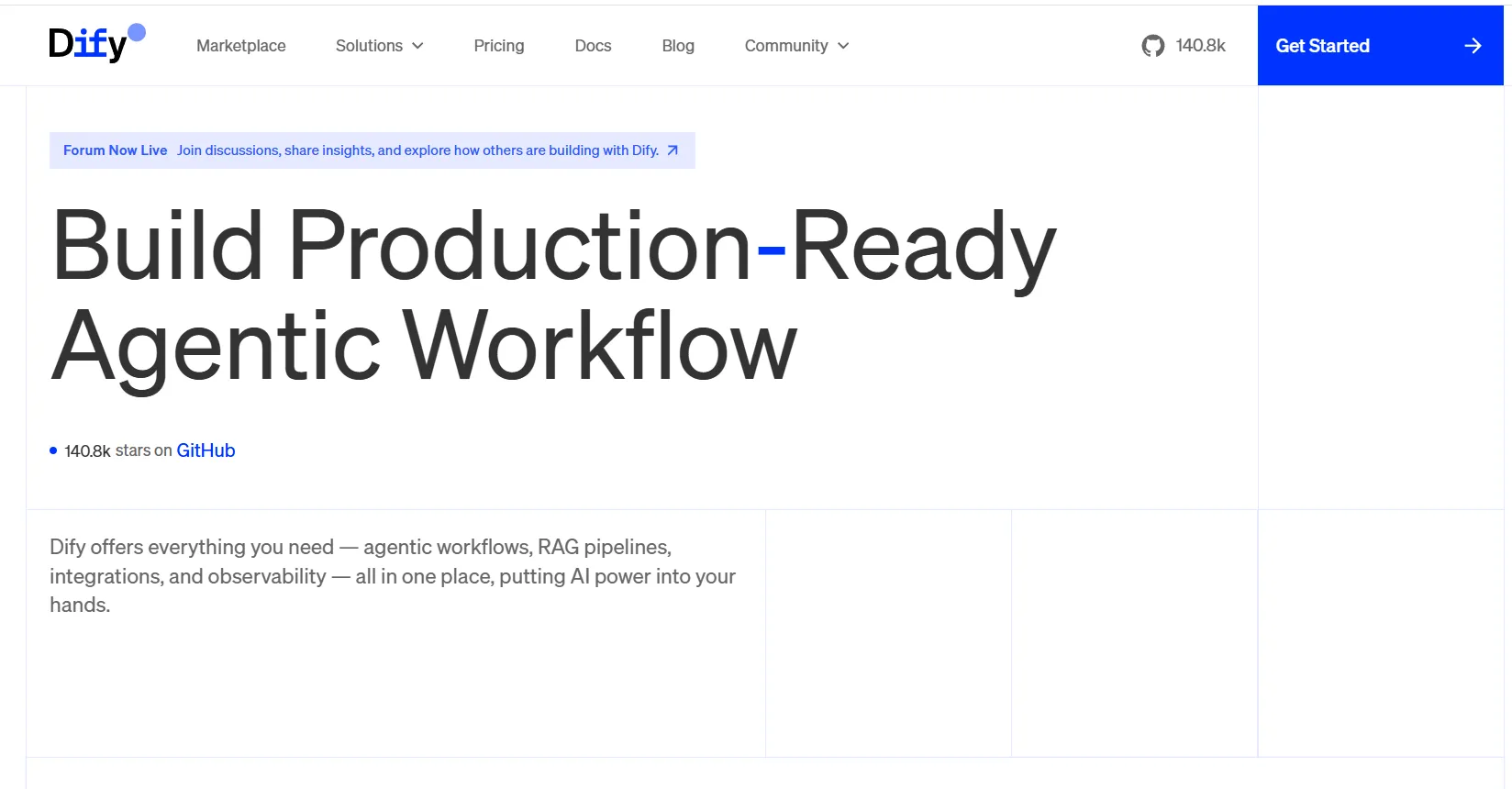
Dify is an open source visual editor for building AI agent applications with RAG pipelines, function calling, and multi-LLM support. It is one of the most accessible AI agent platforms for small businesses exploring AI agent development without heavy infrastructure investment.
| Pros | Cons |
|---|---|
| Fast multi-model AI agent prototyping | Minimal governance for enterprise platforms |
| Low barrier for business users | Agent capabilities limited at production scale |
| Open source with active community | No native cost controls or audit logging |
Dify is well-suited for rapid AI agent development and prototyping but was not built for the governance requirements of large enterprises. TrueFoundry provides the production infrastructure that Dify AI agent builds require before they can operate at enterprise scale.
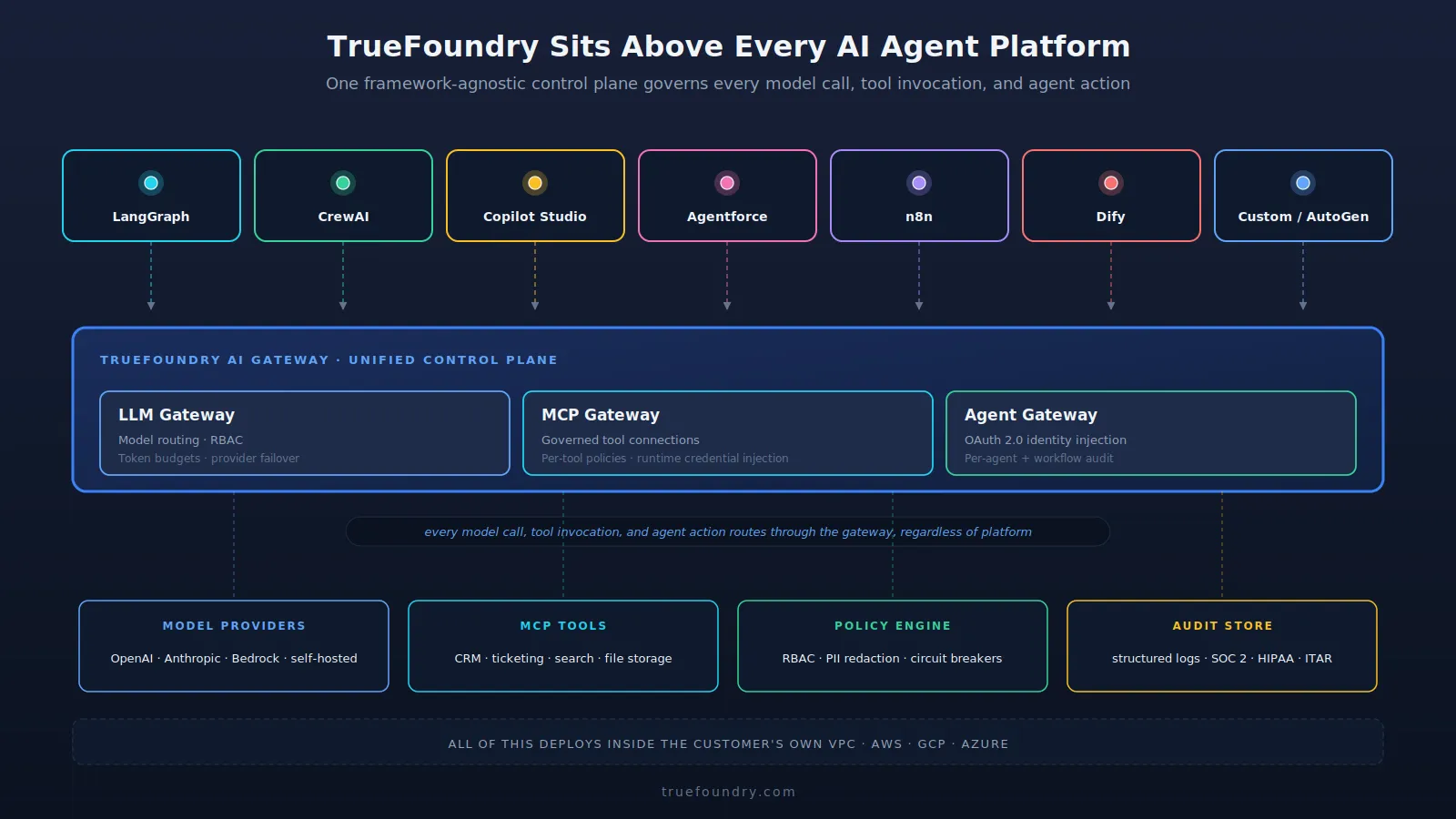
TrueFoundry is not a competing AI agent builder. It is one of the best AI agent platforms that sits above any AI agent platforms and governs what agents can do, what they access, and what running them costs.
The platform is framework-agnostic. An organization running LangGraph in one team, CrewAI in another, n8n elsewhere, and a custom build for a fourth use case gets the same governance layer applied uniformly across all four.
The four governance pillars work as follows:
Book a demo with TrueFoundry to see how the gateway sits above your existing stack and applies consistent governance everywhere.
TrueFoundry AI Gateway delivers ~3–4 ms latency, handles 350+ RPS on 1 vCPU, scales horizontally with ease, and is production-ready, while LiteLLM suffers from high latency, struggles beyond moderate RPS, lacks built-in scaling, and is best for light or prototype workloads.
Product
Company
Resources









.webp)
.webp)
.webp)
.webp)
.webp)
.webp)

.webp)
.webp)