
Most people, including the team here at XDA, will readily say that replacing an old hard drive with an SSD is the single most important performance boost that you can make. It's true, mostly, especially if that speedy SSD is going to be the main storage drive in your computer. But there are some storage situations where the hard drive is still king, and SSDs haven't quite got what it takes.
When I'm planning storage upgrades, I overwhelmingly favor hard drives, and they're the storage medium I use the most. At one point in the past, it was CDs and DVDs, but the amount of data I was creating soon outgrew removable media. Nowadays, I rarely buy SSDs except for new PC builds or to upgrade storage in devices like the ROG Ally X, but I'm always planning when I need to buy more HDDs to increase my storage pools.

4 things you should do when you receive a new hard drive
From manufacturing defects to sellers listing used HDDs as new, buying a hard drive can devolve into a painful experience if you aren't careful enough
To feed my NAS
It's a never-ending struggle to keep my storage needs met
The primary driver for my hard drive stockpiling is to increase the space I have for longer-term storage. Things like photos, business receipts, media files, and regularly used installers, so I don't have to download them every time. I've gone through a succession of external hard drives and off the shelf NAS units, from single-drive Western Digital MyBook drives, through two-bay, four-bay, and currently, a six-bay Synology NAS, and I'm going to need to upgrade that soon enough.
Every step has involved buying the largest 3.5" hard drives that I could find, installing them into a NAS, filling them with data, and planning for the next round of upgrades when the storage pool reaches a certain point. The data on these drives dates back to before SSDs were affordable and, in some cases, before they were widely available to consumers as well.
The data on these drives dates back to before SSDs were affordable and, in some cases, before they were widely available to consumers as well.
The first SSD I used was a Samsung 840 Evo 250GB, way back in 2014. SSDs had been around for a while, but that was the first time they were really affordable. At that time, I could get a 2TB hard drive for around the same price, eight times the storage space. Not to mention that 250GB was barely enough for a Windows boot drive and some programs, so all my secondary storage on my gaming PC was HDDs.
5 tips to prepare for your inevitable NAS drive failure
Your HDD or SSD will fail, but how can you prepare your NAS for this event?
I don't need the speed for long-term storage
I'm limited by the speed of my home network anyway
Time has moved on, and SSDs are more affordable than ever, especially below 2TB of capacity. That change means my laptop and gaming PC have switched to using all-flash storage, with a mix of SATA and NVMe drives. That's only for data that I need quick access to on a regular basis. Some of that data is also synced to cloud storage providers because then I can access it from every device I use, but even then, the regularly accessed data is on SSDs.
But any data files that I don't need that quickly, or video or music files that I want to add to my media server? I'll send them to the spinny drives whirring away in my NAS so they can be archived for whenever I may need them in the future. Hard drive performance when in RAID is more than enough for streaming media through Jellyfin, backing up my photos to reduce my cloud subscription fees, or storing backups that I might need in the future but don't need to see daily. Plus, I've got an SSD cache on my NAS to speed up any VMs or services running on it, to counter the one drawback of using HDDs in it.

7 reasons why drive speed doesn't matter for NAS
Other factors impact NAS performance more than drive speed
SSDs don't have the capacity
I now need drives of 20TB or more to replace my array
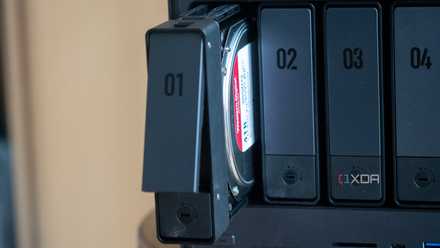
One big reason I still need huge hard drives is that the storage pool in my NAS is already using large drives, four 14TB Seagate Ironwolf Pros and two 20TB Seagate Exos. The next plan is to rotate the 14TB drives out, one at a time, but to do so, I need 20TB drives or larger due to the way hybrid RAID works on Synology devices. I've got PCs, laptops, phones, consoles and more backed up on these drives, and the current capacity is never enough.
That's going to hurt my wallet, but it's an impossible task for using SSD storage. The largest SATA or M.2 drives are 8TB of NAND, and those are the only storage interfaces that my current NAS supports. If I was using a custom-built NAS running on PC hardware or server hardware, I could consider using U.2 SSDs which do go up to 120TB of capacity or so, but these are often prohibitively expensive, even if I had the right connectors, and with SSDs needing to be replaced sooner than hard drives, would be more expense, more often, going forward.
For cold storage
I'm parking data I rarely use on airgapped devices
Any digital storage that's going to be either disconnected from power for long periods of time or airgapped to guard against security threats needs to be on a storage medium that can handle those conditions. At one point, I used to burn data onto CDs or DVDs for this purpose, but even the best removable media only lasts a certain number of years, and the capacity is easily filled with today's data requirements. Plus, storing and organizing that many discs is terrible.
That's why I now use hard drives for long-term cold storage. I can fill up the external hard drive, unplug it, and take it to another location for storage. I'll still need to check it every so often for data integrity, and I don't rely on one drive, but a couple that I cycle through, but it works. Even the best external SSDs can't retain data for as long when disconnected from power, and I don't want to run the risk of losing data.

5 reasons you need to set up cold storage for your backups
Having backups of any kind is good, but cold storage can be preferable in certain ways
So I can set up an off-site backup
Duplicating the capacity of my NAS would be impossible otherwise
Following the 3-2-1 backup rule is difficult enough with hard drive prices, let alone for SSD storage. Having a NAS backup is wise because RAID is not a backup ,and my data, including backups and other important stuff is not safe unless there's another copy away from my home.
RAID is not a backup
Currently, I have upwards of 60TB of NAS storage, and the quickest and easiest way to duplicate this is with an identical NAS, with identical drive configuration. I can't physically do that with consumer SSDs, and have no desire to build a server or two for the purposes of transferring everything to all-flash storage.

4 ways to set up an offsite backup system for your home server
Your home server's data isn't backed up unless you have an offsite storage solution.
Because they're cheaper
The price per GB is far more palatable
I'll admit that price is an important consideration, but it's one of the things I consider last when upgrading storage. Capacity is king, and longevity is next because I know this data needs to be stored. As I mentioned earlier, any storage upgrades need to be of a certain TB, or they won't add to my storage pool. Once I've narrowed down the choices based on those two variables, price often doesn't have many options left. The number of hard drive manufacturers is low, and for the capacities I need, it is even smaller.
I'll still put those hard drives into a watchlist and track the price a little bit before I order because nobody said I couldn't look for deals. I'll also look at the next size(s) up because I'll need those eventually, and sometimes those are more affordable per GB of storage than the drives I need. When you get to this level of data storage, hard drives are always going to be your best bet, unless you have one of the edge cases where SSD storage is necessary, which I do not.

4 reasons you should save money and repurpose old hard drives into a NAS
Using old drives inside your NAS can be a good idea whether you want to store some backups or save money.
I buy more hard drives than SSDs, and I can't see that changing for quite some time
I'm already planning my next round of hard drive upgrades, and the latest drives can store 50% more per drive than my largest current drives. I'm sure at some point, the physical size of 3.5" hard drives will become the hard cap for the data they can store, in which case, I'll be looking for a NAS that can fit more than six drives, or a rackmount server that can hold far more. Even when I hit the physical limits of my current NAS, I won't stop buying hard drives—I'll just hoard more of them.