
Half a decade is a pretty long time in the tech space, and that applies to graphics cards, too. That's enough for two whole generational leaps in GPUs, and then some. Every new GPU pushes the boundaries just a little further, thus pulling the bar of relevance away from older cards already installed in millions of PCs.
Today, however, the landscape is much different. A five-year-old GPU, for example, definitely does not have the raw processing units or AI cores that its modern-day equivalent boasts. However, we've now moved into an era of rendering where software suites are more important than raw hardware, which makes older graphics cards more relevant and usable than ever before.

6 GPUs that are officially too old in 2025
These GPUs can no longer bring it in modern titles
Older GPUs can still compete, thanks to software
Cores have doubled, but times have changed
A GeForce RTX 3070, when it came out, was one of the very best GPUs money could buy in late 2020. Today, a modern-day equivalent would be the RTX 5070, which has just over 5% more shading units and 4GB more VRAM. Now, while the newer card, which is just over a year old, boasts every new technology under Nvidia's DLSS suite, the RTX 3070 isn't too far behind on the software side of things. Barring DLSS multi-frame generation, the 2021 card still has support for DLSS 4.5's fantastic upscaling.
Now, even though Nvidia promised us a generation of true 4K gaming back during the RTX 30-series days, it didn't really happen until the RTX 40 series came out and supported frame generation with its AI-powered Tensor Cores. Regardless, any PC that has a GPU above the RTX 3070 can comfortably play games at respectable frame rates without having to grossly lower the in-game graphics settings. All it really takes is DLSS and a few settings tweaks and even the latest AAA games will deliver 60 fps and more.
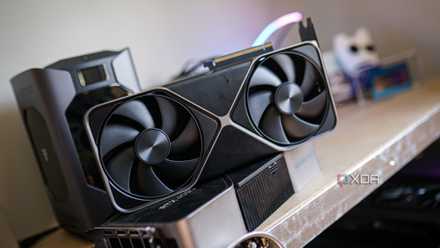
Nvidia's 6x frame generation proves that we've reached the hardware ceiling for GPUs
There's only so much VRAM to go around.
A five-year-old GPU can easily work with a 1440p display
4K may be tough, but 1440p is easily doable
Now, at 1080p, I'd wager even an RTX 20-series card would be pretty solid at running modern AAA titles, let alone a five-year-old RTX 3070 Ti. In fact, even paired with an entry-level, last-gen CPU like a Ryzen 5 5600, an RTX 3070 delivers 60+ fps on major AAA titles like Crimson Desert, Mafia: The Old Country, Silent Hill f, and Assassin's Creed Shadows. Of course, this does require turning on DLSS to the Balanced preset, thus rendering just 58% of native resolution before upscaling it to 1440p, while also lowering settings to turn off ray tracing or keep it to a minimum. Speaking purely in terms of raster graphics and texture settings, medium to high settings are pretty easy to run on an RTX 3070 while jetting out 60 fps consistently.
I whipped up a makeshift test bench with an RTX 3070 and a Ryzen 5 3600 — a seven-year-old CPU that can still punch up when put through its paces. On all six games I tested, the one thing I did across the board was turn off ray tracing. I myself may be a fanatic about using path tracing whenever available, but on an RTX 3070, the goal was to achieve a solid 60 fps on high-to-very high graphics. That wouldn't have been possible without either setting ray tracing to low, or just dismissing it altogether.
|
RTX 3070 + Ryzen 5 3600 + 16GB DDR4 RAM (1440p) |
|||
|
Game |
Graphics Preset |
DLSS Preset |
Avg. FPS |
|
Alan Wake 2 |
Medium |
Balanced |
61 fps |
|
Assassin's Creed Shadows |
Medium |
Balanced |
59 fps |
|
Black Myth: Wukong |
High |
Balanced |
64 fps |
|
Dying Light: The Beast |
Medium |
Balanced |
64 fps |
|
Hogwarts Legacy |
High |
Balanced |
65 fps |
|
Silent Hill f |
High |
Balanced |
62 fps |
Now, with the stellar improvements DLSS 4.5 made to image quality even at lower presets, I didn't have to think twice before dropping everything down to DLSS Balanced. As such, the internal resolution of each game was roughly 840p, and graphics remained medium-to-high. VRAM utilization definitely spiked, since DLSS 4.5 demands a heavier-than-usual toll for RTX 30-series and 20-series cards, but the 3070 met the challenge and walked away with its head held high as all six AAA titles managed to hit 55–70 fps at DLSS quality and high settings.

Linux just made 8GB VRAM feel like enough for the Steam Machine
One dedicated developer is making sure Linux stops stealing too much VRAM
A five-year-old GPU delivers a console-tier experience
It's closer to a PS5 than you might think
If you stop obsessing over ultra presets and native (or upscaled) 4K, what you're really chasing is a smooth, good-looking experience, which is exactly what a five-year-old GPU like the RTX 3070 delivers. In fact, it landed surprisingly close to what a base PlayStation 5 has been offering since day one: dynamic resolution, upscaling, and a target of 60 fps on performance modes. The PS5 doesn't run at native resolution, either, and instead leans heavily on reconstruction techniques and dynamic scaling. That's pretty much exactly what DLSS does on PC, except I had more control over how aggressive or conservative I wanted my trade-off to be.
Running a game at DLSS Balanced at 1440p, then, in many ways, felt similar to how consoles internally render at lower resolutions and upscale to hit performance targets. In fact, the RTX 3070 has an advantage over the base PS5, too, in that it could actually use the latest upscaling tech from Nvidia. On the other hand, the base PS5 can't support Sony's PSSR 2, which, while exclusive to the PS5 Pro, is a remarkable feat of upscaling tech.
Furthermore, PC users aren't locked into a "Performance" or "Quality" toggle, either. We get to fine-tune shadows, textures, volumetrics, and post-processing to land exactly where we want. I'll admit that using an RTX 4070 Ti with frame generation and ray tracing always turned on has spoiled me to the point that I rarely ever tweak or optimize in-game settings. And yet, when you're trying to squeeze out every last bit of performance from a GPU that is half-a-decade old, every toggle and slider in the graphics settings matters.
Gigabyte GeForce RTX 5070 Ti Eagle OC Ice SFF
12 years ago, I left AMD for NVIDIA, and AMD has never given me a reason to come back
NVIDIA's ecosystem became about much more than silicon, years ago.
With older GPUs, the trick is to find the sweet spot
Older GPUs are still capable — just chase a great experience instead of maximum performance.
"Handling modern games" doesn't mean that a five-year-old graphics card can run them at full blast with the highest settings. On the flip side, it doesn't mean scraping by at muddy resolutions and potato graphics just to hit 60 fps, either. There's a very real middle ground here, and that's where a lot of old GPUs can thrive.
With the right balance of settings, a five-year-old card can still feel sensible rather than completely outdated. Trimmed-down ray tracing and upscaling, along with carefully-tweaked settings, can deliver visuals that look genuinely impressive. Add in faster SSDs, smarter game engines, and better asset streaming, and PC users with older graphics cards can also enjoy just how good modern graphics look, all while playing at 60 fps.
With a bit of tweaking and maybe even a light overclock, older GPUs are more than capable of delivering smooth, good-looking gameplay at 60 fps, and that's what the chase is all about — not ultimate perfection, but a great experience.