
For the last five to six years, AMD has been winning the VRAM war, at least on paper. VRAM was the basket Team Red put its eggs in, with their GPUs going head-to-head against Nvidia's with more memory, better raster performance per dollar, and stronger launch-day options. In fact, that even mattered, albeit for a while.
In the meantime, Nvidia invested heavily in the software side of things, making sure the entire gaming landscape transformed around their software suite. Now, the used card market and users who haven't upgraded for years are all seeing the same truth: Nvidia's older GPUs are simply proving to be better value in this stage of the long run against their AMD counterparts that they once struggled to overpower in the VRAM battle.
Nvidia's 6x frame generation proves that we've reached the hardware ceiling for GPUs
There's only so much VRAM to go around.
Driver maturity and long-term optimization make 2018 RTX cards great value
Stability over time matters more than launch headlines
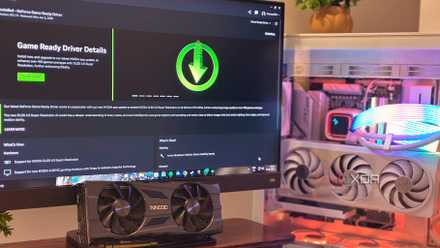
There's something to be said about how Nvidia cards tend to age quietly and gracefully. Over the years, Game Ready drivers have consistently optimized for new releases, and even older architecture GPUs have continued to receive meaningful attention from Team Green. Cards like the GeForce GTX 1660 Ti or GeForce RTX 2070 survived their generations and even thrived in them, all while still remaining viable and impressive GPUs today in 2026.
AMD, to its credit, has delivered massive driver uplifts over time, but those gains have often felt corrective instead of revolutionary. Whether fair or not, the perception has lingered that Nvidia's stack simply encounters fewer "this game hates my GPU" moments. When you're five or six years into a card's lifecycle, stability becomes the central pillar on which your aging system can stay relevant. Longevity isn't just raw graphical power and VRAM count; otherwise, AMD's GPUs would dominate the used card market today. It's more about the ecosystem around you moving in sync, and that is something Nvidia has been getting down pat for years now.
DLSS is the ultimate factor here
This is where the shift really happened
While AMD focused heavily on VRAM capacity, easily winning the battle in VRAM-per-dollar comparisons, Nvidia doubled down on silicon that didn't immediately pay off: tensor cores, RT cores, and AI pipelines. Over time, that bet transformed into an industry standard. DLSS became more than just a feature toggle, and it became part of the way modern games are now designed, for better or worse.
Even decade-old cards from both camps may look similar in graphical power and VRAM count on paper, but an RTX 20-series GPU is simply better positioned today than something like the Radeon RX Vega 64 because it still supports evolving DLSS versions that only aim to increase the longevity of Nvidia cards. Heavy upscaling at 35% internal resolutions that looks remarkably stable and impressive? That's what RTX 20 and 30-series cards are capable of achieving today at 8GB VRAM capacities.
Of course, FSR is usable and applicable across hardware generations, too, but year after year, DLSS has remained an entire generation ahead in reconstruction quality. That quality gap is something that AMD has only ever played catch up with, and it's certainly compounded over time.
NVIDIA App
I benchmarked an RTX 20-series GPU with DLSS 4.5, here's what I found
Is DLSS 4.5 a friend or a foe of the Turing family?
Nvidia's older cards boast better resale value in the used market
My RTX 2070S could still get me a great deal
Nobody is looking for a Radeon VII instead of a GeForce RTX 2080 on the used card market. That's not brand tribalism, either; it's just practical math. An RTX 2080 today can still easily run the latest AAA titles on medium-to-high settings with DLSS Performance (or even Balanced) enabled and manage to achieve 60 FPS. That alone keeps it competitive in ways older AMD cards simply can't replicate at the same visual stability.
Budget builders and secondary PC owners know this. With PC parts prices what they are today, it's not completely off the table to invest in an RTX 30-series card, or even a 2080 and above, because you will still enjoy some great horsepower from 8GB VRAM cards that can ray-trace when pushed and tweaked the right way, all while DLSS helps move things along. And yes, 8GB VRAM is still genuinely great and usable at both 1080p and 1440p, outside of a few outliers that the internet would have you believe are the norm and the death knell for midrange GPUs. The used market doesn't lie; it reflects confidence in older RTX cards and even the 1660 family, while the Vega 64s and Radeon VIIs have all but faded from existence.

Ray tracing promised realism, but it ended up normalizing upscaling
What's the point if I still have to rely on DLSS or FSR?
VRAM mattered more for a while, but now it doesn't
Winning the VRAM-per-dollar battle didn't help AMD win the war
Back in the Turing days, the matchups were clear, even if the outcomes weren't always flattering for either AMD or Nvidia. The GeForce RTX 2070 went up against the Radeon RX Vega 64, and later the Radeon RX 5700 XT. In pure raster performance, the 5700 XT was a killer value card. It forced Nvidia's hand and gave us the 2070 Super, but even then, RT and DLSS support quietly future-proofed Nvidia's side of the fence.
The RTX 2080 sparred with the Radeon VII, and the latter looked unbeatable on paper with its 16GB HBM2. And yet, it never truly displaced the 2080 in gaming relevance. And the GeForce RTX 2080 Ti existed in a league of its own.
Fast-forward to Ampere, and the RTX 3060 Ti and RTX 3070 faced off against the Radeon RX 6700 XT and RX 6800. AMD won the VRAM narrative again, and all of us joined the conversation, agreeing that Nvidia was skimping out on VRAM and skating by on brand loyalty and value. Now, five years later, it seems that those Ampere cards are clearly the more preferred GPUs on the used market against their once-counterparts, and all these years later, the difference between them feels louder than the launch-day benchmarks ever did.
12 years ago, I left AMD for NVIDIA, and AMD has never given me a reason to come back
NVIDIA's ecosystem became about much more than silicon, years ago.
What really makes a graphics card "long-lasting?"
Longevity in GPUs is about which cards remain relevant after the conversation has moved on.
Longevity in GPUs isn't a single spec. It isn't just VRAM, raw raster, or launch-day benchmark charts frozen in time, either. It's about which cards still feel relevant when the conversation has moved past them.
Over the last several years, Nvidia's strategy has quietly ensured that its older GPUs continue to participate in the present instead of merely surviving in it. In a market where upgrades are becoming harder to justify, that kind of relevance carries more weight than ever.