
There's a very specific kind of friction that comes with introducing someone to gaming when they didn't grow up with it. My partner is one of those people, and while she's been happy to be a backseat gamer for many years, it's now time for her to take the wheel.
The problem, however, is that she has to unlearn hesitation while learning buttons and mechanics. Having spent over 90% of her life not being a gamer, it's understandable that the very concept of asking her to control a camera, character, and maybe a tool or weapon in 3D space is overwhelming for her.
So, instead of forcing modern games on her, which really do assume that their players will be well-versed in the unspoken language of video games, I did what most of us unknowingly experience growing up. I went backward and turned her old, non-gaming laptop into a bit of a time machine with emulation. Now, I've crafted a carefully curated experience that starts simple, builds intuition, and slowly prepares her for modern AAA titles before the year is over.
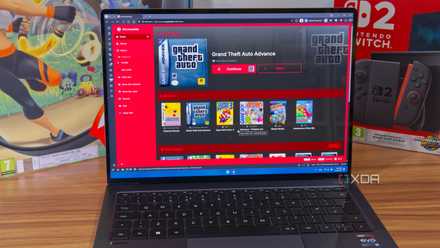
Emulation has become so easy that the setup is completely invisible now
It feels just like a console.
I've turned her work laptop into a perfect emulator
I've brought together three different eras for emulation
My partner's job has long hours but also stretches of downtime when the workload is low. So, instead of letting that time dissolve into doomscrolling and whatever new show Netflix is streaming, I saw an opportunity to build something meaningful: a gaming setup that fits into her routine without disrupting it. RetroArch became the backbone of this entire experience. It's clean, it's unified, and most importantly, almost invisible once you set it all up. While I might be happy to juggle several emulators in different folders and directories on my own PC, she won't have to think about cores or configurations. Everything is set up and works smoothly, which should be the number one priority when onboarding a complete newbie to the medium.
I haven't stopped at just retro games, either. I've even gone ahead and set up PCSX2 and RPCS3, so that she can experience a handful of PS3 games I still own. More importantly, though, each of the four PS3 games I own is incredibly significant and absolutely will teach her something new about gaming — Journey, Portal 2, the first Uncharted, and Shadow of the Colossus. These are all defining titles that will stay with her long after she's done, as they did for us. I still think about how I bought an Xbox 360 back then just to play Halo 3, letting nearly the entirety of the fantastic PS3 era pass me by. Now, however, it feels like I'm finally passing on the right experiences for my partner.

Original Xbox emulation finally comes to Android — sort of
Games aren't exactly playable, but it's mostly a step in the right direction.
Starting where it all made sense
A crash course in the classics
Seeing how modern games can be tough for someone completely new to the medium, I decided to start my partner off with the classics. Setting up RetroArch with NES, SNES, Genesis, and PS1 cores, I went back to the games that taught all of us timing, space, and patience without ever feeling like tutorials. Platformers like Contra, Sonic, Castlevania, and Super Mario World, along with the greatest 16-bit RPGs like The Legend of Zelda: A Link to the Past and Chrono Trigger will be supreme here. They introduce mechanics slowly, in ways that won't overwhelm her.
That's how we learned with these games, after all. We jumped, missed, and learned. We explored, failed, and tried again. Thankfully, RetroArch's hotkeys also come in handy here with quick saves, quick loads, and fast-forward features that help her get through slower segments faster. Pure interaction with the screen and the characters, without being overstimulated by UI elements, is what she needed to build her muscle memory and confidence from the ground up, and RetroArch, along with simpler games that we all consider classics, do exactly that.

I was a Sega kid growing up, here's what it felt like witnessing the console wars
Growing up as a gamer in the 90s was an interesting time. Here's what it was like witnessing the real console wars in the 90s.
There's a reason I'm not doing this on the phone
We're prioritizing comfort and scale
While I use RetroArch to play plenty of classics on my iPhone and carry it with me everywhere, I chose not to take that route with my partner. For starters, she isn't comfortable gaming on a phone, considering just how small the screen is for someone who doesn't automatically know where to look all the time. For her, gaming needs to feel relaxed, but on her iPhone 15 Plus, it feels cramped and forced.
As such, the laptop proved to be a clear winner. It's familiar and already part of her daily routine. Now, it just happens to double as a dedicated emulation machine that she can carry to work every single day and play games on without any friction or mental barriers. Despite not being a gaming-focused machine with a discrete GPU, the laptop she bought is more than capable of running most pre-2010 titles without breaking a sweat.
In a strange way, that limitation is what makes this setup perfect, because by the time she hits the ceiling of what this laptop can achieve via emulators, it will be time for her to graduate to modern AAA games on her own console or PC. In the meantime, her laptop is focused, intentional, and exactly what she needs right now.
RetroArch
RetroArch is a cross-platform emulator frontend that supports many different emulators. It lets you play classic games on modern computers with a single interface.
The 7 most accurate RetroArch cores for gaming like you remember
Mainline nostalgia, straight from your PC
Familiar hardware helps keep her comfortable learning something entirely new
Now that I've turned my partner's old laptop into a near-perfect emulation machine, it's only a matter of time before she feels comfortable with the medium. This setup will slowly remove the intimidation that modern games quietly carry. With the simplest classic titles, my partner won't feel any pressure to "get good" or any overwhelming mechanics, either. The hardware is already familiar to her, which will help her get comfortable with the "new" games she plays, too.
With each passing week, as she picks up a game during quiet hours at work, it feels like she's finding her own way into it, and I'm no longer holding her hand through gaming.