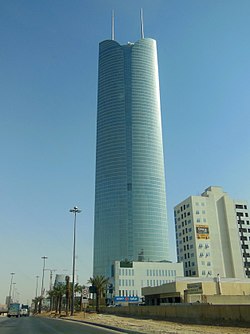
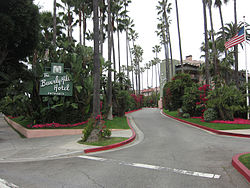
A hotel is an establishment that provides paid lodging on a short-term basis. Facilities provided inside a hotel room may range from a modest-quality mattress in a small room to large suites with bigger, higher-quality beds, a dresser, a refrigerator, and other kitchen facilities, upholstered chairs, a television, and en-suite bathrooms. Small, lower-priced hotels may offer only the most basic guest services and facilities. Larger, higher-priced hotels may provide additional guest facilities such as a swimming pool, a business center with computers, printers, and other office equipment, childcare, conference and event facilities, tennis or basketball courts, gymnasium, restaurants, day spa, and social function services. Hotel rooms are usually numbered (or named in some smaller hotels and B&Bs) to allow guests to identify their room. Some boutique, high-end hotels have custom decorated rooms. Some hotels offer meals as part of a room and board arrangement. In Japan, capsule hotels provide a tiny room suitable only for sleeping and shared bathroom facilities.
Hotel operations vary in size, function, complexity, and cost. Most hotels and major hospitality companies have set industry standards to classify hotel types. An upscale full-service hotel facility offers luxury amenities, full-service accommodations, an on-site restaurant, and the highest level of personalized service, such as a concierge, room service, and clothes-ironing staff. Full-service hotels often contain upscale full-service facilities with many full-service accommodations, an on-site full-service restaurant, and a variety of on-site amenities. Boutique hotels are smaller independent, non-branded hotels that often contain upscale facilities. Small to medium-sized hotel establishments offer a limited amount of on-site amenities. Economy hotels are small to medium-sized hotel establishments that offer basic accommodations with little to no services. Extended stay hotels are small to medium-sized hotels that offer longer-term full-service accommodations compared to a traditional hotel. (Full article...)
Façade of Watson's hotel, now known as the Esplanade Mansion
Watson's Hotel (actually Watson's Esplanade Hotel), now known as the Esplanade Mansion, located in the Kala Ghoda area of Mumbai (Bombay), is India's oldest surviving cast iron building. It is probably the oldest surviving multi-level fully cast-iron framed building in the world, being three years earlier than the Menier Chocolate Factory in Noisiel, France, which are both amongst the few ever built. Named after its original owner, John Watson, the cast and wrought - iron structure of the building was prefabricated in England, and it was constructed between 1867 and 1869.
The hotel was leased on 26 August 1867 for the term of 999 years at a yearly rent of Rupees 92 and 12 annas to Abdul Haq. It was closed in the 1960s and was later subdivided and partitioned into smaller cubicles that were let out on rent as homes and offices. Neglect of the building has resulted in decay and, despite its listing as a Grade II–A heritage structure, the building is now in a dilapidated state. A documentary film about the building was made in 2019 called The Watson's Hotel. (Full article...)
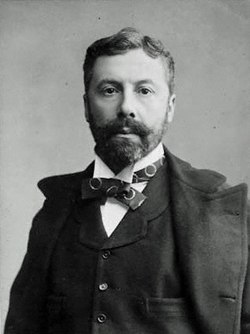
👁 Image Richard D'Oyly Carte Richard D'Oyly Carte (; 3 May 1844 – 3 April 1901) was an English talent agent, theatrical impresario, composer, and hotelier during the latter half of the Victorian era. He built two of London's theatres and a hotel empire, while also establishing an opera company that ran continuously for over a hundred years and a management agency representing some of the most important artists of the day.
Carte started his career working for his father, Richard Carte, in the music publishing and musical instrument manufacturing business. As a young man he conducted and composed music, but he soon turned to promoting the entertainment careers of others through his management agency. Carte believed that a school of wholesome, well-crafted, family-friendly, English comic opera could be as popular as the risqué French works dominating the London musical stage in the 1870s. To that end he brought together the dramatist W. S. Gilbert and composer Arthur Sullivan and nurtured their collaboration on a series of thirteen Savoy operas. He founded the D'Oyly Carte Opera Company and built the state-of-the-art Savoy Theatre to host the Gilbert and Sullivan operas. (Full article...)
The W New York Union Square building was initially the headquarters of the Germania Life Insurance Company. In 1917, when the company became the Guardian Life Insurance Company of America, the building was renamed the Guardian Life Insurance Company Building. A four-story annex to the east was designed by Skidmore, Owings & Merrill and was completed in 1961. Guardian Life moved its offices out of the building in 1999, and the W New York Union Square opened the following year. (Full article...)
The Hotel Polen fire occurred on 9 May 1977 in Amsterdam, the Netherlands. The conflagration destroyed the Hotel Polen (Hotel Poland), a five-story hotel in the centre of the city which had been built in 1891, as well as the furniture store on the ground level and a nearby bookstore. Many of the tourists staying at the hotel (of whom the majority were Swedes) jumped to their deaths trying to escape the flames. Upon their arrival, the fire department used a life net to help people escape, but not everyone could be saved. The incident resulted in 33 deaths and 57 injuries (21 serious). The cause of the fire is unknown. In 1986, the Polish-born artist Ania Bien created a photographic installation based on the fire which compared it to the Holocaust.
The hotel was located between the Kalverstraat (no. 15–17) and the Rokin (no. 14), near the present day Madame Tussauds. Its place is now occupied by the Rokin Plaza, originally an office building, which today houses several fashion shops. (Full article...)
The 795-room hotel was designed by Alan Lapidus and is 480 feet (150 m) tall with 46 floors. The facade was designed in glass and pink granite, with a 100-foot-tall (30 m) arch facing Broadway. The hotel was designed to comply with city regulations that required deep setbacks at the base, as well as large illuminated signs. In addition to the hotel rooms themselves, the hotel contains ground-story retail space, nine stories of office space, and a 159-space parking garage. The hotel's tenants include the American Management Association, and Learning Tree International; in addition, New York Sports Club was a former tenant. (Full article...)
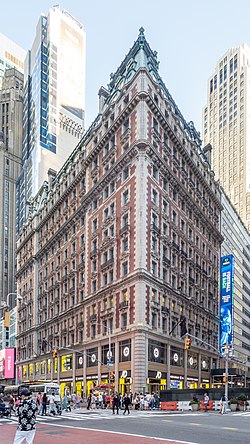
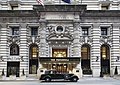
The hotel is designed largely in the Beaux-Arts style by Marvin & Davis, with Bruce Price as consultant. Its primary frontages are on Broadway and 42nd Street. These facades are constructed of red brick with terracotta details and a prominent mansard roof. The Knickerbocker Hotel also incorporates an annex on 41st Street, built in 1894 as part of the St. Cloud Hotel, which formerly occupied the site. The 41st Street facade contains a Romanesque Revival designed by Philip C. Brown. The hotel contains 300 rooms, a restaurant, a coffee shop, and a roof bar. The original interior design was devised in 1905 by Trowbridge & Livingston, scattered remnants of which include an entrance that formerly led from the New York City Subway's Times Square station to the hotel's basement. (Full article...)
The Royal Albion Hotel (originally the Albion Hotel) is a 3-star hotel, on the corner of Old Steine and Kings Road in Brighton, England. Built on the site of a house belonging to Richard Russell, a local doctor whose advocacy of sea-bathing and seawater drinking helped to make Brighton fashionable in the 18th century, it has been extended several times, although it experienced a period of rundown and closure in the early 20th century. A fire in 1998 caused serious damage, and the hotel was restored. However, another fire in 2023 seriously damaged the building to the extent that demolition of the western part of the building began on 19 July 2023.
The Classical-style building has three parts of different sizes and dates but similar appearances. Large pilasters and columns of various orders feature prominently. Amon Henry Wilds, an important and prolific local architect, took the original commission on behalf of promoter John Colbatch. Another local entrepreneur, Harry Preston, restored the hotel to its former high status after buying it in poor condition. The building took on its present three-wing form in 1963. The original part of the building was listed at Grade II* by English Heritage for its architectural and historical importance, and its western extension is listed separately at the lower Grade II. (Full article...)
The hotel has two wings, one on 45th Street and one on 46th Street, connected by a podium at ground level. The first two stories contain retail space, while the Marquis Theatre was built within the building's third floor. The hotel's atrium lobby is at the eighth floor and also includes meeting space and restaurants. Thirty-six stories of guestrooms rise above the lobby, overlooking it. The top three stories contain The View, one of New York City's highest restaurants and revolves for a 360° view of the city. An architectural feature of the hotel is its freestanding concrete elevator core, which has twelve glass elevator cabs on its exterior. (Full article...)
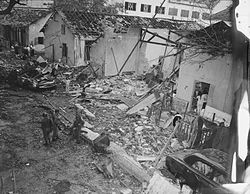
The Brinks Hotel in Saigon, also known as the Brink Bachelor Officers Quarters (BOQ), was bombed by the Vietcong on the evening of 24 December 1964, during the Vietnam War. Two Vietcong operatives detonated a car bomb underneath the hotel, which housed United States Army officers. The explosion killed two Americans, an officer and an NCO, and injured approximately 60, including military personnel and Vietnamese civilians.
The Vietcong commanders had planned the venture with two objectives in mind. Firstly, by attacking an American installation in the center of the heavily guarded capital, the Vietcong intended to demonstrate their ability to strike in South Vietnam should the United States decide to launch air raids against North Vietnam. Secondly, the bombing would demonstrate to the South Vietnamese that the Americans were vulnerable and could not be relied upon for protection. (Full article...)
Hotelito Desconocido (Spanish:[oteˈlitoðeskonoˈsiðo], "Little Unknown Hotel") was a Mexican boutique hotel and ecotourism resort in the municipality of Tomatlán, Jalisco. Formed in 1995 by an Italian architect, Hotelito Desconocido used an architectural style of that combined both rustic and luxurious designs. It was built on an UNESCO-designated natural reserve that was home to a number of endangered bird and turtle species. The hotel won international and domestic awards for its unique architecture and sustainable energy model, and it was a famous getaway spot for international tourists and celebrities. Its construction, however, created tensions with a local group of fishermen that protested against the alleged ecological violations caused by Hotelito Desconocido's construction and expansions.
In 2007, Hotelito Desconocido was acquired by W&G Arquitectos, a company headed by Wendy Dalaithy Amaral Arévalo. She is the wife of Gerardo González Valencia, a former suspected drug lord of Los Cuinis and the Jalisco New Generation Cartel, two allied criminal groups based in Jalisco. After years of resistance from the local fishermen, three members of their group went missing in Guadalajara, Jalisco in 2011 after attending an ecological preservation meeting. They had reportedly previously received death threats from the hotel's management and local farmers who were also opposed to their protests. (Full article...)
The burned dome of the Taj Mahal Palace Hotel on 3 December 2008.
The 2008 Mumbai attacks, also known as 26/11, were a series of twelve coordinated Islamic terrorist attacks carried out in Mumbai, Maharashtra, India, from 26 to 29 November 2008 by ten members of the Lashkar-e-Taiba, a Pakistani Islamic terrorist organisation. A total of 175 people died, including nine of the attackers, and more than 300 were injured.
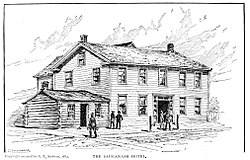
Sauganash Hotel, c. 1830–33 (the smaller building on the left was Chicago's first drug store)
Sauganash Hotel (originally Eagle Exchange Tavern) was a hotel regarded as the first hotel in Chicago, Illinois. Built in 1831, the hotel was located at Wolf Point in the present-day Loopcommunity area at the intersection of the north, south and main branches of the Chicago River. The location at West Lake Street and North Wacker Drive (formerly Market Street) was designated a Chicago Landmark on November 6, 2002. The hotel changed proprietors often in its twenty-year existence and its dining hall area briefly served as Chicago's first commercial theater. It was named after Billy Caldwell, called Sauganash meaning Englishman, a captain in the British Indian Department and son of William Caldwell. (Full article...)
Pikes is a luxury hotel in Ibiza, in the Balearic Islands of Spain. It is located in the countryside, 1.6 miles (2.6 km) to the northeast of the town of Sant Antoni de Portmany, and 10.2 miles (16.4 km) to the northwest of Ibiza Town. A 15th-century stone mansion which was a finca (farm estate), it was converted into a hotel in 1978 by British-born Australian Anthony Pike.
The hotel, cited as one of the most famous or infamous hotels on the island, developed a notorious reputation for hedonism in the 1980s, and is associated with being a playground for the rich and famous. It is best known for being the location of filming for Wham!'s 1983 hit "Club Tropicana" and for Freddie Mercury's 41st birthday bash in 1987, cited as one of the most lavish parties ever to be held on Ibiza. (Full article...)
Israeli strikes on a hotel and residential areas in the towns of Aramoun and Saadiyat, in the south of Beirut, kill eleven people and injure four others. (Al Jazeera)
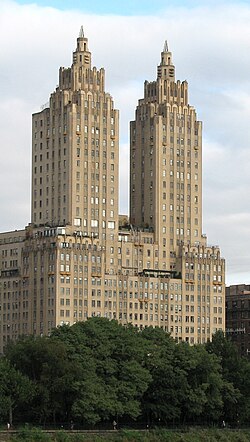
The base contains several small setbacks, and two towers rise from the eastern side of the base. On Central Park West, the first three stories are clad in cast stone, and the main entrance consists of three angular bronze archways. The remainder of the facade is made of tan and brown brick, which are arranged to emphasize the vertical lines of the facade. Some of the upper-story apartments contain angular stone balconies, and the tops of the towers are ornamented with sculpted finials. When the El Dorado opened, it contained 200 apartments with 1,500 rooms, though some apartments have since been split or combined. The main lobby is decorated in marble, and a gym in the building's two basement levels was added in the 1990s.
The El Dorado replaced a pair of apartments that were built in 1902 and also known as the El Dorado. The current apartment complex was constructed from 1929 to 1931 by developer Louis Klosk, who was unable to complete the building after the Wall Street Crash of 1929. The Central Park Plaza Corporation bought the El Dorado at a foreclosure auction in 1931. The corporation was taken over by the Pick Hotels Corporation in 1943, then by Hugh K. McGovern in January 1953. The building was then sold in May 1953 to pastor Charles M. "Daddy" Grace, whose estate sold the building in 1960 to Alexander Gross. The El Dorado became a housing cooperative in July 1982, and several parts of the building were upgraded, despite disagreement among tenants. (Full article...)
👁 Image Rosewood Hotel Group, also known for its former trading namesNew World Hotel Group, New World Hospitality and legal names New World Hotel Management (BVI) Limited, New World Hotel Management Limited is a Hong Kong–based multi-national hotel management group and the parent company of Rosewood Hotels & Resorts (founded in 1979). The company is incorporated in the British Virgin Islands as an offshore company. As of 2016, Rosewood Hotel Group was owned by Chow Tai Fook Enterprises, having acquired Rosewood Hotel Group in 2015 from Chow Tai Fook Enterprises' listed associate companyNew World China Land for HK$1.96 billion.
Rosewood Hotel Group is headed by Sonia Cheng, daughter of Henry Cheng and granddaughter of the late Cheng Yu-tung, the patriarchs of Chow Tai Fook Enterprises and New World Development. She was appointed as the executive vice-chairman of New World Hotel Management Limited in February 2009 and one of the executive director of New World China Land, the parent company at that time in January 2010. (Full article...)
👁 Image A 1792 painting of a Hindu temple and choultry (a travelers' rest house) Choultry is a resting place, an inn or caravansary for travelers, pilgrims or visitors to a site, typically linked to Buddhist, Jain and Hindu temples. They are also referred to as chottry, choultree, chathra, choltry, chowry, chawari, chawadi, choutry, chowree or tschultri.
This term is more common in South India, Central India and West India, while in North India similar facilities are called Dharmshalas. They are known as a chatra, satram, chatram or dharmasala in eastern regions of India. The choultry concept and infrastructure in South Asia dates back to at least the 1st millennium, according to epigraphical evidence such as stone and copper plate inscriptions.
A choultry provides seating space, rooms, water and sometimes food financed by a charitable institution. Its services are either at no cost, or nominal rates, or it is up to the visitor to leave whatever they wish as a donation. They were also used by officials traveling on public business. Many major temples have mandapam and pillared halls, some called Thousand pillared halls with an attached kitchen for servicing pilgrims and travelers to the temple. The term choultry may overlap with a mandapa. Many Hindu monasteries (matha) also built and operated such choultries. (Full article...)
👁 Image Waldorf-Astoria Dance Orchestra in 1924. Will Rogers (standing right), Art Gillham, Wendell Hall, Carson Robison, the Eveready Quartet, Graham McNamee. The Waldorf-Astoria Orchestra was an orchestra that played primarily at the Waldorf Astoria Hotel, both the old and new locations. In addition to providing dinner music at the famous hotel, the orchestra made over 300 recordings and many radio broadcasts. It was established in the 1890s, and was directed by Carlo Curti in early 1900s, Joseph Knecht at least from 1908 to 1925, later by Jack Denny and others, and then Xavier Cugat from approximately 1933 to 1949.
Denny and the Waldorf-Astoria Orchestra appeared in the movie Moonlight and Pretzels in 1933. Both Denny and Cugat had their own orchestras when they began playing at the Waldorf-Astoria, so the term "Waldorf-Astoria orchestras" might be an appropriate description. (Full article...)
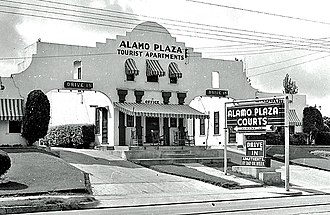
👁 Image Alamo Plaza Courts in Waco, Texas (1939) The Alamo Plaza Hotel Courts brand was the first motel chain in the United States, founded by Edgar Lee Torrance in Waco, Texas, in 1929. By 1955, there were more than twenty Alamo Plazas across the southeastern U.S., most controlled by a loosely knit group of a half-dozen investors and operating using common branding or architecture.
Marketed as "Alamo Plaza Tourist Apartments" using distinctive Mission Revival Style architecture, each formed a U-shaped court with multiple buildings fronted by a distinctive façade which mimics the face of the Alamo Mission in San Antonio. These properties attempted to distinguish themselves from other motels or cabins of the tourist courts of their era by introducing amenities such as telephones in each room (1936), Beautyrest mattresses on every bed and later swimming pools and televisions in rooms.
The roadside tactic of using distinctive, non-standard architecture to catch the attention of passing motorists would later be used by other chains, such as the Wigwam Motels which served U.S. Route 66 travellers or the easily recognised orange rooftops of the original Howard Johnson chain. (Full article...)
The Conrad Fort Lauderdale is a luxury condominium-hotel resort located on ocean-front property on North Fort Lauderdale Beach Boulevard in Fort Lauderdale, Florida. The resort includes 181 condo-hotel units, as well as 109 condominium units in a separate building known as The Ocean Resort Residences. The project initially began construction in July 2005, as Trump International Hotel & Tower Fort Lauderdale. Donald Trump lent his name to the project through a licensing deal before being elected the President of the United States, with New York developer Roy Stillman and Bayrock Group as the project developers. The project's opening was initially scheduled for 2007, but was delayed several times.
Trump removed his name from the unfinished project in 2009, after the developer defaulted on the licensing agreement. By that time, lawsuits alleging breach of contract and misleading advertising had been filed against the project by several condominium buyers. Foreclosure for the project was filed in March 2010, and the building was sold in a foreclosure auction in March 2012. After several ownership changes and a $70 million renovation, the project opened in October 2017. (Full article...)
Nishiyama Onsen Keiunkan (Japanese: 西山温泉慶雲館, lit.'Keiun-era Nishiyama Hot Spring') is an onsenryokan (Japanese hot spring inn) in Yamanashi Prefecture. Founded in 705 by Fujiwara no Mahito, it is a prime example of shinise ("long-established business") and perhaps the oldest independent company in operation following the acquisition of construction company Kongō Gumi in 2006.
In 2011, the Keiunkan was recognized by Guinness World Records as the oldest hotel in the world despite the hotel facilities on site being only a few decades old. (Full article...)
In 1979, the hotel, the largest in Liberia, hosted the Organisation of African Unity conference. The conference was led by President William R. Tolbert, Jr. who was the group's chair at the time, just months before he was overthrown by Samuel Doe. During the Liberian Civil War, many pilots of Russian and Ukrainian origin stayed at the hotel. In the 1980s, the hotel was owned by British-Liberian businessman Michael Doe. On 5 August 1990, the INPFL kidnapped the manager Doe, two Lebanese, and two Liberians at the Hotel Africa, later murdering Michael Doe, throwing him off the 4th floor balcony.
A South African consortium had plans to invest US$100 million to renovate the historic hotel in time for Liberia's hosting duties of an international women's colloquium in 2009. (Full article...)
👁 Image Henry Street entrance prior to August 3, 2025 awning collapse
The Hotel St. George is a building in Brooklyn Heights, Brooklyn, New York City. Built in sections between 1885 and 1930, the hotel was once the city's largest hotel, with 2,632 rooms at its peak. The hotel occupies the city block bounded by Pineapple Street, Henry Street, Clark Street, and Hicks Street.
The building complex consisted of eight attached structures, surrounding a courtyard, prior to a 1995 fire that destroyed two of the buildings. It is located atop the New York City Subway's Clark Street station, whose sole entrance is through the hotel's ground story. The hotel once had various amenities such as a saltwater swimming pool, a ballroom, and numerous restaurants.
The hotel, originally operated by Union Navy captain William Tumbridge, was designed by Augustus Hatfield as a 10-story structure and was expanded over the years. Tumbridge hired Montrose Morris to design two additions in 1898 and 1913. After Tumbridge died in 1921, his son sold the hotel to Bing & Bing, which hired Emery Roth to design additional expansions in 1924 and 1928. The hotel was completed on March 21, 1930, and became a popular venue for events and military personnel over the next three decades. (Full article...)
Starring Siddharth Thakkar, Namit Shah, Shivshakti Sachdev, Tara Sutaria, Damman Baggan and Shruti Seth, the series is set in the Raj Mahal Hotel in Mumbai and centers on Karan and Kabir, trouble-making twins who live there. Other main characters include Vinnie, the intelligent candy-counter girl; Rani Oberoi, the wealthy daughter of the hotel's owner; Preeti, the hotel's assistant manager and mother of twins Karan & Kabir; and the hotel's aggressive manager, Mr. Maan Singh. (Full article...)
... that in 1987, an estimated one-sixth of New York City's homeless children lived at the Martinique Hotel, even though it lacked basic facilities like kitchens?
... that during the late 20th century, residents of the Hotel Chelsea could give the owner paintings instead of paying rent?
... that after a guest smuggled a lion into the Hotel Belleclaire using a piano crate, the lion was thrown out of the hotel?
... that the Hotel Wolcott had to be sold less than a year after it opened?
... that Karen Tei Yamashita realized the structure of her novel, I Hotel, by cutting, folding, and writing on ten cardboard cubes, each representing a year in the book?
... that when part of New York City's Hotel Riverview became a theater, some people thought that the hotel's overflowing toilets and leaky ceilings were part of the show there?
... that a red light in the corner bay window of the Ansorge Hotel told rumrunners of revenue men in town?


.jpg)


.jpg)

.jpg)

.jpg)
.jpg)

.jpg)













_b.jpg)







_(cropped).jpg)







.jpg)








.jpg)




,_Binjaveram_Tinnevelly_district,_Tamil_Nadu_India.jpg)