


|
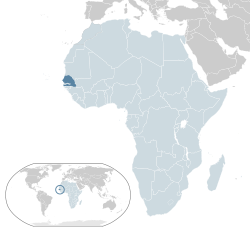
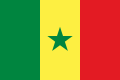
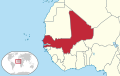
Senegal, officially the Republic of Senegal, is the westernmost country in West Africa, situated along the Atlantic Ocean coast. It borders Mauritania to the north, Mali to the east, Guinea to the southeast and Guinea-Bissau to the southwest. Senegal nearly surrounds the Gambia, a country occupying a narrow strip of land along the banks of the Gambia River, which separates Senegal's southern region of Casamance from the rest of the country. It also shares a maritime border with Cape Verde. The capital and largest city of Senegal is Dakar. Senegal is the westernmost country in the mainland of the Old World, or Afro-Eurasia. It owes its name to the Senegal River, which borders it to the north and east. The climate is typically Sahelian, with a rainy season. Senegal covers a land area of almost 197,000 square kilometres (76,000 sq mi) and has a population of around 18 million.0 The state is a presidential republic; since the country's foundation in 1960, it has been recognized as one of the most stable countries on the African continent. On the 2024 V-Dem Democracy Indices, Senegal is ranked 68th in electoral democracy worldwide and 10th in electoral democracy in Africa. The state was formed as part of the independence of French West Africa from French colonial rule. Because of this history, French is the official language, but it is understood by only a small minority of the population. Over 30 languages are spoken in Senegal. Wolof is the most widely spoken, with 80% of the population speaking it as a first or second language, acting as Senegal's lingua franca alongside French. Arabic and Pulaar also remain popular among certain communities. Like other African nations, the country includes a wide mix of ethnic and linguistic communities, with the largest being the Wolof, Fula, and Serer people. Senegalese people are predominantly Muslim. As a developing nation, Senegal is classified as a heavily indebted poor country, with a relatively low ranking on the Human Development Index (169th out of 193). Most of the population lives on the coast and works in agriculture or other food industries; other major industries include mining, tourism, and services. The historic lack of natural resources in Senegal has redirected efforts towards increasing literacy and educational attainment. Senegal is a member state of the African Union, the United Nations, the Economic Community of West African States (ECOWAS), Organisation internationale de la Francophonie, the Organisation of Islamic Cooperation, and the Community of Sahel–Saharan States. (Full article...) Selected article - show anotherSerer maternal clans or Serer matriclans (Serer : Tim or Tiim; Ndut : Ciiɗim) are the maternal clans of the Serer people of Senegal, the Gambia and Mauritania. The Serer are both patrilineal (simanGol or Simangol) and matrilineal. Inheritance depends on the nature of the asset being inherited – i.e. whether it is a maternal asset which requires maternal inheritance (ƭeen yaay or den yaay) or paternal asset requiring paternal inheritance (kucarla). The Serer woman play a vital role in and. In pre-colonial times until the abolition of their monarchies, a Serer king would be required to crown his mother, maternal aunt or sister as Lingeer (queen) after his own coronation. This re-affirms the maternal lineage to which they both belong (Tim). The Lingeer was very powerful and had her own army and palace. She was the queen of all women and presided over female cases. From a religious perspective, the Serer woman plays a vital role in Serer religion. As members of the Serer priestly class (the Saltigues), they are among the guardians of Serer religion, sciences, ethics and. There are several Serer matriclans; not all of them are listed here. Alliance between matriclans in order to achieve a common goal was, and still is very common. The same clan can be called a different name depending on which part of one finds oneself in. Some of these matriclans form part of Serer mythology and dynastic history. The mythology afforded to some of these clans draws parallels with the Serer creation narrative, which posits that: the first human to be created was a female. Many Serers who adhere to the tenets of Serer religion believe these narratives to contain profound truths which are historic or pre-historic in nature. (Full article...) Selected images
Selected quotation - show another
👁 Image | ||||||||







.jpg)


.jpg)



_2006.JPG)


._19th_Century._Jung-Jung_From_The_Kingdom_of_Sine_(in_modern_day_Senegal).jpg)















.jpg)
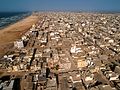

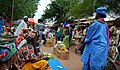

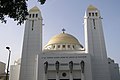


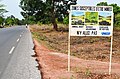


_03.jpg)


.svg)








| 👁 Image |
You are invited to participate in WikiProject Senegal, a WikiProject dedicated to developing and improving articles about Senegal. |


Related portals


.svg)


Associated Wikimedia
The following Wikimedia Foundation sister projects provide more on this subject:
-
Commons
Free media repository -
Wikibooks
Free textbooks and manuals -
Wikidata
Free knowledge base -
Wikinews
Free-content news -
Wikiquote
Collection of quotations -
Wikisource
Free-content library -
Wikiversity
Free learning tools -
Wikivoyage
Free travel guide -
Wiktionary
Dictionary and thesaurus


Things you can do
- Watch and respond to the alert page of articles relating to Senegal.
- Explore, edit, and improve articles in Category:Senegal.
- Join WikiProject Senegal, WikiProject Gambia and WikiProject Africa.


