The Sun accounts for 99.86% of the Solar System's total mass. Inside the Sun's core, hydrogen is fused into helium, releasing energy that is emitted through the Sun's photosphere. This creates the heliosphere and a decreasing temperature gradient across the Solar System.
Io (pronounced /ˈaɪoʊ/ eye'-oe, or as Greek Ῑώ) is the innermost of the four Galilean moons of Jupiter and, with a diameter of 3,642 kilometers, the fourth largest moon in the Solar System. It was discovered in 1610 by Galileo Galilei, along with the other Galilean satellites. This discovery furthered the adoption of the Copernican model of the Solar System and the development of Kepler's laws of motion. Unlike most satellites in the outer Solar System (which have a thick coating of ice), Io is primarily composed of silicate rock surrounding a molten iron or iron sulfide core. Io has one of the most geologically active surfaces in the solar system, with over 400 active volcanoes. This extreme geologic activity is the result of tidal heating from friction generated within Io's interior by Jupiter's varying pull. Several volcanoes produce plumes of sulfur and sulfur dioxide that climb as high as 500 km (310 mi). Io's surface is also dotted with more than 100 mountains that have been uplifted by extensive compression at the base of the moon's silicate crust. Some of these peaks are taller than Earth's Mount Everest. Most of Io's surface is characterized by extensive plains coated with sulfur and sulfur dioxide frost. (Full article...)
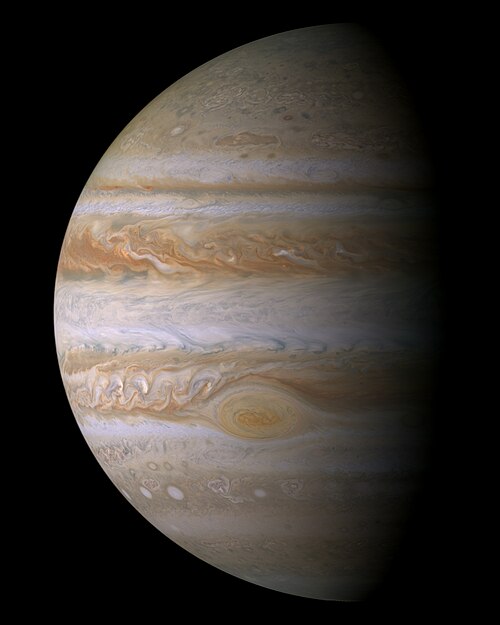
Jupiter is the fifth planet from the Sun and by far the largest within the Solar System. It is 318 times more massive than Earth, with a diameter 11 times that of Earth, and with a volume 1300 times that of Earth. Its best known feature is the Great Red Spot, a storm larger than Earth, which was first observed by Galileo four centuries ago. This picture, taken by the Cassini orbiter was one of 26 thousand images taken of Jupiter during the course of its flyby and is the most detailed global color portrait of the planet ever produced.
Hyperion, a moon of Saturn, is one of the largest highly irregular (non-spherical) bodies in the Solar System. Enhanced image processing was used to bring out details and color differences in this photo taken by the Cassini orbiter. Hyperion is entirely saturated with deep, sharp-edged craters that give it the appearance of a giant sponge. Dark material fills the bottom of each crater.
An animated view of Voyager I's approach to Jupiter. One frame of this image was taken each Jupiter day (approximately 10 hours) between January 6 and February 9, 1979, as the space probe flew from 58 million to 31 million kilometers from Jupiter during that time. The small, round, dark spots appearing in some frames are the shadows cast by the moons passing between Jupiter and the Sun, while the small, white flashes around the planet, are the moons themselves.
This false-colorradar image taken by the Cassini orbiter provides convincing evidence for large bodies of liquid methane on Titan. Images taken during a fly-by of the moon on July 22, 2006 show more than 75 large bodies of liquid ranging in diameter from three to 70km (1.9 to 43.6 mi) in the moon's northern hemisphere. Intensity in this colorized image is proportional to how much radar brightness is returned. The lakes, darker than the surrounding terrain, are emphasized here by tinting regions of low backscatter in blue. Radar-brighter regions are shown in tan. Smallest details in this image are about 500 m (1,640 ft) across. On January 3, 2007, NASA announced that scientists have "definitive evidence of lakes filled with methane on Saturn's moon Titan."
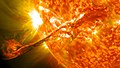
A solar flare, a sudden flash of brightness observed over the Sun's surface or the solar limb which is interpreted as a large energy release, recorded on August 31, 2012. Such flares are often, but not always, followed by a colossal coronal mass ejection; in this instance, the ejection traveled at over 900 miles (1,400 km) per second.
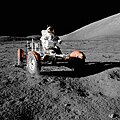
Astronaut Eugene Cernan makes a short test drive of the lunar rover (officially, Lunar Roving Vehicle or LRV) during the early part of the first Apollo 17extravehicular activity. The LRV was only used in the last three Apollo missions, but it performed without any major problems and allowed the astronauts to cover far more ground than in previous missions. All three LRVs were abandoned on the Moon.
Illustration of the Ptolemaicgeocentric model of the Universe (the theory that the Earth is the center of the universe) by Portuguese cosmographer and cartographer Bartolomeu Velho. Taken from his treatise Cosmographia, made in Paris, 1568. Notice the distances of the bodies to the centre of the Earth (left) and the times of revolution, in years (right).
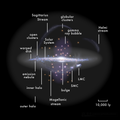
The Milky Way is the galaxy that contains the Solar System, with the name describing the galaxy's appearance from Earth: a hazy band of light seen in the night sky formed from stars that cannot be individually distinguished by the naked eye. The term Milky Way is a translation of the Latin via lactea, from the Greek γαλαξίας κύκλος (galaxías kýklos, 'milky circle'). From Earth, the Milky Way appears as a band because its disk-shaped structure is viewed from within. Galileo Galilei first resolved the band of light into individual stars with his telescope in 1610. Until the early 1920s, most astronomers thought that the Milky Way contained all the stars in the Universe. Following the 1920 Great Debate between the astronomers Harlow Shapley and Heber Curtis, observations by Edwin Hubble showed that the Milky Way is just one of many galaxies.
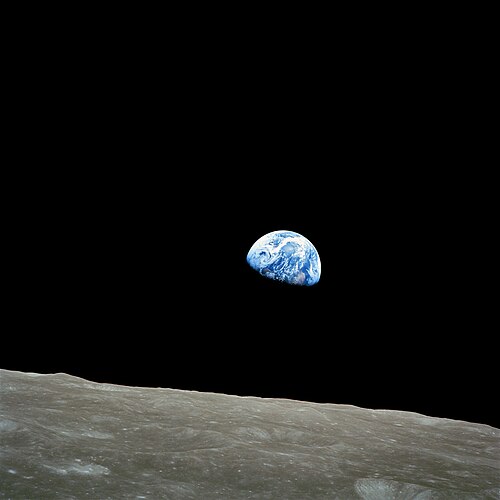
Earthrise, the first occasion in which humans saw the Earth seemingly rising above the surface of the Moon, taken during the Apollo 8 mission on December 24, 1968. This view was seen by the crew at the beginning of its fourth orbit around the Moon, although the first photograph taken was in black-and-white. Note that the Earth is in shadow here. A photo of a fully lit Earth would not be taken until the Apollo 17 mission.
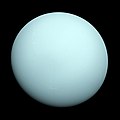
Uranus is the seventh planet from the Sun and the fourth most massive in the Solar System. In this photograph from 1986 the planet appears almost featureless, but recent terrestrial observations have found seasonal changes to be occurring.
False-color mosaic shows the entire hemisphere of Iapetus (1,468 km or 912 mi across) visible from the Cassini orbiter on the outbound leg of its encounter with the two-toned moon of Saturn in September 2007. The central longitude of the trailing hemisphere is 24 degrees to the left of the image's center. It is hypothesized that the moon's two-toned nature is due to the sublimation of various ices evaporated from the warmer parts of the surface.
False-colorMars Reconnaissance Orbiter image of a side of the Chasma Boreale, a canyon in the polar ice cap of the Planum Boreum (north pole of Mars). Light browns are layers of surface dust, greys and blues are layers of water and carbon dioxide ice. Regular geometric cracking is indicative of higher concentrations of water ice.
The Planum Boreum's permanent ice cap has a maximum depth of 3 km (1.9 mi). It is roughly 1200 km (750 mi) in diameter, an area equivalent to about 1½ times the size of Texas. The Chasma Boreale is up to 100 km (62.5 mi) wide and features scarps up to 2 km (1.25 mi) high. For a comparison, the Grand Canyon is approximately 1.6 km (1 mi) deep in some places and 446 km (279 mi) long but only up to 24 km (15 mi) wide.
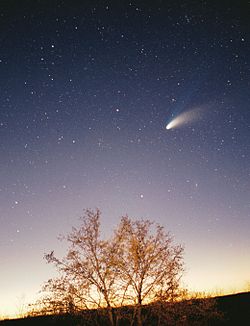
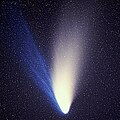
Comet Hale–Bopp sails across the sky in the vicinity of Pazin in Istria, Croatia. To the lower right of the comet the Andromeda Galaxy is also faintly visible. The comet was visible to the naked eye for a record 18 months, twice as long as the Great Comet of 1811. At perihelion, it shone brighter than any star in the sky except Sirius, and its two tails stretched 30-40 degrees across the sky. The passage of Hale-Bopp was notable also for inciting a degree of panic about comets not seen for decades. Rumours that the comet was being followed by an alienspacecraft inspired a mass suicide among followers of the Heaven's Gatecult.
The Blue Marble is a famous photograph of Earth. NASA officially credits the image to the entire Apollo 17 crew — Eugene Cernan, Ronald Evans and Jack Schmitt — all of whom took photographic images during the mission. Apollo 17 passed over Africa during daylight hours and Antarctica is also illuminated. The photograph was taken approximately five hours after the spacecraft's launch, while en route to the Moon. Apollo 17, notably, was the last manned lunar mission; no humans since have been at a range where taking a "whole-Earth" photograph such as "The Blue Marble" would be possible.
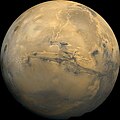
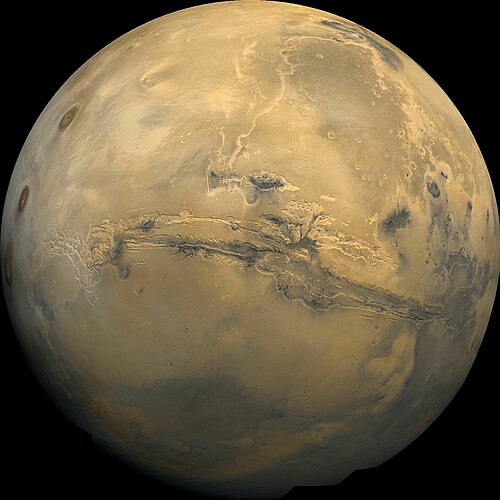
Mars, the fourth planet from the Sun, is named after the Roman god of war because of its blood red color. Mars has two small, oddly-shaped moons, Phobos and Deimos, named after the sons of the Greek god Ares. At some point in the future Phobos will be broken up by gravitational forces. The atmosphere on Mars is 95% carbon dioxide. In 2003 methane was also discovered in the atmosphere. Since methane is an unstable gas, this indicates that there must be (or have been within the last few hundred years) a source of the gas on the planet.
The most detailed full-disc view of Titan, the largest moon of Saturn and second-largest in the Solar System. The brighter region on the right side and equatorial region is named Xanadu, and the large, dark region at the center is Shangri-la. This image has been processed to reduce the effects of the atmosphere and to sharpen surface features. It has been trimmed to show only the illuminated surface and not the atmosphere above the edge of the moon.
A diagram of Jupiter showing a model of the planet's interior, with a rocky core overlaid by a deep layer of liquid metallic hydrogen and an outer layer predominantly of molecular hydrogen. Jupiter's true interior composition is uncertain. For instance, the core may have shrunk as convection currents of hot liquid metallic hydrogen mixed with the molten core and carried its contents to higher levels in the planetary interior. Furthermore, there is no clear physical boundary between the hydrogen layers—with increasing depth the gas increases smoothly in temperature and density, ultimately becoming liquid.
These images are composites of the complete radar image collection obtained by the Magellan mission. The Magellan spacecraft was launched aboard Space Shuttle Atlantis in May 1989 and began mapping the surface of Venus in September 1990. The spacecraft continued to orbit Venus for four years, returning high-resolution images, altimetry, thermal emissions and gravity maps of 98 percent of the surface. Magellan spacecraft operations ended on October 12, 1994, when the radio contact was lost with the spacecraft during its controlled descent into the deeper portions of the Venusian atmosphere.
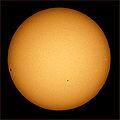
The transit of Mercury across the face of the Sun that took place in November 2006. Mercury appears as a black speck in the Sun's lower center-right region; the black areas on the left and right edges are sunspots. The transit was first recorded by French astronomer Pierre Gassendi on November 7, 1631. Transits of Mercury take place in May or November, at intervals of 7, 13, or 33 years, with the next one scheduled to appear in May 2016.
A close-up of 10 km (6.2 mi) high mountains within the equatorial ridge on Saturn's moon Iapetus, photographed by the Cassini orbiter. Above the middle of the image can be seen a place where an impact has exposed the bright ice beneath the dark overlying material. The image was taken on September 10, 2007, with the Cassini spacecraft narrow-angle camera at a distance of approximately 3,870 km (2,400 mi) from Iapetus.
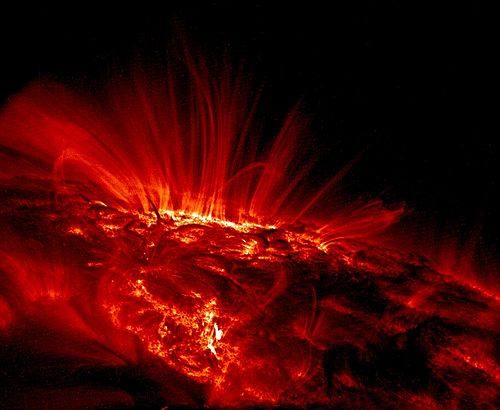
A TRACE image of sunspots on the surface, or photosphere, of the Sun from September 2002, is taken in the far ultraviolet on a relatively quiet day for solar activity. However, the image still shows a large sunspot group visible as a bright area near the horizon. Although sunspots are relatively cool regions on the surface of the Sun, the bright glowing gas flowing around the sunspots have a temperature of over one million °C (1.8 million °F). The high temperatures are thought to be related to the rapidly changing magnetic field loops that channel solar plasma.
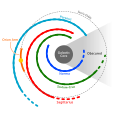
Image 6The orbital eccentricities and inclinations of the scattered disc population compared to the classical and resonant Kuiper belt objects (from Solar System)
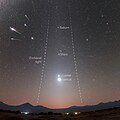
Image 13A color enhanced photograph from the Moon of a range of components of the Solar System. The three dots at the lower left are from left to right the planets Saturn, Mars, and Mercury, and in the middle of the picture rises the Sun's corona over the dark limb of the Moon, which is from the right lit by earthshine. (from Solar System)
Image 15Solar system diagram by Emanuel Bowen in 1747, when neither Uranus, Neptune, nor the asteroid belts had yet been discovered. Orbits of planets are to scale, but the orbits of moons and the sizes of bodies are not. (from Solar System)
Image 16Plot of objects around the Kuiper belt and other asteroid populations. J, S, U and N denotes Jupiter, Saturn, Uranus and Neptune. (from Solar System)
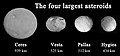
Image 17The four largest asteroids: Ceres, Vesta, Pallas, Hygiea. Only Ceres and Vesta have been visited by a spacecraft and thus have a detailed picture. (from Solar System)
Image 25The outer planets Jupiter, Saturn, Uranus and Neptune, compared to the inner planets Earth, Venus, Mars, and Mercury at the bottom right (from Solar System)
Image 29The sparse plasma (blue) and dust (white) in the tail of comet Hale–Bopp are being shaped by pressure from solar radiation and the solar wind, respectively.
Image 31Animations of the Solar System's outer planets orbiting. This animation is 100 times faster than the inner planet animation. (from Solar System)
Image 33Simulation showing outer planets and Kuiper belt: a) Before Jupiter/Saturn 2:1 resonance b) Scattering of Kuiper belt objects into the Solar System after the orbital shift of Neptune c) After ejection of Kuiper belt bodies by Jupiter
Image 35Comparison of the distances between planets, with the white bar showing orbital variations. The size of the planets is not to scale. (from Solar System)
Image 36Diagram of the Local Interstellar Cloud, the G-Cloud and surrounding stars. As of 2022[update], the exact position of the Solar System within the interstellar clouds remains an unresolved question in astronomy. (from Solar System)
























_(2023-152).jpg)




.jpg)






.jpg)


.jpg)









![👁 Image 36Diagram of the Local Interstellar Cloud, the G-Cloud and surrounding stars. As of 2022[update], the exact position of the Solar System within the interstellar clouds remains an unresolved question in astronomy. (from Solar System)](https://upload.wikimedia.org/wikipedia/commons/thumb/7/7c/The_Local_Interstellar_Cloud_and_neighboring_G-cloud_complex.svg/120px-The_Local_Interstellar_Cloud_and_neighboring_G-cloud_complex.svg.png)