|
VOOZH | about |
|
VOOZH | about |
Suppose you want to learn a new subject. There are two ways to do that. One is to buy some books and start reading everything from scratch. The other way round is to go to a teacher and he will share all the knowledge and experience he has gained. Which process is faster and easier as well. Obviously, the second one i.e taking the help of a teacher.
Transfer learning works in a similar manner. Transfer learning is the method that uses a neural network trained on a large and generalized enough dataset and being used for another problem. These neural networks are called Pre-trained networks.
Note: If you are more interested in learning concepts in an Audio-Visual format, We have this entire article explained in the video below. If not, you may continue reading.
The basic requirement for transfer learning is the availability of a pre-trained network. Luckily, we have several state of the art deep learning networks shared by the respective teams. Like for computer vision we have
Out of these pre-trained networks, in this article, we are going to discuss Lenet-5 in detail.
Lenet-5 is one of the earliest pre-trained models proposed by Yann LeCun and others in the year 1998, in the research paper Gradient-Based Learning Applied to Document Recognition. They used this architecture for recognizing the handwritten and machine-printed characters.
The main reason behind the popularity of this model was its simple and straightforward architecture. It is a multi-layer convolution neural network for image classification.
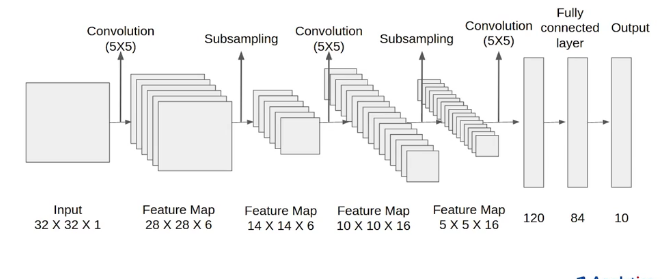
Let’s understand the architecture of Lenet-5. The network has 5 layers with learnable parameters and hence named Lenet-5. It has three sets of convolution layers with a combination of average pooling. After the convolution and average pooling layers, we have two fully connected layers. At last, a Softmax classifier which classifies the images into respective class.
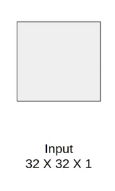
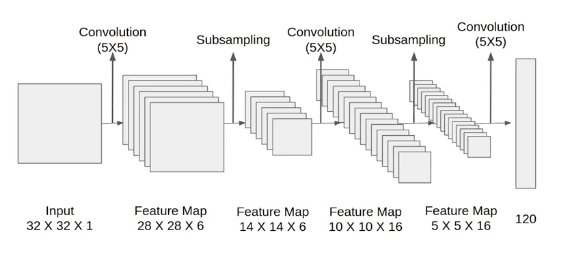
The input to this model is a 32 X 32 grayscale image hence the number of channels is one.
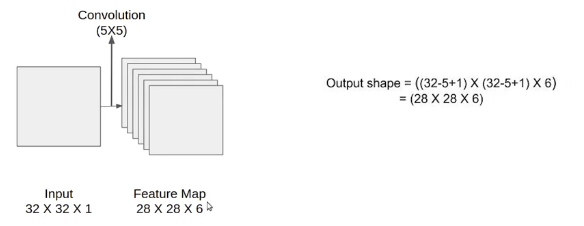
We then apply the first convolution operation with the filter size 5X5 and we have 6 such filters. As a result, we get a feature map of size 28X28X6. Here the number of channels is equal to the number of filters applied.
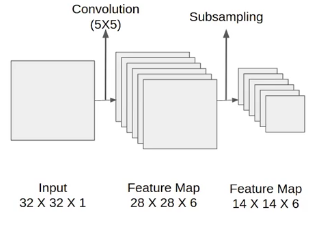
After the first pooling operation, we apply the average pooling and the size of the feature map is reduced by half. Note that, the number of channels is intact.
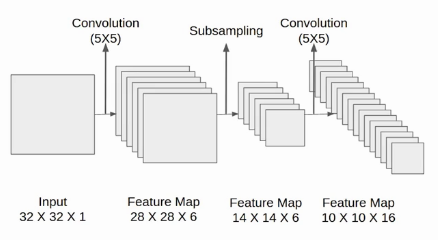
Next, we have a convolution layer with sixteen filters of size 5X5. Again the feature map changed it is 10X10X16. The output size is calculated in a similar manner. After this, we again applied an average pooling or subsampling layer, which again reduce the size of the feature map by half i.e 5X5X16.
Then we have a final convolution layer of size 5X5 with 120 filters. As shown in the above image. Leaving the feature map size 1X1X120. After which flatten result is 120 values.
After these convolution layers, we have a fully connected layer with eighty-four neurons. At last, we have an output layer with ten neurons since the data have ten classes.
Here is the final architecture of the Lenet-5 model.
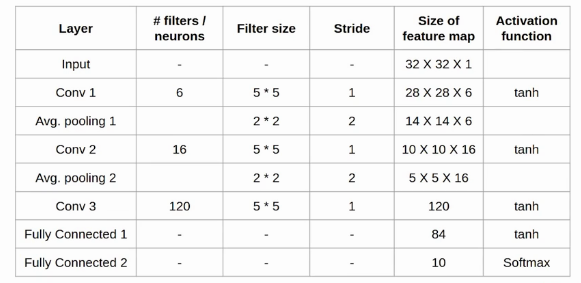
Let’s understand the architecture in more detail.
The first layer is the input layer with feature map size 32X32X1.
Then we have the first convolution layer with 6 filters of size 5X5 and stride is 1. The activation function used at his layer is tanh. The output feature map is 28X28X6.
Next, we have an average pooling layer with filter size 2X2 and stride 1. The resulting feature map is 14X14X6. Since the pooling layer doesn’t affect the number of channels.
After this comes the second convolution layer with 16 filters of 5X5 and stride 1. Also, the activation function is tanh. Now the output size is 10X10X16.
Again comes the other average pooling layer of 2X2 with stride 2. As a result, the size of the feature map reduced to 5X5X16.
The final pooling layer has 120 filters of 5X5 with stride 1 and activation function tanh. Now the output size is 120.
The next is a fully connected layer with 84 neurons that result in the output to 84 values and the activation function used here is again tanh.
The last layer is the output layer with 10 neurons and Softmax function. The Softmax gives the probability that a data point belongs to a particular class. The highest value is then predicted.
This is the entire architecture of the Lenet-5 model. The number of trainable parameters of this architecture is around sixty thousand.
This was all about Lenet-5 architecture. Finally, to summarize The network has
Ready to kickstart your Data Science journey? Discover everything you need in one place with Analytics Vidhya’s Certified AI & ML BlackBelt Plus Program. Join now and transform your skills!
A. LeNet and AlexNet are both convolutional neural network (CNN) architectures, but they differ in terms of depth, structure, and impact on the field. LeNet, introduced in 1998, was one of the earliest CNN models and consisted of only seven layers. In contrast, AlexNet, proposed in 2012, was deeper, with eight layers, and featured larger convolutional filters. Additionally, AlexNet employed the rectified linear unit (ReLU) activation function, introduced the concept of dropout regularization, and won the ImageNet Large Scale Visual Recognition Challenge, significantly popularizing deep learning and inspiring subsequent advancements in the field.
A. LeNet stands for “LeNet-5,” which refers to the fifth iteration of the LeNet convolutional neural network model. It was developed by Yann LeCun et al. in 1998 and became one of the pioneering architectures for convolutional neural networks. LeNet-5 was primarily designed for handwritten digit recognition tasks and played a significant role in advancing the field of deep learning.
Shipra is a Data Science enthusiast, Exploring Machine learning and Deep learning algorithms. She is also interested in Big data technologies. She believes learning is a continuous process so keep moving.
GPT-4 vs. Llama 3.1 – Which Model is Better?
Llama-3.1-Storm-8B: The 8B LLM Powerhouse Surpa...
A Comprehensive Guide to Building Agentic RAG S...
Top 10 Machine Learning Algorithms in 2026
45 Questions to Test a Data Scientist on Basics...
90+ Python Interview Questions and Answers (202...
8 Easy Ways to Access ChatGPT for Free
Prompt Engineering: Definition, Examples, Tips ...
What is LangChain?
What is Retrieval-Augmented Generation (RAG)?
Very well written. Appreciate the great effort that you have made to put everything in place.
Thanks for the article. It would be more helpful if you could explain how to calculate those 60000 trainable parameters.
This is a fundamental explanation of LeNET architecture for a blog like this. I had high expectations, maybe you could try to dive deeper into the facts like why this model was tuned in such a fashion, and what could have brought better results if they focused more on features and not on the input's resolution. Otherwise, great job on explaining it in laymen's terms. Thanks!
Edit
Resend OTP
Resend OTP in 45s