|
VOOZH | about |
|
VOOZH | about |
This article was published as a part of the Data Science Blogathon.
We know how useful convolutional neural networks are. CNNs have transformed image analytics. They are the most widely used building blocks for solving problems involving images. Many architectures like ResNet, Google Net have achieved exceptional accuracies in image classification tasks are built with CNNs. But… These too come with some flaws and one of them is the time they take to train on huge datasets. Separable Convolutions are helpful to tackle this problem.
Let’s understand Conventional Convolution first.
According to Wikipedia convolution is a mathematical operation on two functions that produces a third function that expresses how the shape of one is modified by the other.
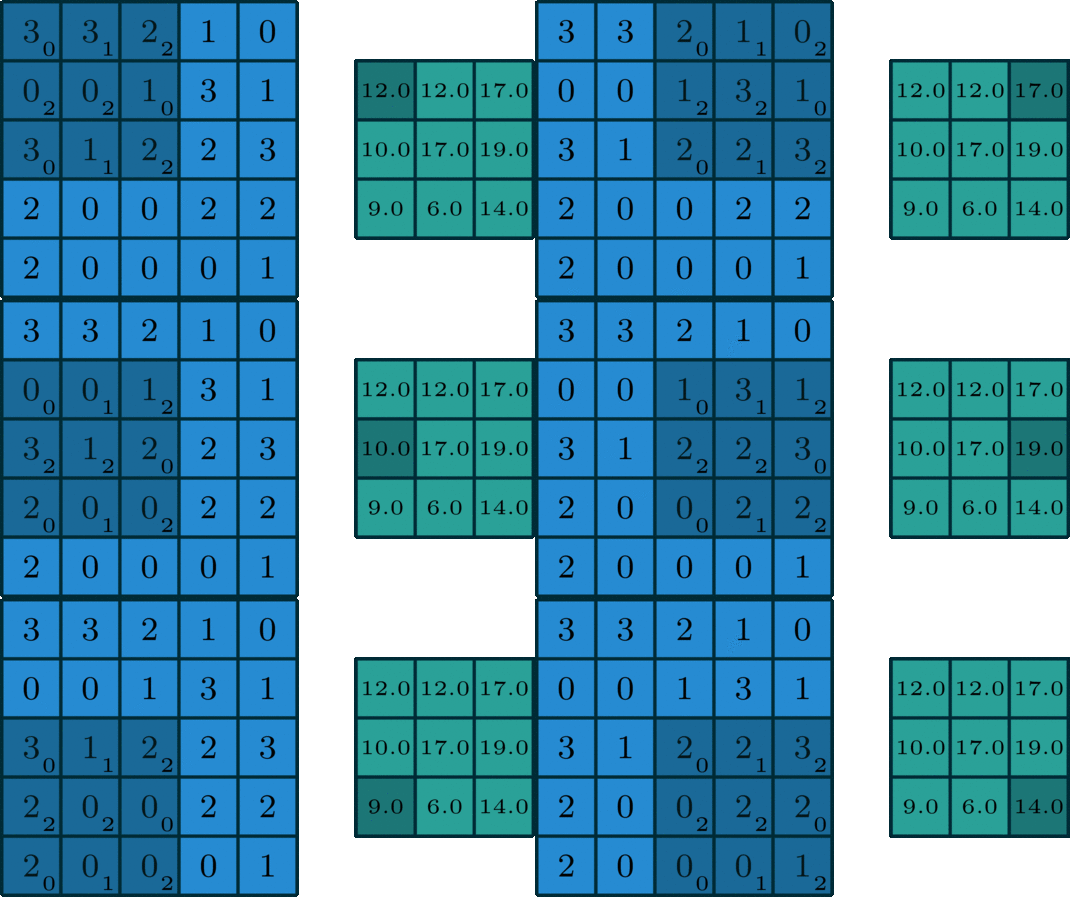
A 2D Convolution is a mathematical process in which a 2D kernel slides over the 2D input matrix performing matrix multiplication with the part that is currently on and then summing up the result matrix into a single pixel. You can read more about this here.
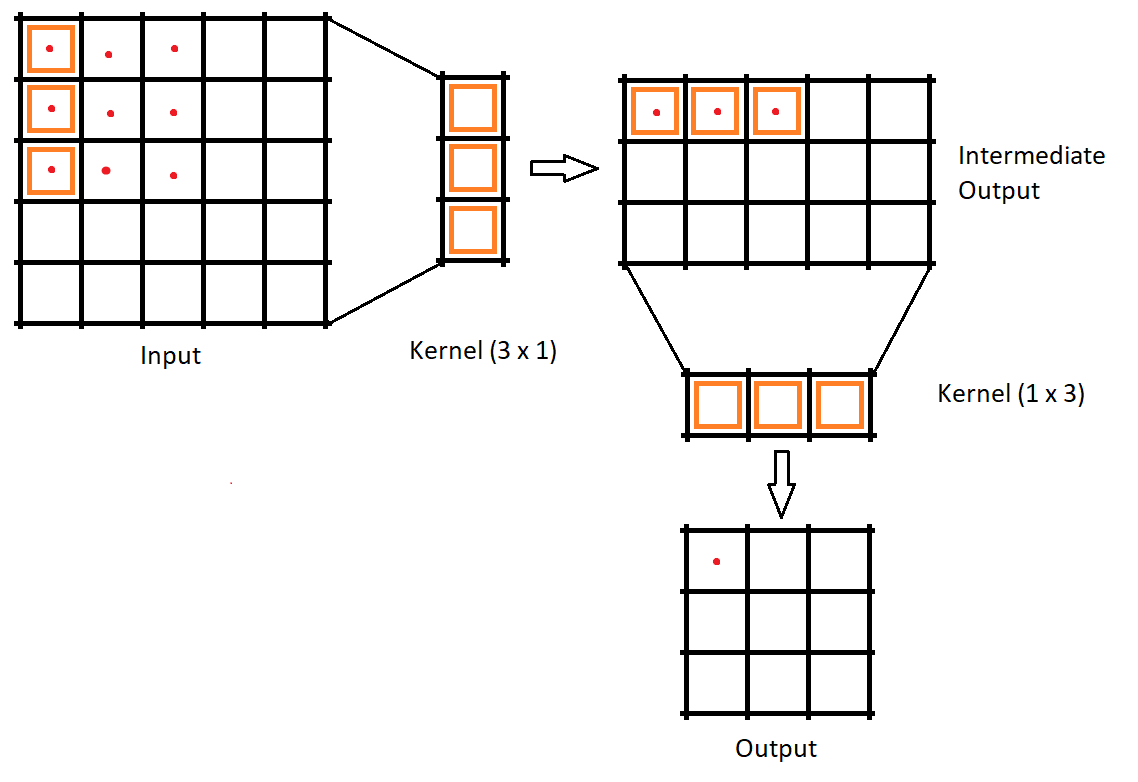
A Separable Convolution is a process in which a single convolution can be divided into two or more convolutions to produce the same output. A single process is divided into two or more sub-processes to achieve the same effect. Let’s understand Separable Convolutions, their types in-depth with examples.
Mainly there are two types of Separable Convolutions
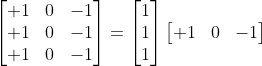
(The above-mentioned example is called the Prewitt kernel. This kernel is used to detect edges in the images)
Convolutions with spatially separable kernels
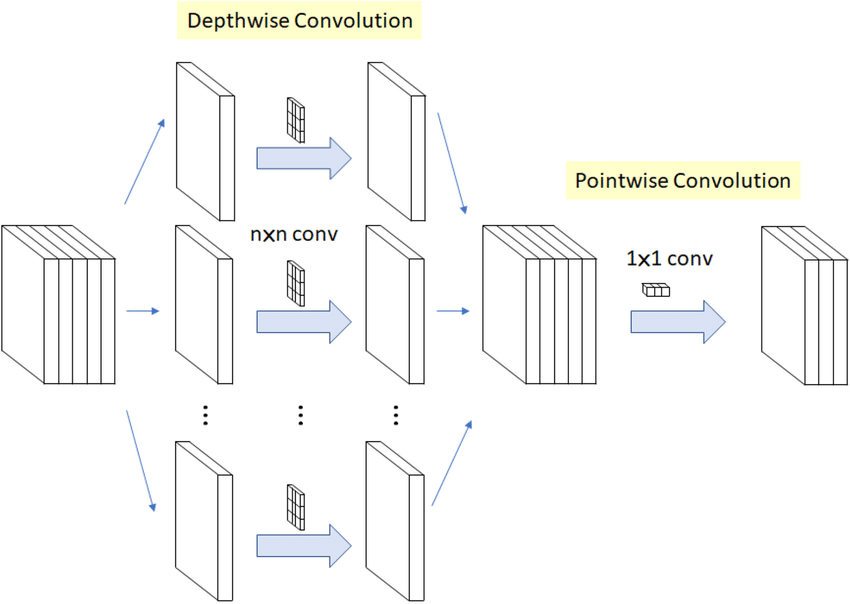
When you call tf.keras.layers.SeparableConv2D you would be calling a Depthwise separable convolution layer itself. Here you can use even those kernels which can not be spatially separable. Similar to spatial convolution, here also a regular convolution is divided into two convolutions namely
Image credit Imran Junejo
Let us assume we have an image input of shape 7x7x3. We make sure after the depthwise convolution the intermediate image has the same depth. This is done by convoluting with 3 kernels with shape 3x3x1. Each kernel iterates on only one channel of the image-producing an intermediate output of shape 5x5x1 which are stacked together to create an output of shape 5x5x3.
In this example, the regular convolution would have to do 32 3x3x3 kernels that move 5×5 times that is 21600 multiplication but in this method, we would have to do 3x3x3x5x5 + 32x1x1x3x5x5 = 3075 multiplication. So we can see that this method can eliminate a large chunk of multiplication.
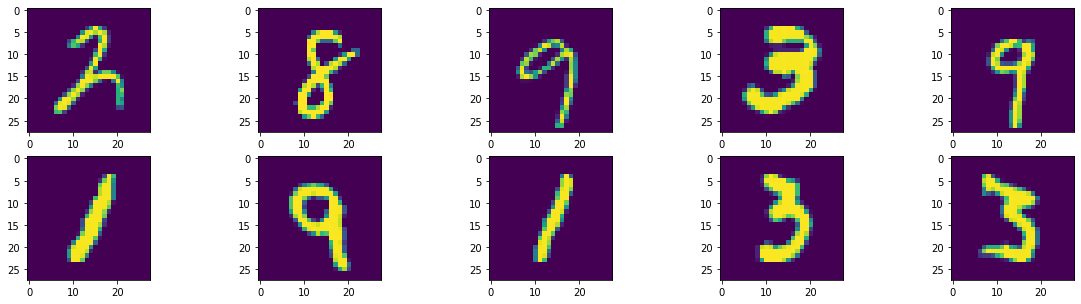
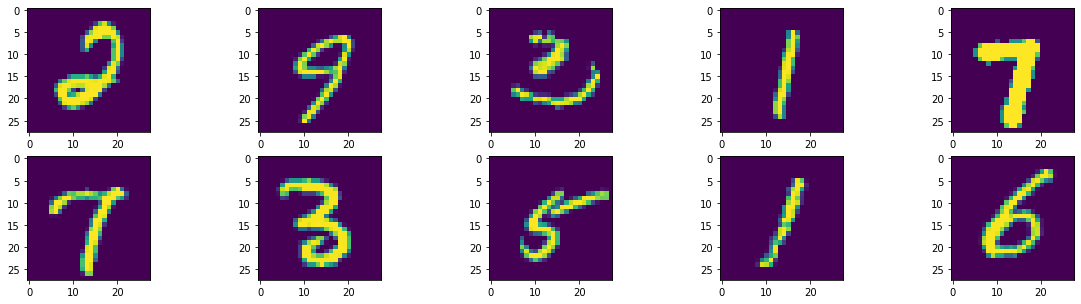
In this explanation, I have taken the most famous mnist dataset. You can know more about this dataset here.
plt.figure(figsize=(20,5))
for i in range(1,11):
 plt.subplot(2,5,i)
 plt.imshow(x_train[randint(1,60000)].reshape(28,28))
plt.figure(figsize=(20,5))
for i in range(1,11):
 plt.subplot(2,5,i)
 plt.imshow(x_test[randint(1,10000)].reshape(28,28))
model = tf.keras.Sequential([
 tf.keras.layers.Conv2D(8, 7, input_shape=(28,28,1), strides=2),
 tf.keras.layers.Conv2D(16, 5, strides=2),
 tf.keras.layers.Conv2D(32, 3),
 tf.keras.layers.GlobalAveragePooling2D(),
 tf.keras.layers.Dense(10, activation='softmax')
])
model.compile(loss='categorical_crossentropy', metrics=['acc'])
model.summary()
Model: "sequential_17"
_________________________________________________________________
 Layer (type) Output Shape Param #
=================================================================
 conv2d_43 (Conv2D) (None, 11, 11, 8) 400

 conv2d_44 (Conv2D) (None, 4, 4, 16) 3216

 conv2d_45 (Conv2D) (None, 2, 2, 32) 4640

 global_average_pooling2d_17 (None, 32) 0
 (GlobalAveragePooling2D)

 dense_17 (Dense) (None, 10) 330

=================================================================
Total params: 8,586
Trainable params: 8,586
Non-trainable params: 0
_________________________________________________________________
model.save("model.hdf5")
size = os.path.getsize('model.hdf5')
print('Size of file is', size/1024, 'kilo bytes')
t = time()
loss, acc = model.evaluate(x_test, y_test)
print('Test Accuracy = {}'.format(acc))
print('Time taken for evaluation of 10000 images = {:.2f} seconds'.format(time()-t))
Size of file is 105.2265625 kilo bytes
313/313 [==============================] - 1s 3ms/step - loss: 0.2982 - acc: 0.9169
Test Accuracy = 0.9168999791145325
Time taken for evaluation of 10000 images = 1.43 seconds
I kept all the other parameters exactly same and replaced Conv2D with SeparableConv2D
model = tf.keras.Sequential([
 tf.keras.layers.SeparableConv2D(8, 7, input_shape=(28,28,1), strides=2),
 tf.keras.layers.SeparableConv2D(16, 5, strides=2),
 tf.keras.layers.SeparableConv2D(32, 3),
 tf.keras.layers.GlobalAveragePooling2D(),
 tf.keras.layers.Dense(10, activation='softmax')
])
model.compile(loss='categorical_crossentropy', metrics=['acc'])
model.summary()
Model: "sequential_18"
_________________________________________________________________
 Layer (type) Output Shape Param #
=================================================================
 separable_conv2d_9 (Separab (None, 11, 11, 8) 65
 leConv2D)

 separable_conv2d_10 (Separa (None, 4, 4, 16) 344
 bleConv2D)

 separable_conv2d_11 (Separa (None, 2, 2, 32) 688
 bleConv2D)

 global_average_pooling2d_18 (None, 32) 0
 (GlobalAveragePooling2D)

 dense_18 (Dense) (None, 10) 330

=================================================================
Total params: 1,427
Trainable params: 1,427
Non-trainable params: 0
_________________________________________________________________
model.save("model.hdf5")
size = os.path.getsize('model.hdf5')
print('Size of file is', size/1024, 'kilo bytes')
t = time()
loss, acc = model.evaluate(x_test, y_test)
print('Test Accuracy = {}'.format(acc))
print('Time taken for evaluation of 10000 images = {:.2f} seconds'.format(time()-t))
Size of file is 56.9375 kilo bytes
313/313 [==============================] - 1s 3ms/step - loss: 0.3394 - acc: 0.9021
Test Accuracy = 0.9021000266075134
Time taken for evaluation of 10000 images = 1.11 seconds
We have seen how separable convolutions are useful still we don’t use them very often and the reasons for that are
Separable convolutions are great when you are optimizing the model for smaller size or higher speed compromising least with accuracy. It is not advised to use it when you are optimizing the model for accuracy. Many deep learning algorithms are built using Separable convolutions, one among them is the Xception algorithm which you can go and check out.
You can access the colab link for the above codes here
You can connect with me here
Thank you so much for reading this article. Your feedback is very precious, you share your thoughts on this here.
The media shown in this article is not owned by Analytics Vidhya and are used at the Author’s discretion
GPT-4 vs. Llama 3.1 – Which Model is Better?
Llama-3.1-Storm-8B: The 8B LLM Powerhouse Surpa...
A Comprehensive Guide to Building Agentic RAG S...
Top 10 Machine Learning Algorithms in 2026
45 Questions to Test a Data Scientist on Basics...
90+ Python Interview Questions and Answers (202...
8 Easy Ways to Access ChatGPT for Free
Prompt Engineering: Definition, Examples, Tips ...
What is LangChain?
What is Retrieval-Augmented Generation (RAG)?
Edit
Resend OTP
Resend OTP in 45s