Cal AI pricing 2026: Free plan vs premium, what you actually get


Last edited June 16, 2026

What is Cal AI?
Cal AI (calai.app) is an AI-powered calorie and macro tracking app for iOS and Android. The core pitch is simple: snap a photo of a meal, and the app uses AI to estimate calories, protein, carbs, and fat - no manual logging or portion weighing required.
It was built by teenage founders Zach Yadegari and Henry Langmack, launched in May 2024, and scaled fast - over 5 million downloads in the first eight months, founder-stated $50M ARR before acquisition, and a 4.8-star rating from approximately 329,000 Apple reviews as of June 2026.
The app offers three ways to log food: photo scan, barcode scan, or text description. The photo scan is the headline differentiator - the phone's depth sensor estimates food volume, then a multimodal AI stack returns the macro breakdown against a database of over one million foods. Barcode scanning and text entry are more conventional but part of the package on every plan.
Since the March 2026 MyFitnessPal acquisition, Cal AI continues to operate as its own standalone app.
Cal AI pricing breakdown
Here's the honest picture: the app is free to download, but the free experience is close to unusable if you came for the AI photo scanning.
| Plan | Price | AI photo scanning | Barcode scanning | Food database | Progress tracking |
|---|---|---|---|---|---|
| Free | $0 | No | Yes | Yes (basic) | Limited |
| Premium - monthly | $9.99/mo | Yes | Yes | Full (1M+ foods) | Full |
| Premium - annual | $29.99/yr (~$2.49/mo) | Yes | Yes | Full (1M+ foods) | Full |
| Family Plan | $59.99/yr | Yes | Yes | Full | Full |
All plans include a 3-day free trial. Prices above reflect the most commonly displayed rates - Cal AI aggressively A/B-tests its paywall, so what you see during onboarding may differ. Some users have reported being shown $2.99/week, $5.99/month, $19.99/year, or $49.99/year variants.
The annual plan is the obvious value pick: $29.99/year works out to $2.49/month, compared to $9.99/month if you pay monthly. Anyone planning to use the app for longer than 3 months will save significantly going annual.
What the free plan actually gives you
The free tier is not a lite version of the app - it's closer to a shell. You get:
- Barcode scanning - works well for packaged foods; it's a direct database lookup, so accuracy is high when the entry is correct
- Manual food search - search by name or brand from the food database
- Text/voice meal description - describe a meal in words and get an estimate
- Basic progress tracking - weight log and goal setting from the onboarding questionnaire
What you don't get: AI photo scanning. That's the feature most people saw in a fitness influencer video before downloading the app. On the free plan, there is no "snap a photo" workflow - you're logging everything manually.
For calorie tracking that doesn't require a subscription at all, apps like MyFitnessPal's free tier or Cronometer's free version offer more functional no-cost experiences. The Cal AI free plan is worth using to test the app's interface, but it doesn't represent what the product actually does.
What premium adds
Premium unlocks the photo-based AI scanning that defines the app. With a subscription you get:
- AI photo scanning with macro breakdown - depth-sensor volume estimate plus AI calorie, protein, carbs, and fat output, all from one photo
- Full food database access - including custom foods, recipes, and relog from past meals
- Complete progress tracking - weight trends, measurement history, and AI-generated suggestions based on your goal
- Water and exercise tracking - daily water log plus a step counter that adjusts your calorie budget
- Streaks and social features - Public Groups, a gamified streak system, and dark mode
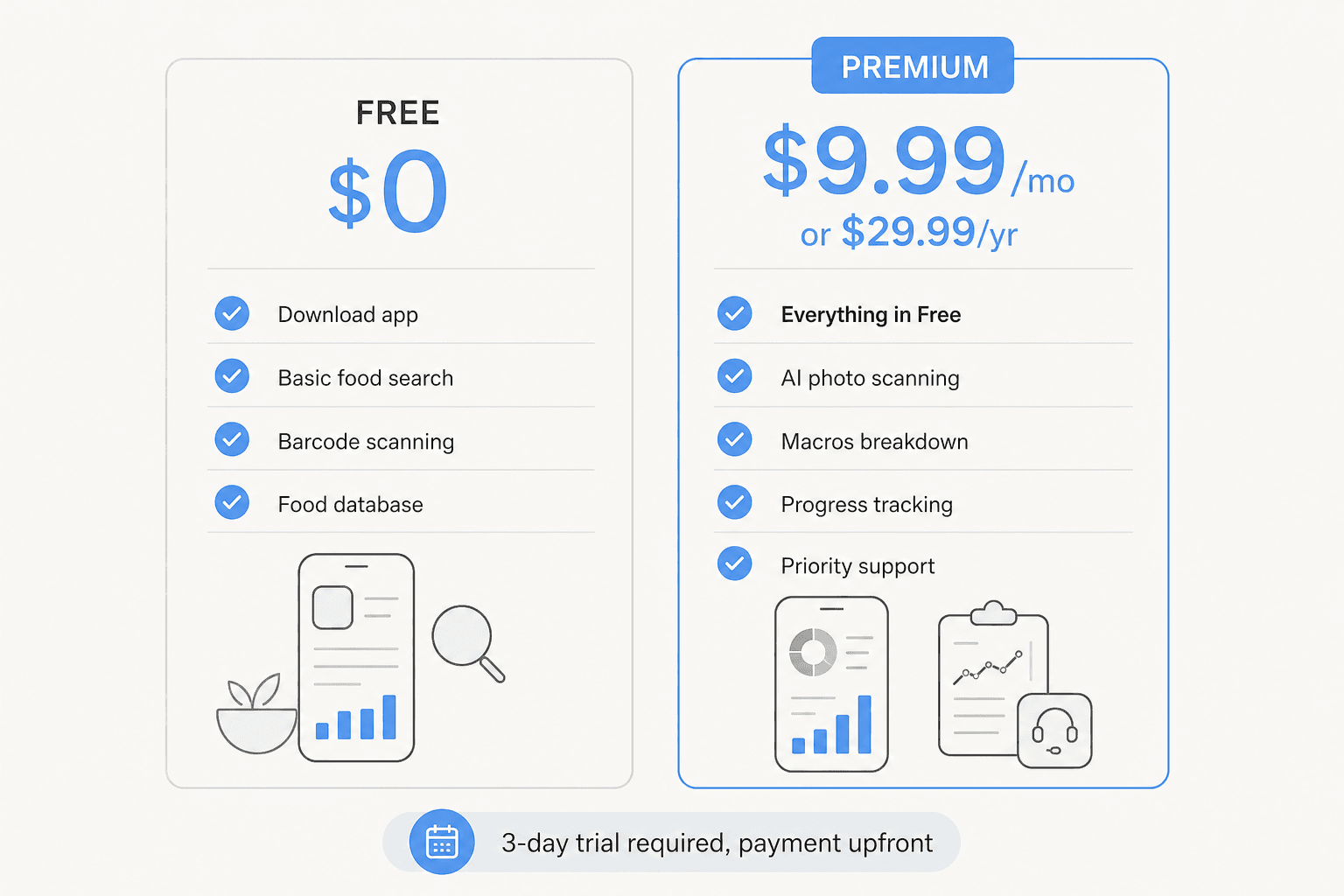
At $2.49/month on the annual plan, premium is cheap as fitness app subscriptions go. MyFitnessPal Premium runs around $19.99/month, Noom is roughly $70/month, and Cronometer Gold is around $9.99/month. Cal AI undercuts most of them - assuming the photo scanning accuracy holds up for your eating patterns.
The 3-day trial - what to know before you start
The trial is where most of the billing complaints originate.
Cal AI's 3-day trial is the shortest in the calorie-tracking category - most rivals offer 7 days or longer. It requires a valid payment method to activate and auto-renews to a full subscription the moment it ends.
The critical detail: deleting the app does not cancel the subscription. Charges continue even after uninstalling. To cancel, you must go through your Apple or Google account settings:
- iOS: Settings → [Your Name] → Subscriptions → Cal AI → Cancel Subscription
- Android: Google Play Store → Subscriptions → Cal AI → Cancel
Apple removed Cal AI from the App Store in April 2026 specifically over the paywall design: the screen displayed the weekly equivalent price more prominently than the actual amount users would be billed, and the free-trial toggle was placed in a way that obscured automatic renewal information. The app also re-prompted users who declined the initial offer with a second, different purchase flow. After the issues were fixed, the app returned to the store.
"I started my free trial… and then canceled it the day after… Two days ago I see a charge on my apple wallet for a year subscription… today, apple told me they can't refund me."
u/Confident_Bid_7051, r/offmychest (Feb 2026)

Cal AI's terms state subscription fees are non-refundable except as required by law. If you're charged unexpectedly, your best recourse is disputing through Apple, Google, or your credit card company.
How accurate is Cal AI?
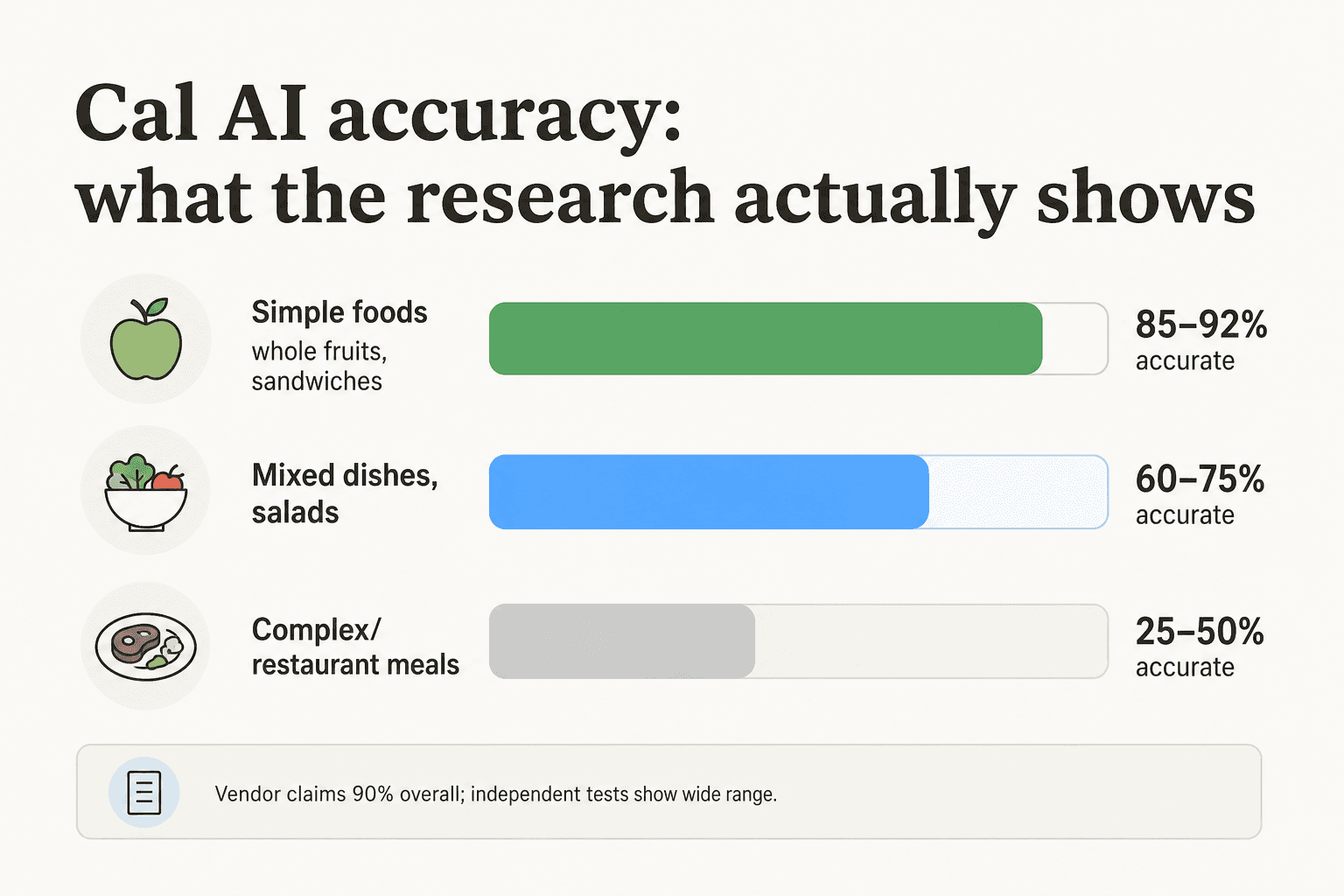
Cal AI claims 90% accuracy across all food types. The honest picture is more nuanced.
For simple, whole foods - a piece of fruit, a sandwich with visible components, a bowl of clearly distinct items - the app performs reasonably well. Community comparisons and independent tests put it around 85-92% accuracy for these cases: close enough to be a useful ballpark.
For mixed dishes, restaurant meals, and foods with variable portions - a pasta, a stir-fry, a burger from a restaurant - accuracy drops significantly. In side-by-side tests against manual logging, mixed meals showed 25-50% variance, typically undercounting calories.
"Cal AI for me was so inaccurate honestly… I did the test side by side with manual logging and picture scanning… Cal AI or myfitnesspal were far far from accurate."
u/visiontech_33, r/Healthy_Recipes
"The calorie figures are literally random."
top comment, r/Healthy_Recipes
The vendor's 90% accuracy claim has been challenged publicly - one Redditor noted the figure comes with "zero citations." Cal AI works best as a ballpark tracker for straightforward meals, not as a precision nutrition tool.
If precision matters - tracking macros for a specific diet protocol, managing a medical condition, working with a dietitian - Cronometer is built for that use case and has a more credible accuracy methodology.
What changed in 2026
Three significant events in early 2026 changed the Cal AI story, and all three matter for a pricing decision:
MyFitnessPal acquisition (March 2026). MyFitnessPal acquired Cal AI in a deal announced in March. Cal AI continues to operate as a standalone app. What this means for pricing long-term - whether Cal AI gets folded into MFP's subscription structure or remains its own product - hasn't been disclosed.
Apple billing crackdown (April 2026). Apple temporarily removed Cal AI for violations including deceptive paywall design and manipulative subscription flows. The app was reinstated after the fixes. As of June 2026, it is live and available in the App Store.
Data breach (March 2026). A breach documented by Kiteworks exposed 3.2M+ user records - names, email addresses, and health tracking data - via an unauthenticated Firebase database. If you used Cal AI before this period, your data may have been affected.
These events don't make the app unusable, but they're the kind of context that should inform how much personal health data you're comfortable sharing with it.
Cal AI vs the alternatives
The right comparison depends on what you're trading off.
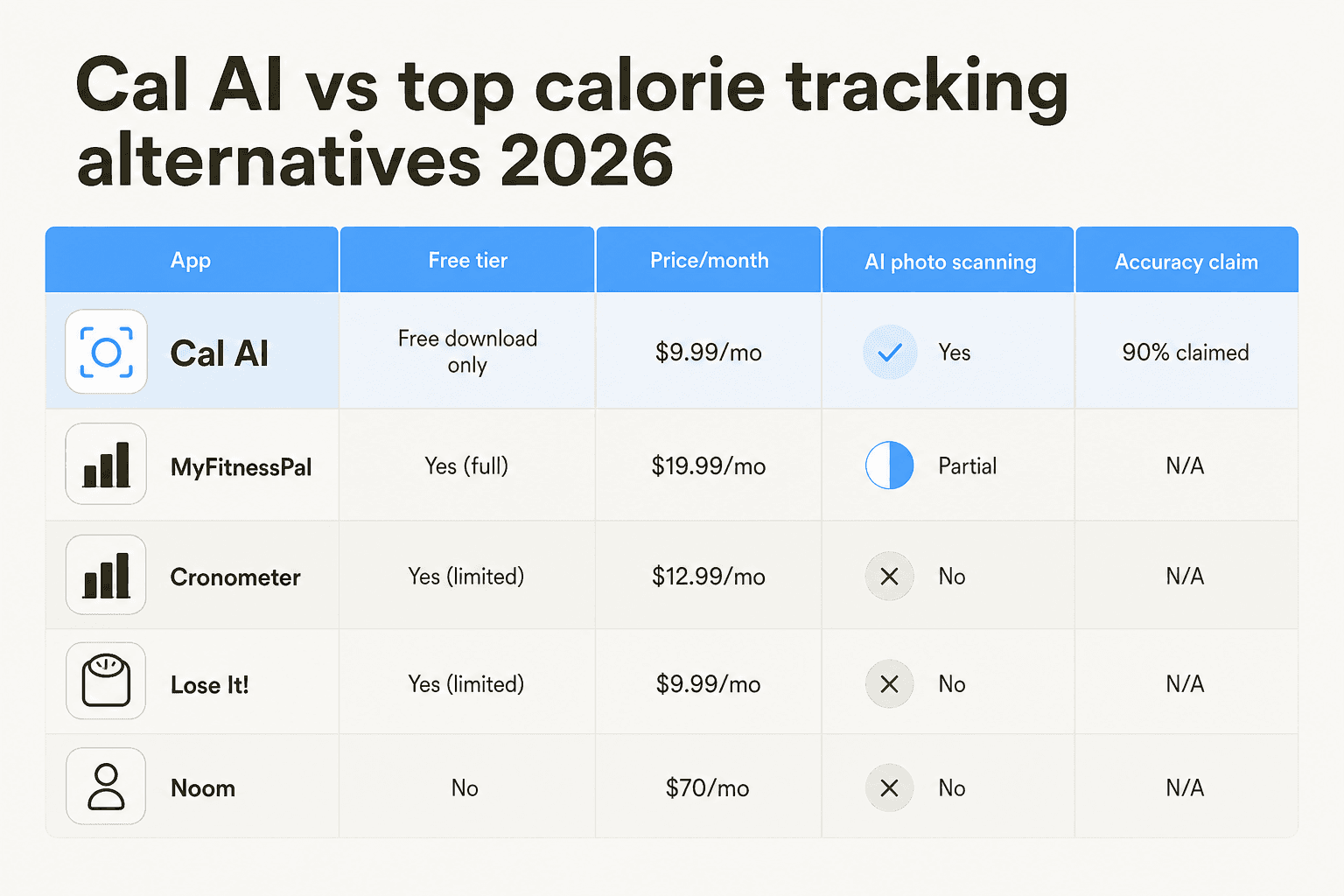
| App | Free tier usability | Price/year | AI photo scanning | Best for |
|---|---|---|---|---|
| Cal AI | Limited (no AI scan) | $29.99/yr | Yes | Fast ballpark logging |
| MyFitnessPal | Good (full database) | ~$79.99/yr | Partial | Comprehensive logging, community |
| Cronometer | Good (limited macros) | ~$35.99/yr | No | Precision tracking, dietitian use |
| Lose It! | Good | ~$39.99/yr | No | Clean UX, goal tracking |
| Noom | No real free tier | ~$209/yr | No | Coaching, behavioral change |
Cal AI's strongest advantage is AI photo scanning at the lowest price point in the category - no competitor matches the snap-a-photo workflow at $29.99/year. MyFitnessPal has a deeper database and a much larger community, but premium costs 2.5 times more. Cronometer wins on precision. Lose It! offers a cleaner free tier with no billing friction.
The main reasons people switch away from Cal AI: accuracy concerns on complex meals, billing friction during the trial, and unease after the data breach. The main reason people stay: the photo logging genuinely reduces effort compared to manual entry, and at $2.49/month on annual, the price makes it easy to shrug off the imprecision.
For a full breakdown of alternatives, see our Cal AI alternatives guide.
Is Cal AI worth it?
At $29.99/year, yes - if the photo-snap workflow fits how you actually eat. The annual plan is one of the cheaper subscriptions in health apps, and the friction reduction is real for anyone who has ever given up on manual logging after a week. Simple meals, quick logging, ballpark accuracy - that's where Cal AI delivers.
The case against: the trial mechanics need active attention to avoid unwanted charges (cancel through the app store, not by deleting), accuracy on complex meals is unreliable, and the 2026 billing crackdown and data breach are legitimate reasons to be thoughtful about the data you share.
Our take: if you eat mostly recognizable, separable foods and want to track without much friction, the annual plan is reasonable. If you cook complex dishes or eat out often and need precision, look at Cronometer instead. If you want the best free tier and the deepest database, MyFitnessPal is still the benchmark.
Try eesel
The same AI-powered shift that makes Cal AI useful - getting instant answers instead of doing everything manually - is what eesel brings to customer support teams. eesel builds AI teammates that live inside your existing helpdesk (Zendesk, Freshdesk, HubSpot, Gorgias, and others), handle incoming tickets automatically, and learn from your support history from day one.
If you're running a health, wellness, or fitness company and your support team is drowning in repetitive questions, eesel's AI helpdesk agent resolves tier-1 tickets without human triage - customers get accurate answers instantly, and your team focuses on the cases that actually need judgment. Teams like Design.com handle 50,000+ tickets per month on eesel without expanding headcount. Try eesel - $50 in free usage, no credit card required.
Frequently Asked Questions

Share this article

Article by
Riellvriany Indriawan
Riell is a designer and writer at eesel AI with about two years of experience researching CX platforms, AI chatbots, and helpdesk software. She combines her design background with a sharp eye for how these tools actually look and feel in practice — making her comparisons unusually visual and user-focused.