|
VOOZH | about |
|
VOOZH | about |
Artificial Intelligence (AI) enables machines to perform tasks that typically require human intelligence. As AI becomes more widely adopted, it is important to understand both its advantages and disadvantages.
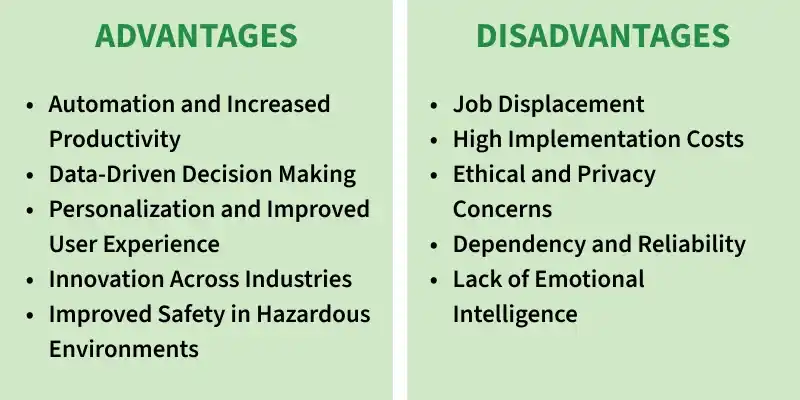
One of the biggest advantages of Artificial Intelligence is automating repetitive tasks with high accuracy, which improves productivity, reduces costs, and allows humans to focus on higher-value work.
AI helps organizations make better decisions by analyzing large datasets, identifying patterns, and generating actionable insights. It's predictive capabilities support planning, forecasting, and problem-solving across various industries.
AI enables businesses to deliver personalized experiences by analyzing user behavior, preferences, and interactions. This helps improve customer satisfaction and engagement through tailored services and recommendations.
AI drives innovation by enabling the development of advanced technologies, products, and services. It supports breakthroughs in fields such as healthcare, robotics, transportation, and scientific research.
In hazardous environments, AI can perform dangerous tasks, reducing the risk to human workers. This is particularly beneficial in industries such as mining, construction, and space exploration.
AI-driven automation can replace certain repetitive and routine jobs. While new roles may emerge, workers often need reskilling to adapt to changing job requirements.
Developing and implementing AI systems require significant investment. The cost of hardware, software, and skilled personnel can be a barrier for smaller businesses and organizations.
AI systems can pose ethical and privacy challenges. Issues such as data privacy, surveillance, and the potential for biased decision-making are critical concerns that need to be addressed.
Over-reliance on AI can lead to problems if the systems fail or produce incorrect results. It is crucial to have checks and balances to ensure the reliability and accuracy of AI systems.
AI lacks the ability to understand and respond to human emotions effectively. This limitation can impact customer service and other areas where emotional intelligence is essential.