|
VOOZH | about |
|
VOOZH | about |
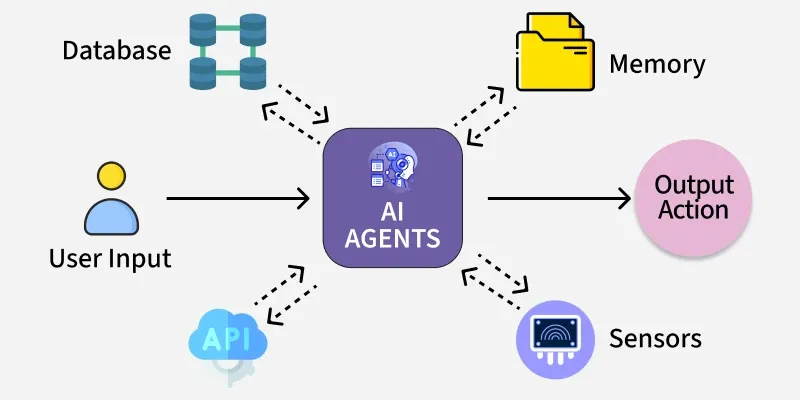
AI Agent Memory is the ability of an AI agent to store, recall and use information from past interactions to make better decisions in the present and future. Without memory, an agent treats every interaction as if it is the first interaction. With memory, an agent can maintain context, adapt to users and improve over time i.e memory gives AI agent continuity, context-awareness and learning abilities.
Many real-world scenarios demand agents to remember and adapt to:
An agent without memory is limited to short and isolated responses whereas it can act more intelligently and deliver better experience with memory.
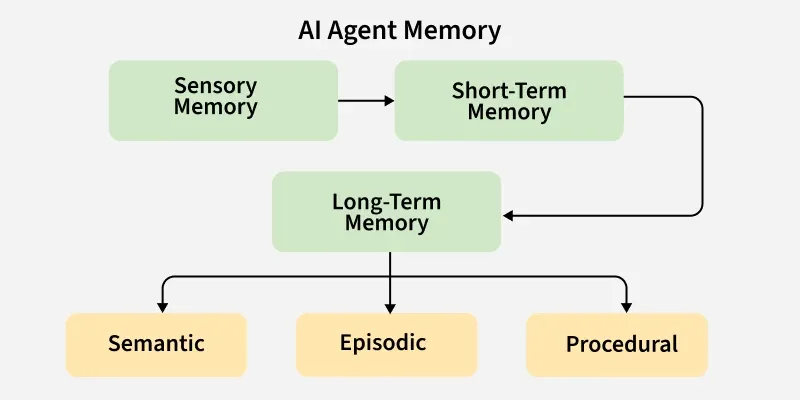
AI agents use different types of memory, each serving a unique purpose:
Short-term memory (STM) is like the AI agent’s temporary notepad. It holds recent information just long enough to finish the current task. After that, it is cleared for the next job. This type of memory is great for quick tasks such as customer support chats, where the agent only needs to remember the ongoing conversation to help the user.
Long-term memory (LTM) stores information for much longer periods. It can keep specific details, general facts, instructions or even the steps needed to solve certain problems. There are different types of long-term memory:
Memory type | What it Stores | Example |
|---|---|---|
Short-term Memory | Context of current session | Conversation so far in a chatbot session. |
Long-term Memory | Knowledge or data over time | User preferences saved across sessions. |
Episodic Memory | Specific events and experiences | Sequence of actions taken in a mission. |
Semantic Memory | Facts and world knowledge | Paris is the capital of France. |
Procedural Memory | Rule based data for immediate tasks. | Numbers held while solving a math problem. |
Memory can be implemented in various ways depending on the type and scale required:
Technique | Best for | Strengths | Limitations |
|---|---|---|---|
Simple Buffer (FIFO) | Short-term context | Easy to implement, Fast | Cannot handle long-term storage |
Relationship Database | Structured long-term memory | Mature technology and easy for querying | Poor at semantic/contextual queries |
Vector Database | Semantic search and unstructured data | Handles fuzzy matching and is scalable | Requires embedding generation |
Knowledge Graph | Relationships and World Knowledge | Good for reasoning and inference | Complex to build and maintain |
Neural Turing Machine | Advanced neural memory | Integrates with deep learning models | Computationally intensive |