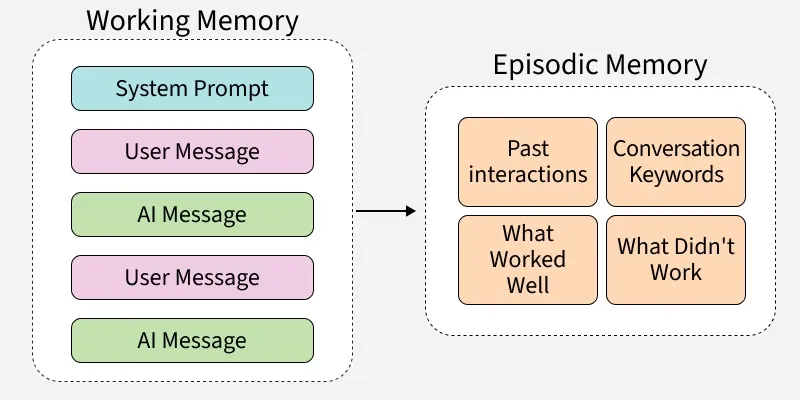
Episodic memory in AI agents is an advanced capability that enables an artificial agent to store, recall and reason about its own past experiences or events it has personally encountered during its operation similar to how humans remember distinct moments in their lives. This ability gives AI agents richer situational awareness and adaptability by going beyond immediate inputs and static knowledge to leverage historical context dynamically.
Working Memory vs Episodic Memory in AI Agents?
In AI agents, working memory refers to a short-term, rapidly accessible store for current, task-relevant information, enabling immediate reasoning and interaction, but it is quickly overwritten as the context changes, while episodic memory acts as a long-term archive of specific past experiences and events (like previous user interactions or actions taken), allowing the agent to recall, learn from and adapt based on prior episodes thereby supporting user personalization, context continuity and improved decision making over time.
Recall specific past events relevant to current decision-making.
Learn from previous successes and failures by reusing or avoiding past actions.
Detect patterns over time to improve performance.
Provide explanations by relating to past events.
Maintain a coherent experience history to improve long-term planning and adaptability.
This elevates agent intelligence from reactive to reflective, allowing agents to factor in history in complex, dynamic environments.
Importance and Benefits
Most conventional AI systems rely on short-term or task-specific memory, limiting their ability to adapt beyond immediate inputs. Integrating episodic memory enables:
Enhanced contextual awareness, considering historical experience alongside current perception.
Improved learning and reasoning, by revisiting past episodes and outcomes.
Better anticipation and planning, based on sequences of related events.
Transparency and explainability, through recallable past behavior.
Safety and reliability, as agents can be designed to remember and avoid risky situations.
Core Components and Design of Episodic Memory Systems
Episodic memory implementation typically involves three key phases:
Encoding
Deciding when and what to record as an episode (e.g., after every action, significant state changes or rare/unexpected events).
Selecting relevant features such as sensory data, internal states, actions taken and received rewards.
Compressing and structuring this information effectively for storage without overwhelming resources.
Storage and Organization
Maintaining an efficient, indexed database of episodes organized by time or content similarity.
Handling long-term retention and consolidation of memories.
Supporting scalable growth as the agent accumulates numerous experiences.
Retrieval and Use
Using contextual cues to match and recall relevant past episodes.
Leveraging similarity measures or vector embeddings for efficient search.
Integrating recalled memories into current decision processes, learning updates or explanations.
The episodic memory system must balance detail richness, storage efficiency and retrieval speed to be practical in applications ranging from robotics to conversational AI.
Approaches for Episodic Memory Implementation
Simple Logging: Recording key events, actions and outcomes in structured logs or databases for later retrieval.
Vector Embeddings & Similarity Search: Encoding episodes as embeddings (e.g., via transformers) and using nearest neighbor search algorithms (FAISS, Annoy) to retrieve similar memories efficiently.
Sparse / Selective Storage: Filtering episodes to store only significant or novel experiences, reducing storage overhead.
Memory-Augmented Neural Networks: Architectures where neural networks write to and read from an external memory bank dynamically during inference.
Hybrid Architectures: Combining episodic with semantic and working memory for comprehensive AI cognition.
Implementation
Step 1: Initializing the Agent’s Episodic Memory
The constructor here sets up the agent’s internal storage as an empty list called memory. This list will hold all recorded episodes, each represented as a dictionary containing the context, action and outcome. Without this, the agent cannot store or recall past events.
Step 2: Encoding (Storing) an Episode
This method records a new experience (an “episode”) every time the agent takes an action in some context. The episode is a dictionary with three parts:
context: A description of the current situation the agent observes (e.g., “obstacle ahead on the left”).
action: What the agent decided to do in that context (e.g., “turn right”).
outcome: A numeric value indicating success or failure (e.g., 1 for success).
The method appends this episode to the memory list so the agent accumulates knowledge of past experiences. Printing confirms the episode has been stored, useful for debugging or interactive learning.
Step 3 : Retrieving Similar Past Episodes
To make use of past experiences, the agent needs to recall relevant episodes that resemble the current situation. This function:
Tokenizes the current context string into lowercase words to create a set of keywords.
Iterates through previously stored episodes, tokenizing each episode’s context similarly.
Checks if there is any word overlap between the current context and episodes.
Collects and returns all episodes with at least one overlapping keyword.
Step 4. Deciding Action Based on Episodic Memory
This method is where the agent makes decisions leveraging episodic memory. The process includes:
Using retrieve_similar_episodes to find past episodes related to the new context.
If such episodes exist, it selects the episode with the highest outcome (best success).
Returns the action taken in that successful episode, assuming it will work well again.
If no similar episodes are found, it returns a default fallback action, indicating unfamiliarity or the first encounter with the context.
Step 5: Example Usage
Below example is now used to check the episodic memory.