|
VOOZH | about |
|
VOOZH | about |
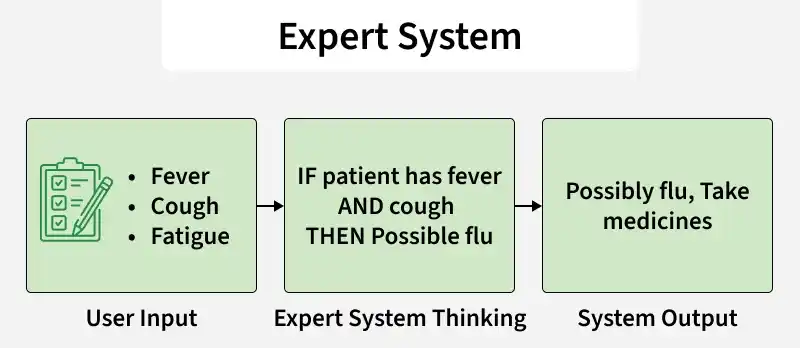
An Expert System is a branch of Artificial Intelligence designed to simulate the decision-making ability of a human expert.
Expert systems play a major role in AI because they allow computers to use human expertise to solve real-world problems.
A famous example is MYCIN which was developed in the 1970s to diagnose bacterial infections. Although it was not deployed in hospitals, it proved that computers could assist doctors in diagnosis.
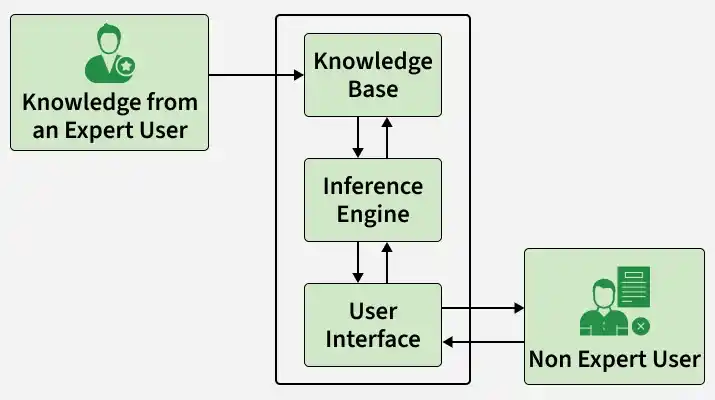
An expert system is made of several connected parts that work together.
The knowledge base is the most important part of an expert system. It contains all the information the system needs to solve problems, similar to how a human expert stores knowledge in their brain. It includes:
The quality of an expert system depends heavily on how accurate and complete this knowledge base is. If the knowledge stored is wrong or incomplete, the system’s decisions will also be incorrect.
This module must also be updated regularly. Without updates, the system becomes outdated and unreliable.
The inference engine is the reasoning unit of the expert system. It works like the thinking process of a human expert and decides how to apply the stored knowledge to a problem. Its main tasks include:
The inference engine mainly uses two reasoning strategies:
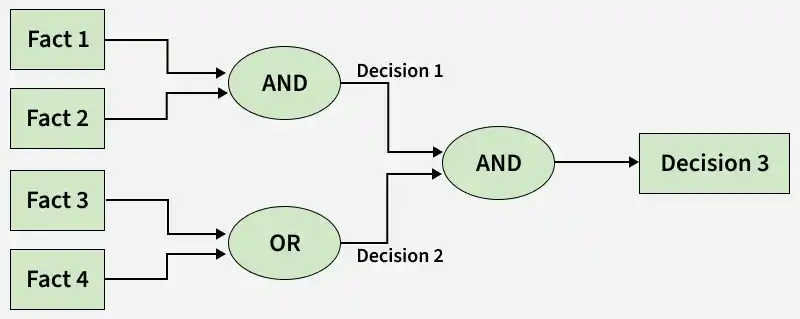
1. Forward Chaining: This is a data-driven reasoning approach where the system starts with the available facts and applies rules to infer new facts or conclusions.
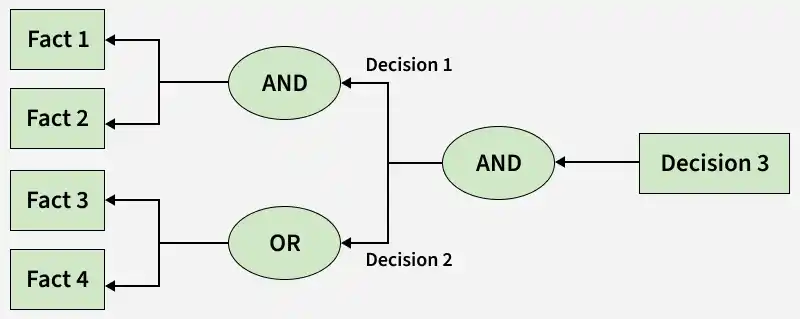
2. Backward Chaining: This is a goal-driven reasoning approach where the system starts with a hypothesis or a goal to prove and works backward to determine which facts or conditions would support that conclusion.
Because of this reasoning ability, the inference engine acts as the “decision maker” of the system.
The user interface is the communication layer between the user and the expert system. Without it, users would not be able to interact with the system. It allows users to:
In modern expert systems, the interface may be:
One of the key advantages of expert systems over many modern AI models is their ability to explain their reasoning. The explanation system helps users understand:
For example, a medical expert system may say: “Diagnosis: Flu — because fever, cough and body pain match rule R12.”
The process of building an expert system is called Knowledge Engineering and its working is:
This structured reasoning process allows expert systems to produce consistent and explainable decisions.
Some well-known expert systems include:
Expert systems can be classified based on how knowledge is represented.
These are the most common type of expert systems. They represent knowledge using IF–THEN rules such as:
IF temperature high AND cough present → infection likely
They are:
Most early expert systems including medical diagnosis tools, were rule-based.
Frame-based systems store knowledge in structured units called frames which are similar to objects in programming. Each frame represents a concept and contains:
For example, a “Car” frame may include:
This method is useful when the system must represent complex objects and relationships rather than simple rules.
Traditional expert systems use strict true/false logic. However, many real-world problems involve uncertainty or partial truth. Fuzzy expert systems use fuzzy logic where values can be partial such as:
This makes them suitable for:
They are better at handling vague or imprecise information compared to classical rule-based systems.
Neural expert systems combine traditional expert systems with Artificial Neural Network models. They use:
This hybrid approach is useful when:
Such systems are used in modern applications like fraud detection, predictive maintenance and intelligent decision support.
Neuro-Fuzzy Expert Systems combine fuzzy logic with neural networks to create systems that can both reason with uncertainty and learn from data. In these systems:
Unlike normal fuzzy systems where rules are manually defined, neuro-fuzzy systems can adapt and tune themselves. This makes them very useful for real-world decision-making where:
Lets see a quick difference between Expert Systems and Machine Learning:
| Feature | Expert Systems | Machine Learning |
|---|---|---|
| Knowledge source | Human experts | Uses past data |
| Learning ability | No automatic learning | Learns from data |
| Transparency | Easy to explain rules | Often hard to explain |
| Best for | Well-defined problems | Data-driven problems |