|
VOOZH | about |
|
VOOZH | about |
Model-based reflex agents are a type of intelligent agent in artificial intelligence that operate on the basis of a simplified model of the world. Unlike simple reflex agents that only react to current perceptual information, model-based reflex agents maintain an internal representation, or model, of the environment that allows them to anticipate the consequences of their actions.
Simple reflex agents make decisions based solely on what they can currently see or sense from their environment. This can be limited because they don't remember past information or anticipate future changes. To handle situations where not all information is immediately available (partial observability), model-based agents are used, which keep track of what they cannot see at the moment. In this article, we will discuss the Model-Based Reflex Agents in AI in detail.
Table of Content
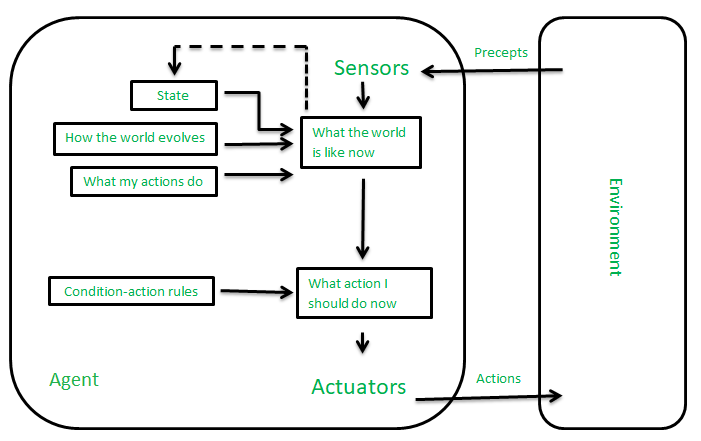
Model-based reflex agents are a type of intelligent agent designed to interact with partial observable or dynamic environments. Unlike simple reflex agents, Model-based reflex agents maintain an internal state that reflects not just the current perception but also incorporates past observations to infer aspects of the environment that are not directly visible.
The key difference between simple reflex agents and model-based agents in AI is that they have memory—they remember what they've seen before. This memory (or internal state) is built based on the history of what the agent has perceived. By storing this information, the agent can make more informed decisions because it can predict how the environment might change based on its actions.
Model-based reflex agents use condition-action rules to make decisions and act in real-time, based on their perception of the environment. It represents a simple form of logic that dictates how the agent should respond to specific conditions in its environment. Rules can be defined manually or learned through machine learning techniques. These rules or logic specify actions to be taken in response to certain conditions perceived by the agent.
Condition-action rules are often represented in the form of "if-then" statements, where the "if" part specifies the condition and the "then" part specifies the action.
For example:
Here's how a model-based reflex agent typically operates:
Here's a simplified pseudo code illustrating the working of a model-based reflex agent in artificial intelligence:
function MODEL-BASED-REFLEX-AGENT(percept) returns an action
 persistent:
 state, the agent's current conception of the world state
 model, a description of how the next state depends on the current state and action
 rules, a set of condition-action rules
 action, the most recent action, initially none

 // Update the agent's internal state based on the current percept and previous action
 state ← UPDATE-STATE(state, action, percept, model)

 // Match the current state against the condition-action rules
 rule ← RULE-MATCH(state, rules)

 // Select the action prescribed by the matched rule
 action ← rule.ACTION

 // Return the selected action
 return action
Explanation:
MODEL-BASED-REFLEX-AGENT takes a percept as input and returns an action.state, model, rules, and action to maintain the agent's internal state, the model of the environment, the set of condition-action rules, and the most recent action, respectively.UPDATE-STATE function, which takes the current state, previous action, percept, and the model as inputs.RULE-MATCH function is used to find a condition-action rule that matches the current state. Once a matching rule is found, its corresponding action is selected.Model-based reflex agent function updates internal state based on percept, matches against the state predetermined rules, and selects action accordingly.
Model-based reflex agents are employed in various real-world applications where predictive capabilities are crucial for decision-making. Some examples include:
Model-based reflex agents in AI integrate sensory perception, internal modeling, and decision-making for intelligent interaction with changing environments. Despite challenges like model complexity and resource requirements, their versatility and effectiveness highlight their crucial role in shaping the future of AI and robotics.