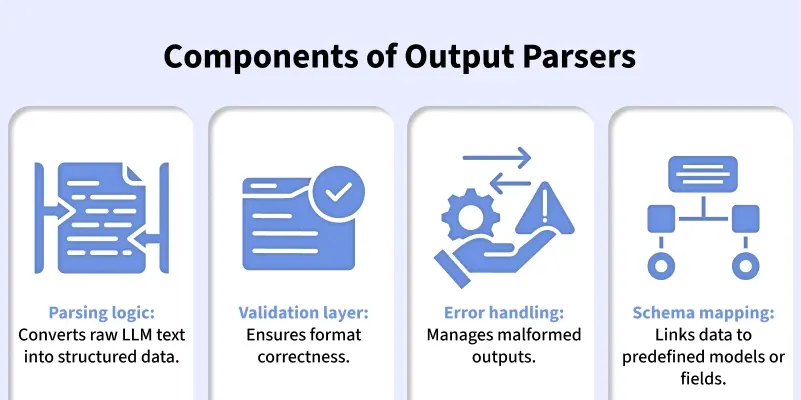
LLMs often generate text that is unstructured or inconsistent. Output parsers help convert this raw text into structured formats ensuring our application can reliably interpret and use the results.
Output parsers act as a bridge between the model and our application enforcing formats like JSON, lists or Python objects. This makes data extraction, validation and further processing seamless and consistent.
Here, the prompt asks GPT-4 to return a JSON object with specific fields.
{topic} is a variable that will be replaced dynamically when you run the chain.
Step 5: Initialize the LLM
Initializing the LLM.
Using GPT-4 for high-quality structured output.
temperature=0 ensures deterministic responses which is important when expecting JSON format.
Step 6: Create the Chain
Creating the chain by:
Linking the prompt template and GPT-4 model into a single pipeline.
When run, it automatically fills {topic}, sends the prompt to GPT-4 and returns the raw text output.
Step 7: Run the Chain
Running the chain by:
Substituting {topic} with "LangChain ChatPromptTemplate".
GPT-4 responds with text that should contain a JSON structure.
Step 8: Extract JSON Portion
Extracting JSON Portion by:
Using regular expressions to locate the JSON object inside the raw text.
re.DOTALL lets "." match line breaks too, in case the JSON spans multiple lines.
Step 9: Parse the JSON Output
Parsing the JSON Output by:
Extracting JSON string (json_string) is parsed by JsonOutputParser into a proper Python dictionary.
If JSON isn’t found like the model added extra text, it prints the raw output instead.
Output:
Parsed JSON Output:
{'summary': 'LangChain ChatPromptTemplate is a tool for generating conversation prompts in various languages.', 'key_points': ['LangChain ChatPromptTemplate supports multiple languages.', 'It is designed to facilitate language learning and practice.', 'The tool generates prompts that can be used in both formal and informal conversation contexts.'], 'difficulty': 'medium'}
Handling Errors and Inconsistent Outputs
Ways to handle errors and inconsistent outputs are:
Incomplete or Missing Data: LLMs may omit required fields or provide partial information which can disrupt downstream processing.
Unexpected Formatting: Model output can include extra text, wrong delimiters or inconsistent structure making parsing difficult.
Type or Schema Mismatch: Fields may have incorrect data types or an unexpected order causing validation failures.
Validation Failures: Raw outputs might not pass checks for required fields, length or data type leading to errors in applications.
Automatic Correction with OutputFixingParser: This parser detects and fixes missing or mis-formatted fields, ensuring outputs match the expected schema.
Reformatting and Data Cleanup: It can reformat text, split lists or fill in default values to make the data immediately usable.
Logging and Error Tracking: Keeps track of errors or inconsistencies for debugging and helps improve prompts or parser logic.
Applications
Some of the applications of Output Parsers:
Data Extraction: Converts raw LLM outputs into structured formats for databases, APIs or analytics pipelines.
Form Filling and Automation: Automatically populates forms or generates reports from model responses without manual intervention.
Multi-Step Workflows: Feeds structured outputs into subsequent chains or agents for complex tasks.
Data Validation: Ensures outputs meet required schemas or data types before further processing.
Content Summarization: Parses model generated summaries into structured formats for dashboards or reporting tools.
Recommendation Systems: Extracts key entities or user preferences from text to drive personalized suggestions.
Benefits
Some of the benefits of Output Parsers:
Consistency: Maintains predictable output formats across all LLM calls.
Reliability: Reduces errors caused by inconsistent or unexpected outputs.
Efficiency: Automates parsing and validation, saving time and effort.
Integration: Facilitates smooth connection of LLM outputs with applications, APIs and downstream processes.
Scalability: Handles large volumes of outputs consistently without manual intervention.
Error Reduction: Minimizes human mistakes by ensuring outputs are automatically cleaned and structured.
Challenges of Output Parsers
Some of the challenges of Output Parsers:
Model Inconsistencies: LLM outputs may still vary or include unexpected text that parsers must handle.
Complex Schema Handling: Parsing nested or multi-type outputs can be tricky and requires careful design.
Performance Overhead: Additional parsing and validation steps can slightly slow down workflows.
Maintenance: Custom parsers may require updates if prompts or output formats change.