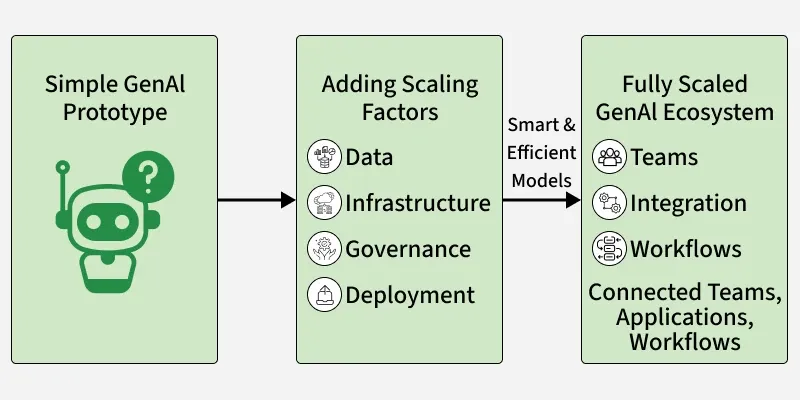
Scaling Generative AI means moving from small, isolated proofs of concept to production ready AI systems that work reliably across multiple teams, workflows and geographies. Scaling GenAI involves:
Turning small GenAI experiments into business-wide solutions
Managing large scale model deployment, fine-tuning and integration
Ensuring responsible and secure AI usage at scale
To achieve this, organizations need a strong data strategy, scalable infrastructure, effective governance and thoughtful change management.
Most organizations start with small prototypes of GenAI, such as chatbots, content generators or code assistants but the actual transformation happens when those pilots have been scaled across the enterprise. Key Benefits of Scaling GenAI:
Consistency: Provides uniform output and decisions throughout teams and departments.
Speed to Innovation: Accelerates the roll out of AI powered tools and solutions.
Data Utilization: Leverage enterprise scale data in extracting deep insights and business value.
Operating Model for Scaling GenAI
The AI Operating Model defines how an organization integrates Generative AI into business workflows-data, models, applications and governance aligned to drive frictionless large scale adoption. It serves as a blueprint for managing data flow, model lifecycle and responsible AI operations.
Key Layers of Operating Model:
Data Layer : Handles data collection, preprocessing and storage to ensure reliable inputs for GenAI systems.
Model Layer : Manages model training, fine-tuning and evaluation to optimize performance and adaptability.
Application Layer : Focuses on building business-facing applications powered by GenAI outputs.
Governance Layer : Ensures compliance, security, explainability and continuous monitoring of AI systems
How to Build a Scalable GenAI Ecosystem
Scaling Generative AI isn’t just about larger models it’s about building strong foundations across data, infrastructure, governance and culture. Below are the five key pillars for scaling GenAI effectively across an enterprise.
1. Data Foundation
Build a centralized data lake for all structured and unstructured data.
Maintain pipelines for cleaning, deduplication and bias reduction.
Add metadata management for lineage and versioning.
Integrate data from CRM, ERP and analytics systems.
2. Approach to Modeling
Use base models (GPT, Gemini, Llama) for general tasks.
Fine-tune models with enterprise-specific data for higher accuracy.
Adopt multimodal models when needed.
Start with small task models and scale up gradually.
3. Infrastructure & Deployment
Use cloud-native setups across AWS, Azure or GCP.
Deploy using Docker and Kubernetes for flexibility.
Use edge deployment to reduce latency.
Monitor models with Prometheus, Grafana or MLflow.
4. Governance and Security
Set ethical guidelines for fairness and transparency.
Apply strict access control for sensitive data.
Maintain audit logs for model outputs and interactions.
Ensure compliance with GDPR, HIPAA and ISO/IEC 42001.
5. Change Management and Culture
Upskill teams to work confidently with GenAI tools.
Encourage cross-functional collaboration.
Promote experimentation and continuous learning.
Use feedback loops to improve real-world performance.
Step-By-Step Implementation
Here we containerized the GenAI app and packaged the FastAPI model into a Kubernetes Deployment and Service to run it reliably. Then we enabled autoscaling with a HorizontalPodAutoscaler (HPA), added resource requests/limits and provided deployment commands for production readiness.
Step 1 : Model Loading and Generation
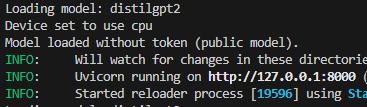
Initializes a Hugging Face text generation pipeline with a configurable model (distilgpt2 by default).
Reads settings like model name, seed and max length from environment variables for flexibility.
Uses set_seed() to ensure reproducible and consistent text generation results.
Provides a generate_text() method that validates prompts and produces variable-length outputs with sampling.
Step 2 : FastAPI service
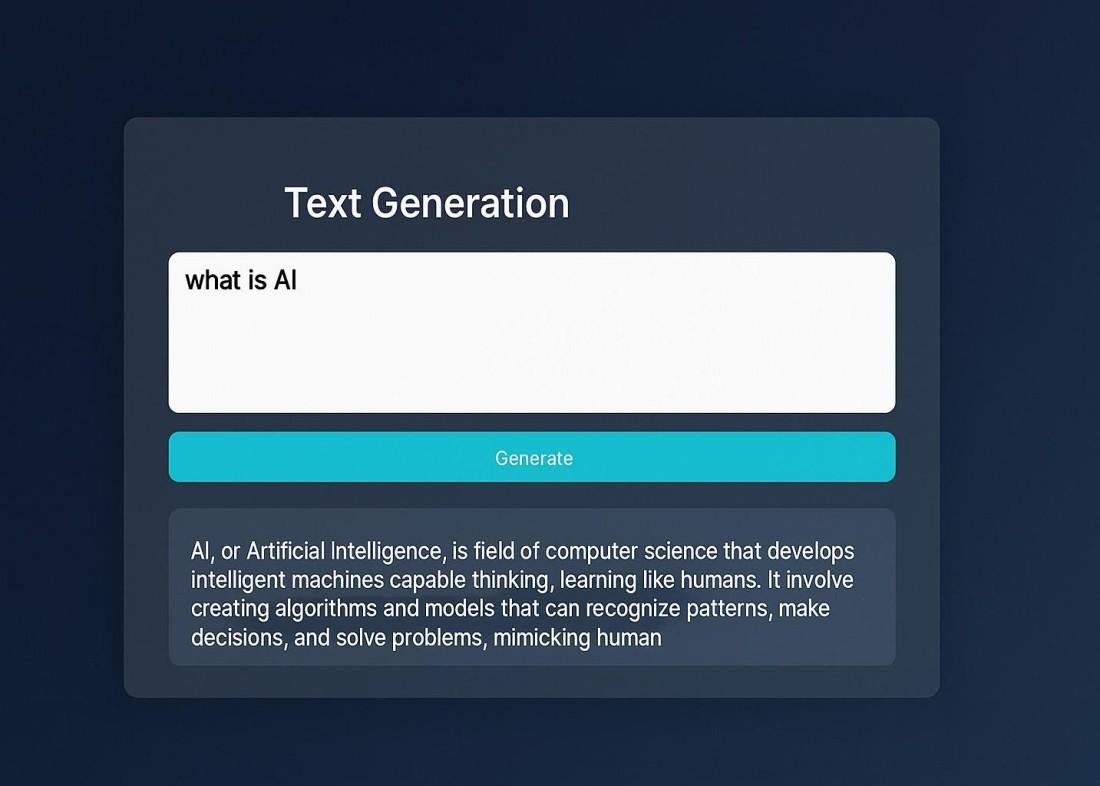
Exposes a lightweight HTTP API with a health root (/) and a /generate POST endpoint.
Loads the model once at app startup, avoiding per-request loading overhead.
Uses Pydantic model to validate incoming payloads (type-safe defaults).
Catches exceptions and converts them to HTTP errors for predictable client responses.
Accelerated Innovation: Enables rapid prototyping and automates creative tasks like content creation, product design and marketing.
Enhanced Decision Making: Integrates with analytics to summarize complex data and suggest optimal actions, reducing decision latency and improving data-driven strategy.
Operational Efficiency: Automates repetitive workflows such as document drafting, coding and customer support freeing employees for higher-value tasks.
Improved Customer Experience: Delivers personalized recommendations, conversational agents and adaptive user interactions increasing satisfaction and loyalty.
Competitive Edge and Agility: Early GenAI adopters respond faster to market trends and deploy innovations more quickly, fostering a culture of continuous learning.
Better Knowledge Management: Transforms unstructured data into searchable, AI-powered knowledge bases enhancing information access and collaboration.
Challenges
Data Quality and Accessibility: Enterprise data is often siloed or unstructured, causing biased outputs. Build a centralized data lake and enforce strong governance.
High Computational Costs: Large models need costly GPUs and storage. Use cloud infrastructure, model compression or PEFT to cut expenses.
Model Drift: Performance drops as data patterns change. Implement continuous retraining and monitoring with MLOps.
Ethical and Security Risks: GenAI can produce biased or unsafe content. Apply AI ethics frameworks, audit logs and explainability tools.
Workforce Readiness: Employees may resist or misuse AI tools. Offer AI literacy programs and promote cross-functional collaboration.