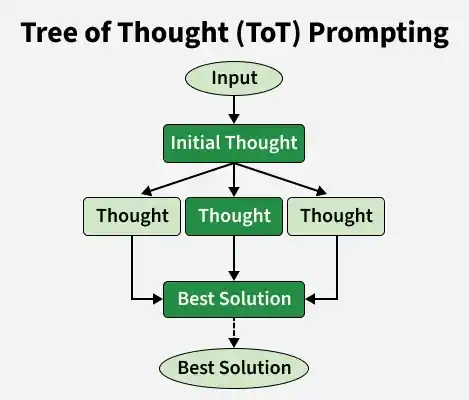
Tree of Thought (ToT) prompts give reasoning as a branching tree, allowing the model to explore multiple paths and choose the best solution, similar to human problem-solving.
Explores multiple reasoning paths instead of following a single solution.
Evaluates intermediate steps to choose the most promising direction.
Refines and improves reasoning by comparing different paths.
Mimics human thinking by considering alternatives and eliminating weak options.
It uses a structured approach where the model explores multiple reasoning paths, evaluates them and focuses on the best ones to reach an optimal solution.
1. Branching Reasoning Structure
The model decomposes a complex problem into intermediate steps, called "thoughts."
Each thought is a node in the tree, representing a partial solution or an intermediate idea.
From each node, the model generates multiple possible continuations (branches), exploring diverse lines of reasoning.
2. Exploration and Backtracking
Unlike linear methods like chain-of-thought, ToT allows the model to pursue several paths simultaneously.
If a path leads to a dead end or suboptimal result, the model can backtrack and explore alternative branches similar to how humans reconsider decisions when initial attempts fail.
3. Evaluation and Pruning
At each stage, the model evaluates the generated thoughts using heuristics or value prompts.
Less promising branches are pruned, focusing computational resources on the most viable paths.
This iterative process continues until an optimal or satisfactory solution is found.
Example of Solving a Puzzle
This example shows how Tree of Thought prompting solves a problem by exploring multiple solution paths step by step.
Step 1: The model generates several possible first moves (e.g., different equations or approaches).
Step 2: For each move, it generates several possible next steps, creating a branching tree of solutions.
Step 3: At each node, the model evaluates progress toward the final answer, pruning dead ends.
Step 4: The process continues, with the model backtracking and trying new branches as needed, until it finds the correct solution.
Applications
Solves complex mathematical and logical problems using multiple reasoning paths
Helps in puzzles and decision-making tasks by evaluating different possibilities
Supports creative writing by generating and refining multiple ideas
Useful in planning and strategy tasks where multiple outcomes must be considered
Improves performance in tasks requiring exploration rather than fixed steps
Advantages
Explores multiple reasoning paths, increasing chances of better solutions
Allows backtracking to avoid incorrect or weak approaches
Produces more flexible and robust problem-solving strategies
Mimics human decision-making by evaluating alternatives
Useful for both structured (math, logic) and open-ended tasks
Limitations
Computationally expensive due to multiple reasoning paths
Slower compared to linear approaches like Chain of Thought
Requires careful control to avoid excessive branching
May generate redundant or irrelevant paths if not guided properly