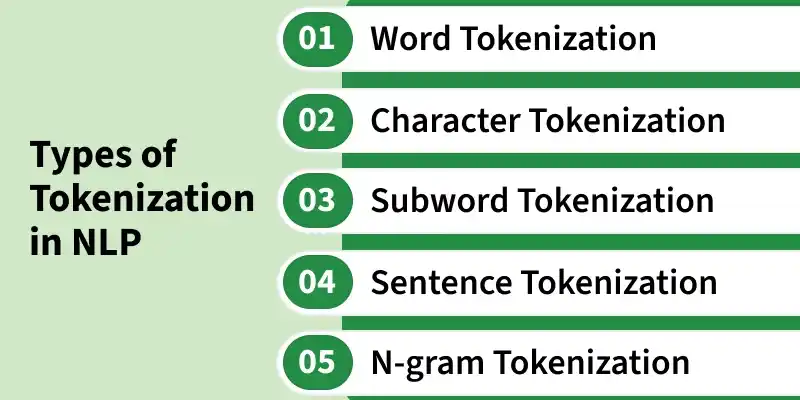
Tokenization is the process of breaking text into smaller parts called tokens, such as words, sentences, or characters. Different tokenization techniques are used in Natural Language Processing (NLP) depending on the task.
Converts raw text into a format that AI models can understand Helps in analyzing and processing text efficiently Useful for improving the accuracy of NLP models 👁 types_of_tokenization_in_nlp Types of Tokenizers 1. Word Tokenization It splits the text into individual words.
Separates text based on spaces Each word is treated as one unit Does not break words further Example:
Input: “Machine learning is powerful” Output: [“Machine”, “learning”, “is”, “powerful”]
Advantages Simple to implement Efficient for basic text processing Disadvantages Cannot handle unseen or complex words Ignores context within words 2. Sentence Tokenization This splits the text into individual sentences.
Breaks text using punctuation (like . ? !) Helps in dividing large text into smaller parts Useful for summarization and analysis Example:
Input: "AI is transforming industries. It is used everywhere." Output: [“AI is transforming industries.”, “It is used everywhere.”]
Advantages Helps in organizing text clearly Useful for understanding context between sentences Disadvantages It can make mistakes with complex punctuation Rules may differ across languages 3. Subword Tokenization It works by splitting words into smaller meaningful parts.
Breaks long or complex words into smaller pieces Helps handle unknown words Balances word and character levels Example:
Input: “playing” Output: [“play”, “ing”]
Advantages Handles unseen words effectively Reduces vocabulary size Disadvantages More complex than word tokenization Can break words unnaturally 4. Character Tokenization It splits text into individual characters instead of words.
Breaks every word into letters Works the same for all languages Does not depend on words or vocabulary Example:
Input: “Data” Output: [“D”, “a”, “t”, “a”]
Advantages Does not face any issue with unknown words Language-independent Disadvantages Increases sequence length Slower to process 5. N-gram Tokenization This splits text into groups of consecutive words.
Groups words together instead of splitting them alone Helps capture relationships between words Can be bigrams (2 words), trigrams (3 words), etc. Example:
Input: “Deep learning models” Output: Bigrams: [“Deep learning”, “learning models”]
Advantages Captures context better than single words Useful for prediction tasks Disadvantages Increases data size Needs more system resources (like Memory or CPU) 6. Byte Pair Encoding (BPE) Byte Pair Encoding is a subword tokenization technique that splits words into frequently occurring character sequences.
Merges the most frequent pairs of characters or subwords Reduces vocabulary size while preserving meaning Widely used in modern NLP models Example:
Input: "lower" Output: ["low", "er"]
Advantages Handles rare and unknown words effectively Creates a balanced vocabulary size Disadvantages Requires training on large datasets Can be complex to implement Difference Between Tokenization Techniques Technique Unit of Split Example Output Best Use Case Limitation Word Tokenization Words ["Machine", "learning"] Basic text processing Cannot handle unknown words Sentence Tokenization Sentences ["AI is good.", "It helps."] Text summarization Issues with complex punctuation Subword Tokenization Sub-parts of words ["play", "ing"] Handling rare/unseen words Slightly complex Character Tokenization Characters ["D", "a", "t", "a"] Language-independent tasks Longer sequences, slower N-gram Tokenization Word groups ["Deep learning", "learning models"] Context-based predictions High memory usage Byte Pair Encoding
Subword units
["low", "er"]
Modern NLP models
Needs training
When to Use Which Tokenization Technique Word Tokenization : Use when working on simple tasks like basic text analysis, counting words, or preprocessing. Sentence Tokenization : Use when you need to split large text for summarization, sentiment analysis, or paragraph understanding. Subword Tokenization : Use in modern NLP models (like transformers) where handling unknown or rare words is important. Character Tokenization : Use when working with multiple languages, misspellings, or when vocabulary is not fixed. N-gram Tokenization : Use when capturing context between words is important, like in text prediction or language modeling. Byte Pair Encoding: Use in modern NLP models where handling rare words and maintaining a compact vocabulary is important.