|
VOOZH | about |
|
VOOZH | about |
In C#, threads are used to achieve tasks concurrently, a fundamental feature in multithreading and parallel programming. However, there are scenarios where we need to terminate a thread. There are different ways to terminate a thread and in this article, we will discuss those ways with their code implementation.
The Abort() method throws a ThreadAbortException to the thread in which it is called, forcing the thread to terminate. However, this method is deprecated due to unpredictable behavior and is no longer recommended for use in modern versions of .NET.
Syntax:
public void Abort();
Exceptions:
Example:
Output:
Explanation: The above example shows the use of the Abort() method which is provided by the Thread class. By using thr.Abort(); statement, we can terminate the execution of the thread.
Note: This method is deprecated and is no longer used in newer versions of .NET. Instead of using Abort(), prefer safer alternatives like CancellationToken.
This method raises a ThreadAbortException in the thread on which it is invoked, to begin the process of terminating the thread while also providing exception information about the thread termination. Same as Abort method this is also not recommended to use.
Syntax:
public void Abort(object information);
Here, the information contains any information that you want to pass in a thread when it is being stopped. This information is only accessible by using the ExceptionState property of ThreadAbortException.
Exceptions:
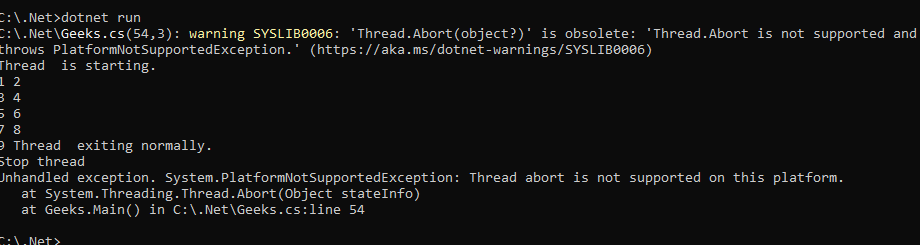
Example:
Output:
Note:Abort(Object) is also not in used in newer versions and if we try to to execute the above program it will give the warning as shown in the output picture.
CancellationToken allows us to politely request that a thread should stop its work. It is recommended to use in newer versions. We need to create a CancellationTokenSource object and pass its token to the thread.
Syntax
CancellationTokenSource tokenSource = new CancellationTokenSource(); // create object
Thread workerThread = new Thread(() => LongRunningOperation(tokenSource.Token));
if (token.IsCancellationRequested)
{
// Perform cleanup and exit
return;
}
tokenSource.Cancel();
Example:
Working... Step 1
Working... Step 2
Working... Step 3
Work completed.
Main thread exits.
We can also terminate a thread manually just like creating a flag that the thread checks regularly to see if it should stop. This is a manual and simple method, but it requires the thread to periodically check the flag and decide when to exit.
Syntax
private volatile bool stopRequested; // Flag to signal thread termination
public void DoWork()
{
while (!stopRequested) // Check flag periodically
{
// Thread work hereConsole.WriteLine("Working...");
Thread.Sleep(100); // Simulate work
}}
public void RequestStop() => stopRequested = true;
Example:
Working... Step 1
Working... Step 2
Stop requested, terminating the thread.
Main thread exits.