LINQ (Language Integrated Query) is a feature in C# that provides a way to query and manipulate data from different sources such as collections, databases, XML or objects. It integrates query capabilities directly into the C# language using a set of query operators and extension methods.
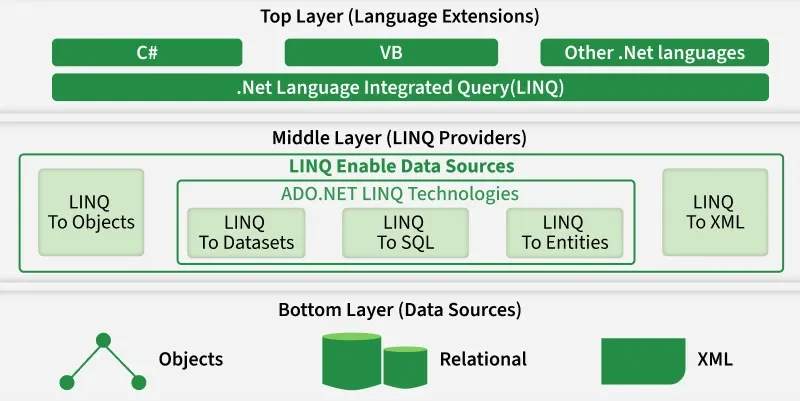
Top Layer (Language Extensions): Integrates query capabilities directly into C# and VB.NET using query syntax and lambda expressions.
Middle Layer (LINQ Providers): Translates queries into the format understood by different data sources (e.g., LINQ to Objects, LINQ to SQL, LINQ to XML).
Bottom Layer (Data Sources): The actual data collections, typically objects implementing IEnumerable<T> or IQueryable<T>, such as arrays, lists, databases or XML documents.
Types of LINQ
LINQ in C# is categorized into several types based on the data source it works with. Some of them are:
1. LINQ to Objects
Works with in-memory collections like arrays, List<T>, Dictionary<TKey, TValue>, etc.
Use Case: Query, filter, sort and transform data directly in collections without writing loops.
2. LINQ to SQL
Works with SQL Server database.
Use Case: Converts LINQ queries into SQL commands and executes them on the database. Useful for strongly typed, compile-time checked queries.
3. LINQ to XML
Works with XML documents (XElement, XDocument).
Use Case: Simplifies reading, querying and updating XML data with LINQ syntax instead of manual XML parsing.
4. LINQ to Entities
Works with Entity Framework models connected to relational databases.
Use Case: Enables database queries at an object level using entities instead of raw SQL.
5. LINQ to DataSet
Works with DataSet and DataTable objects in ADO.NET.
Use Case: Useful in disconnected environments where data is fetched into a DataSet and then LINQ is applied for filtering or transformation.
Benefits of using LINQ
Simplifies querying of arrays, collections, XML, SQL and entities
Reduces code length and improves readability compared to loops or delegates
Provides compile-time type checking and IntelliSense support
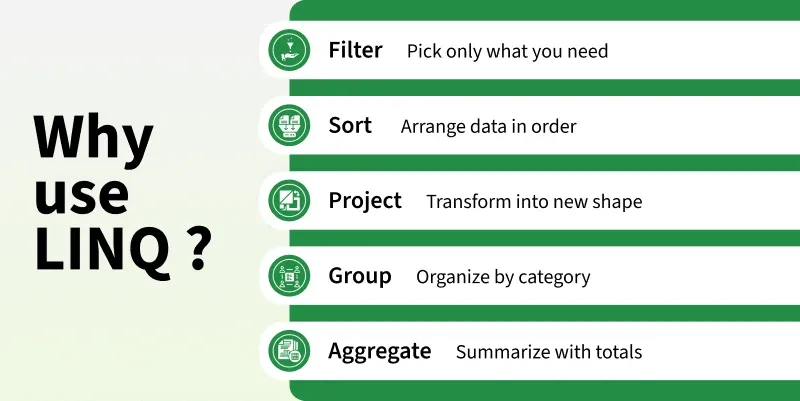
Supports filtering, sorting, grouping and data transformations
Enables reusable queries across different data sources without learning new query languages
Integrates seamlessly with C# for easier debugging