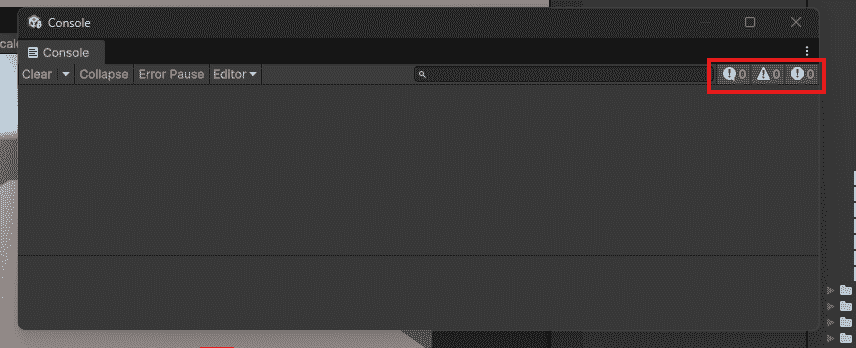
The Console window displays messages from Unity and your scripts. It helps you find errors, track variable values and understand what your game is doing.
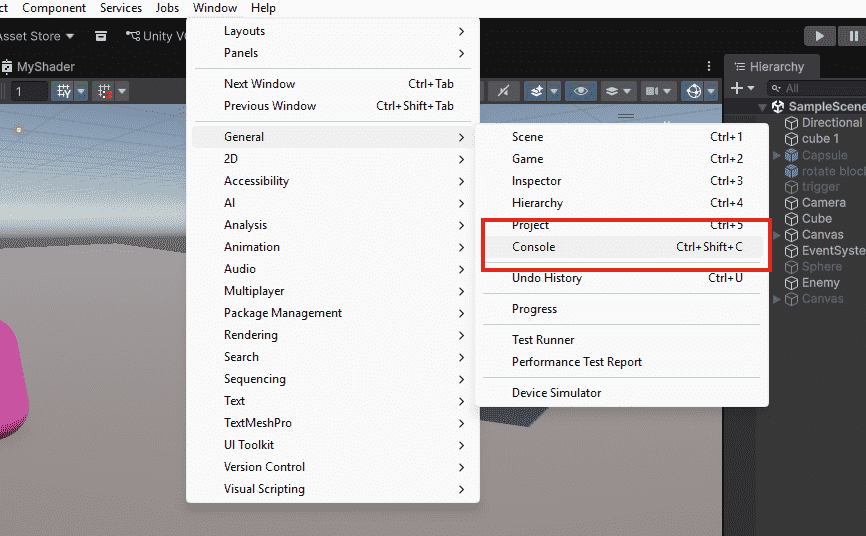
Errors (red): Game-breaking issues that stop something from working. Warnings (yellow) : Potential problems that might cause issues. Logs (white) : Information you print with Debug.Log(). 👁 Console-Window-In-Unity Console Window In Unity Opening the Console Method 1 : Window -> General -> Console. Method 2 : Ctrl + Shift + C (Windows) or Cmd + Shift + C (Mac). The Console usually docks at the bottom of Unity by default.
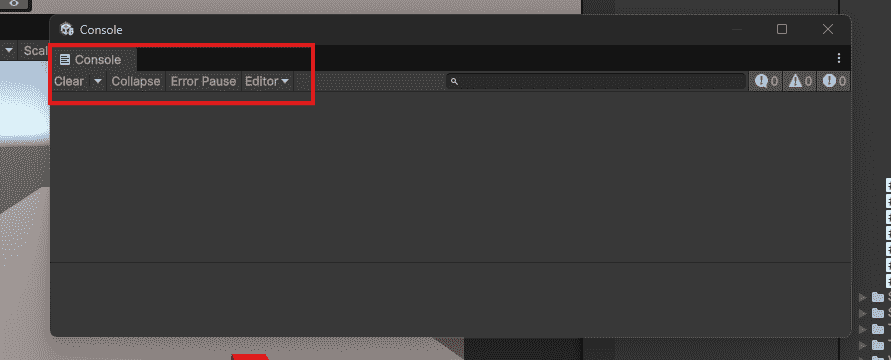
👁 Opening-the-Console-In-Unity Opening Console Window In Unity Console Toolbar Buttons The top of the Console has several important buttons:
Clear : Removes all messages. Collapse : Groups identical messages and shows count. Clear on Play : Clears Console when Play mode starts. Error Pause : Pauses the game automatically on errors. Filter by Type : Show/hide Logs, Warnings, or Errors. 👁 Console-Toolbar-Buttons-In-Unity Console Unity Buttons Clicking on Messages Click any message in the Console. Unity automatically opens the script at the exact line that created it.
Double-click: Opens script at that line. Right-click: Copy message text or open full stack trace. Filtering Messages Use the filter buttons to focus on specific message types:
Logs : Your debug messages. Warnings : Potential issues. Errors : Actual problems. Toggle off Logs to hide them. Only see Errors and Warnings.
Clearing Console from Script Example :
Attach to a button for a "Clear Console" button in your game.
Common Console Messages NullReferenceException: You tried to use something that doesn’t exist. MissingReferenceException: Object was destroyed but still accessed. IndexOutOfRangeException: Array index is invalid. CS1002: Missing semicolon. CS0103: Variable name doesn’t exist (typo).