|
VOOZH | about |
|
VOOZH | about |
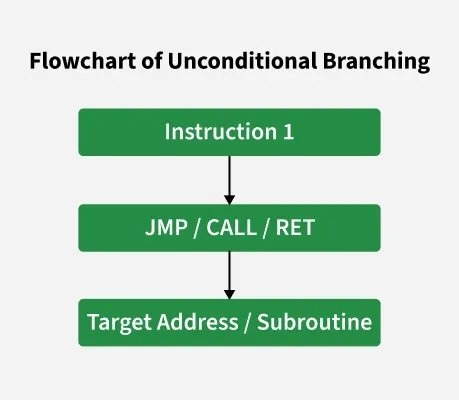
Branching is the process of directing program control to a different memory location instead of executing instructions sequentially, and it can be either conditional or unconditional.
Following are three types of unconditional branching:
The JMP (Jump) instruction unconditionally transfers control to a specified memory address by updating the Program Counter (PC). For example, JMP 2050 redirects execution to address 2050. It is mainly used for creating loops, skipping code sections, or jumping to specific program routines.
| OPCODE | OPERAND | EXAMPLE |
|---|---|---|
| JMP | address | JMP 2050 |
The CALL instruction transfers control to a subroutine at a specified address while saving the current Program Counter (PC) on the stack. For example, CALL 2050 jumps to the subroutine at address 2050. It is mainly used in modular programming to execute reusable routines like input/output or display functions.
| OPCODE | OPERAND | EXAMPLE |
|---|---|---|
| CALL | address | CALL 2050 |
The RET instruction returns program control from a subroutine to the calling function. When executed, it retrieves the saved return address from the stack and loads it into the Program Counter (PC), allowing execution to continue from where the subroutine was called. It is typically placed at the end of a subroutine to ensure proper program flow.
| OPCODE | OPERAND | EXAMPLE |
|---|---|---|
| RET | none | RET |
In unconditional branching, the Program Counter (PC) is updated to alter the normal sequence of execution. Some instructions also use the stack to save or restore return addresses when calling or exiting subroutines.
Branching — both conditional and unconditional — is a fundamental aspect of program control flow. It allows programs to change the sequence of instruction execution, making decision-making, repetition, and modular code possible.
| Use Case | Explanation |
|---|---|
| Loop Creation | Branching enables loops like for, while, and do-while by controlling repeated execution. |
| Conditional Execution | Programs can execute specific blocks only if certain conditions are met (e.g., if-else). |
| Function and Subroutine Handling | Allows calling reusable blocks of code and returning after execution. |
| Program Segmentation | Branching enables modular code by jumping between different code sections. |
| Error Handling | Enables jumping to error-handling routines based on specific conditions. |
| Code Optimization | Unreachable or unnecessary code can be skipped using branching logic. |
| Interrupt Handling | Branching is used in handling interrupts by jumping to interrupt service routines. |