|
VOOZH | about |
|
VOOZH | about |
The two basic classifications of parallel processing are SIMD which stands for Single Instruction Multiple Data and MIMD which stands for Multiple Instruction Multiple Data. The use of SIMD enables the processing of many data with a single instruction and is applicable to most operations that are uniform such as image processing. On the other hand, MIMD permits different instructions on different data items to be performed hence making it more versatile for versatile applications, simulation applications, and multitasking applications. Comparing SIMD and MIMD allows the decision on what architecture to use when concentrating on a certain kind of computational problem.
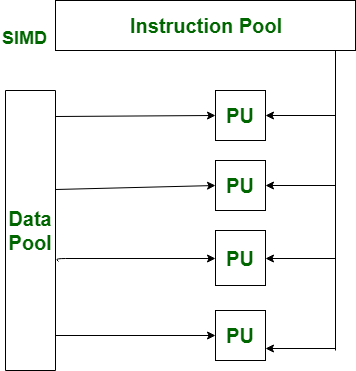
SIMD stands for Single Instruction Multiple Data that is a specialized type of computer architecture in which the processors perform all calculations on a series of data at one time. This architecture is ideal for those applications that involve the same operation to be done on large sets such as multimedia and scientific simulations. The SIMD can be done on different types of hardware such as; the CPU with simultaneous multiple data hardware such as the Intel SSE or the AVX and the GPU hardware.
MIMD or Multiple Instruction, Multiple Data is a type of parallel processing where in many processors handle various instructions on various data at the same time. This architecture allows for a great degree of adaptability and the system can be used for a wide range of applications, from realistic modeling to multi-threaded program. MIMD systems find more application in the current multi-core processors and distributed computational platforms.
| S.NO | SIMD | MIMD |
|---|---|---|
| 1. | SIMD stands for Single Instruction Multiple Data. | While MIMD stands for Multiple Instruction Multiple Data. |
| 2. | SIMD requires small or less memory. | While it requires more or large memory. |
| 3. | The cost of SIMD is less than MIMD. | While it is costlier than SIMD. |
| 4. | It has single decoder. | While it have multiple decoders. |
| 5. | It is latent or tacit synchronization. | While it is accurate or explicit synchronization. |
| 6. | SIMD is a synchronous programming. | While MIMD is a asynchronous programming. |
| 7. | SIMD is a simple in terms of complexity than MIMD. | While MIMD is complex in terms of complexity than SIMD. |
| 8. | SIMD is less efficient in terms of performance than MIMD. | While MIMD is more efficient in terms of performance than SIMD. |
These include the SIMD and MIMD classifications of parallel processing; each has its own advantages and disadvantages. What arises here is that SIMD is highly optimized for data parallelism of the same kind, which manifests great performance and favorable efficiency of working on specific tasks, for instance, multimedia. On the other hand, MIMD is more elastic and modular, which predisposes it for various and complicated assignments. Depending on the nature of the job and the kind of environment that is being used in the computation, the SIMD or the MIMD can best be used.