VOOZH about

URL: https://www.geeksforgeeks.org/computer-organization-architecture/differences-between-data-paths/

⇱ Data Path Components and Designs - GeeksforGeeks


  • Courses
  • Tutorials
  • Interview Prep

Data Path Components and Designs

Last Updated : 14 Oct, 2025

In computer architecture, the datapath is a core part of the CPU that executes instructions by processing and transferring data. It includes components like registers, ALUs, multiplexers, and buses, all coordinated by control signals from the control unit.

  • Performs arithmetic, logic, data storage, and transfer operations.
  • Operates under the control unit, which directs data flow through control signals.

Types of Datapath Designs

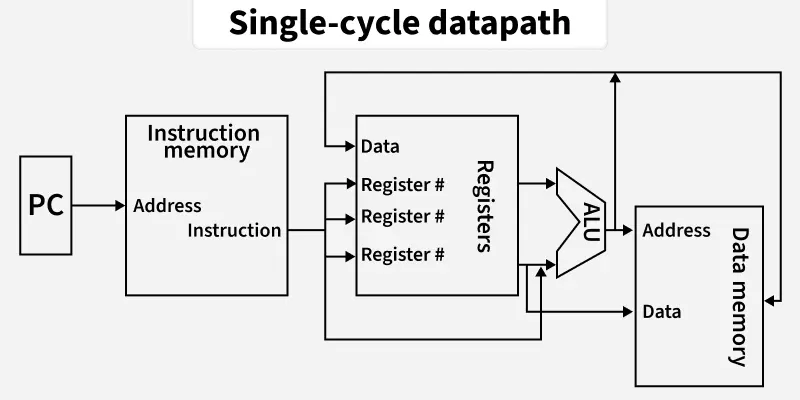
1. Single-Cycle Datapath

Each instruction is completed in a single clock cycle, performing all steps in one go. It's simple but inefficient due to the long cycle time.

  • All instruction stages (fetch to write-back) occur in one long clock cycle.
  • Executes one instruction at a time with no overlapping.
  • Simple design with no extra registers or complex control.
👁 1

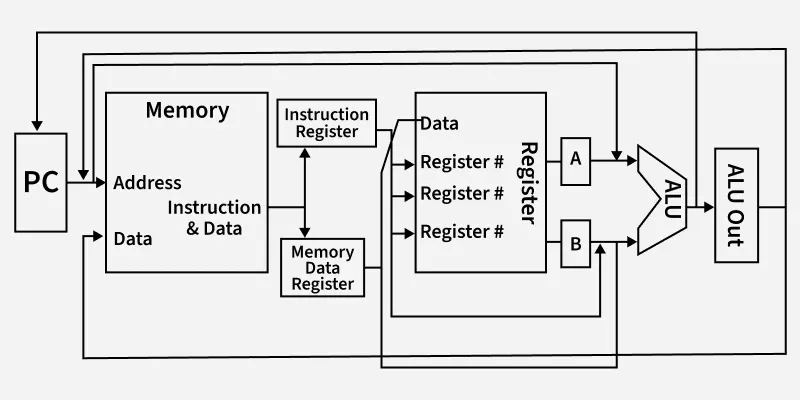
2. Multi-Cycle Datapath

Instructions are broken into multiple steps, each taking one clock cycle. This allows for better efficiency with more complex control logic.

  • Instruction is split across multiple short cycles, using extra registers between stages.
  • Only one instruction is executed at a time, still without overlapping.
  • More efficient than single-cycle but requires complex control logic.
👁 2
Multi-cycle Datapath

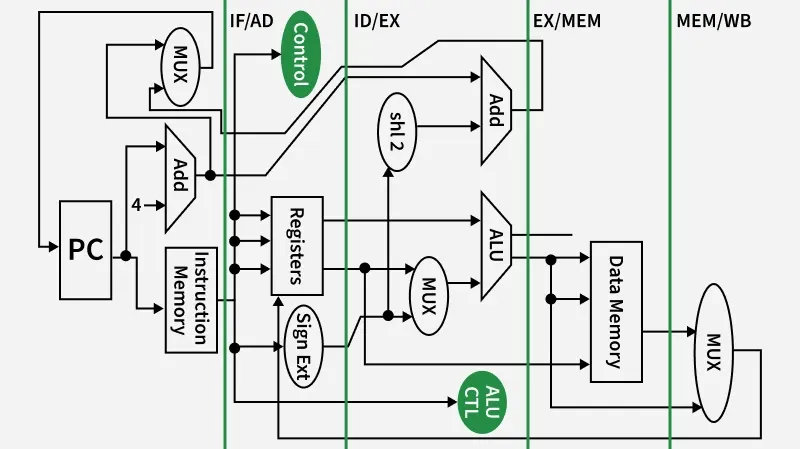
3. Pipelined Datapath

Instruction execution is divided into fixed stages, allowing multiple instructions to be processed simultaneously. This improves throughput but introduces complexity.

  • Multiple instructions are executed in parallel, each at a different stage.
  • Uses short clock cycles with extra registers between pipeline stages.
  • High performance but needs hazard detection and handling logic.
👁 20
Pipelined Datapath

Note: Single-cycle uses a longer clock cycle for all instructions while multi-cycle and pipelined designs use shorter, more efficient cycles.

Main Components of a Datapath

Key hardware elements involved in executing instructions by processing and transferring data.

  1. Registers: Temporary storage for data and intermediate results (e.g., PC, IR).
  2. Register File: A collection of registers with multiple read/write ports for fast access.
  3. ALU (Arithmetic Logic Unit): Performs arithmetic and logical operations on data.
  4. Multiplexers (MUX): Select one of several input signals based on control inputs.
  5. Memory: Stores instructions and data for read/write operations during execution.
  6. Sign/Zero Extender: Extends immediate values to match the datapath's bit-width.
  7. Shift Units: Performs bit-level shifts, often used in address or data calculations.
  8. Buses: Shared data lines for transferring information between components.
  9. Control Signals: Guide the operation of all datapath elements during instruction execution.
Comment

Explore