This article is about a decoding technique using the
74139, a 2-to-4 decoder.
The above mentioned device has two 2-to-4 decoders inside, one is used for interfacing I/O ports and the second is used for interfacing memory.
Let's see I/O interfacing:
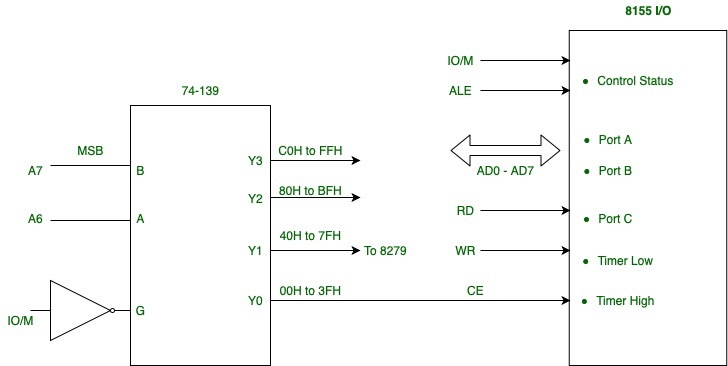
- The input to the decoder are the address lines A7 and A6.
- The decoder is enabled by the IO/M signal through an inverter.
- Whenever the processor asserts IO/M high to access an I/O port, the decoder becomes active.
- The address lines A5-A0 are not decoded in this schematic, some of them are connected to programmable I/O devices such as the 8155 and 8279
The figure will look something like this:
👁 Image
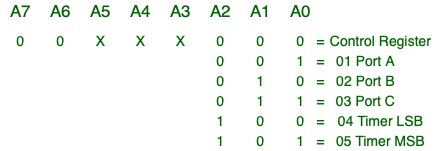
8155 I/O Addresses:
👁 Image
8279 I/O Addresses:
👁 Image
Multiple I/O Addresses:
The
8279 needs only two addresses, but because of the five don't care lines, it occupies the space of 64 I/O addresses. In the case of the
8155, three addresses lines don't care; therefore, it has eight sets of address ranges for its I/O ports and the timer.
Advantages:
- Save Costs
- Save Space