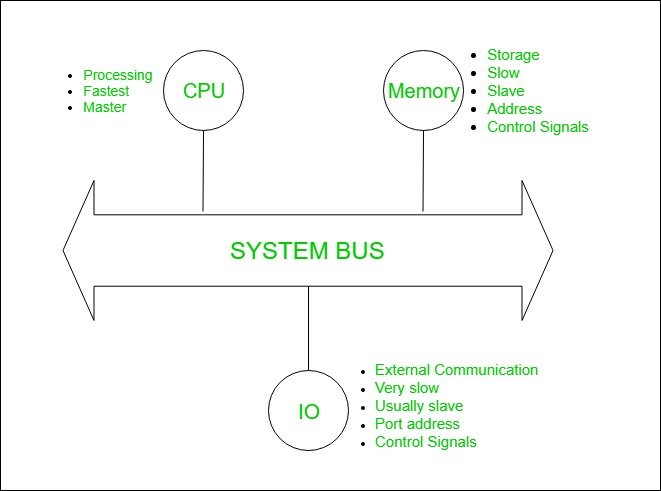
System bus design refers to the architecture and layout of communication pathways that transfer data, addresses, and control signals among core components like the CPU, memory, and I/O devices. It acts as a shared communication channel — like a highway — enabling efficient data exchange and influencing overall system performance.
- A system bus consists of parallel conductors (wires, PCB tracks, or chip-level trails), where each wire carries one bit; the total number of wires determines the data word size (e.g., 8-bit, 16-bit, etc.).
- It is a shared transmission medium, meaning only one device can transmit data at a time.
👁 Image
Categories of System Buses
System bus contains 3 categories of lines used to provide the communication between the CPU, memory and IO.
1. Address Lines
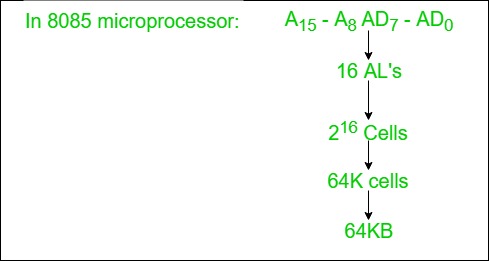
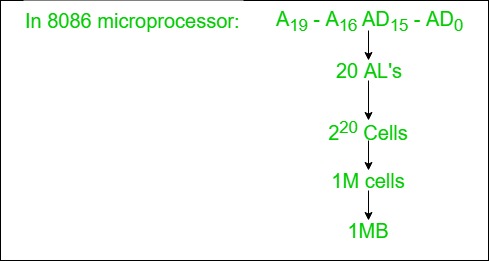
The address lines carry addresses from the CPU to memory and I/O devices and are unidirectional.
- They transmit signals only from the CPU to memory or I/O.
- The width of the address lines determines the maximum capacity of the main memory.
👁 Image
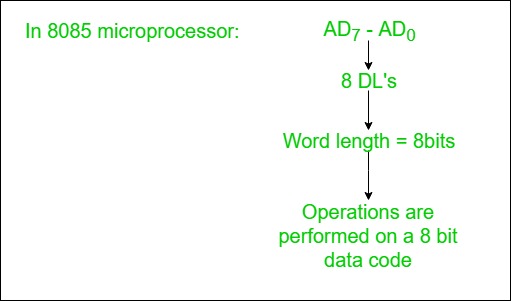
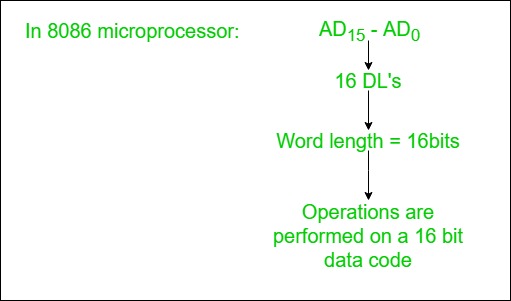
The data lines carry binary data between the CPU, memory, and I/O devices and are bidirectional.
- They transmit data both to and from the CPU, memory, and I/O.
- The width of the data lines determines the CPU’s word length, which affects the CPU’s performance.
👁 Image
👁 Image
3. Control Lines
Control lines carry control and timing signals between the CPU, memory, and I/O devices.
- Control signals indicate the type of operation, such as Memory Read, Memory Write, I/O Read, or I/O Write, ensuring components know what action to perform.
- Timing signals synchronize memory and I/O operations with the CPU clock to coordinate data transfers and prevent errors.
- Typical control lines include Memory Read/Write, I/O Read/Write, Bus Request/Grant, Interrupt Request, and Clock signals.
- Control signals also manage bus arbitration, allowing multiple devices to communicate efficiently without conflicts.
- Without control signals, the system would lack coordination, causing data corruption, timing issues, and malfunction.