|
VOOZH | about |
|
VOOZH | about |
The nth-last-child() selector in CSS is used for selecting elements based on their position among sibling elements, but starting the count from the end rather than the beginning. This selector is particularly useful for styling elements dynamically based on their order in reverse, allowing for flexible and responsive design solutions. Understanding how to effectively use the nth-last-child() selector can enhance your CSS skills and enable more precise control over the styling of your web pages.
The nth-last-child() selector takes a single argument that determines the pattern for matching elements from the end. This argument can be a number, keyword (odd or even), or a functional notation.
:nth-last-child(number) {
 //CSS Property }
odd, even, or a functional notation like An+B.An+B from the end, where A and B are integers. For every positive integer or zero value of n, the position of elements is determined.In this example, the formula 2n+1 is used to select every odd element counting from the end.
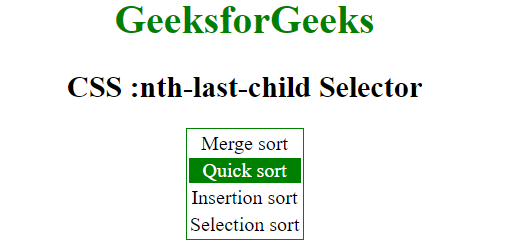
In this example, the formula 2n is used to select every even element counting from the end.
Output:
The nth-last-child() selector in CSS allows developers to apply styles dynamically based on the reverse order of sibling elements. This capability is essential for creating sophisticated and responsive web designs. By leveraging this selector, you can enhance the flexibility and control of your CSS, leading to more maintainable and visually appealing web pages.
Supported Browsers: The browser supported by :nth-last-child selector are listed below: