|
VOOZH | about |
|
VOOZH | about |
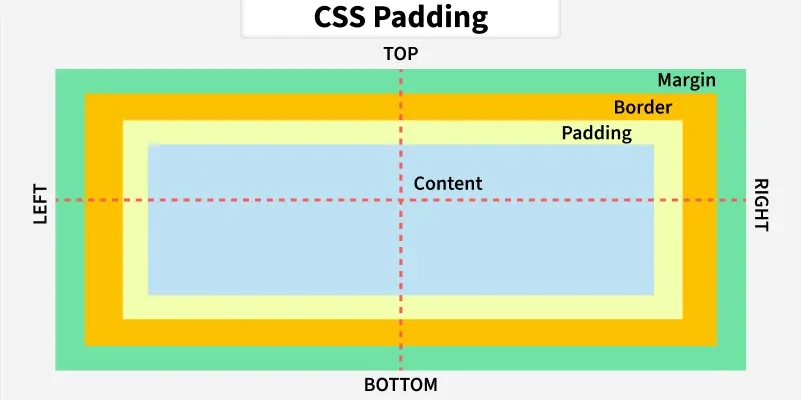
CSS Padding property is used to create space between the element's content and the element's border. It only affects the content inside the element.
CSS provides properties to specify padding for individual sides of an element which are defined as follows:
Padding properties can have the following padding values:
Example: To demonstrate using the padding property in which we apply padding to each side of the div individually.
Syntax:
/* Applying padding to each side individually */
.myDiv
{ padding-top: 80px;
 padding-right: 100px;
 padding-bottom: 50px;
 padding-left: 80px;
}
The Shorthand Padding Property in CSS allows you to set the padding on all sides (top, right, bottom, left) of an element in a single line with some combinations, so we can easily apply padding to our targeted element.
There are four cases while using shorthand property:
If the padding property has one value, then it applies padding to all sides of an element. For example padding: 20px applies 20 pixels of padding to all sides equally.
.element {
 /* Applies 20px padding to all sides */
 padding: 20px;
}
Example: To demonstrate applying 20px padding to all sides of div.
If the padding property contains two values, then the first value applies to the top and bottom padding, and the second value applies to the right and left padding. For Example - padding: 10px 20px i.e. top and bottom padding are 10px while right and left padding is 20px.
.element {
 /* Applies 10px padding to top and bottom,
 20px padding to right and left */
 padding: 10px 20px;
}
Example: To demonstrate using a padding property with two values.
If the padding property contains three values, then the first value sets the top padding, the second value sets the right and left padding, and the third value sets the bottom padding.
For Example - padding: 10px 20px 30px;
.element {
 /* Applies 10px padding to top,
 20px padding to right and left,
 30px padding to bottom */
 padding: 10px 20px 30px;
}
Example: Here, we are using padding with three values.
If the padding property contains four values, then the first value sets the top padding, the second value sets the right padding, the third value sets the bottom padding, and the fourth value sets the left padding.:
For Example - padding: 10px 20px 15px 25px;
.element {
 /* Applies 10px padding to top,
 20px padding to right,
 15px padding to bottom,
 and 25px padding to left */
 padding: 10px 20px 15px 25px;
}
Example: To demonstrate using a padding property with four values.
Combining individual side properties and shorthand properties, there are 5 total properties of CSS padding:
| Property | Description |
|---|---|
| padding | shorthand property for setting all the padding properties in one declaration |
| padding-bottom | Sets the bottom padding of an element |
| padding-left | Sets the left padding of an element |
| padding-right | Sets the right padding of an element |
| padding-top | Sets the top padding of an element |