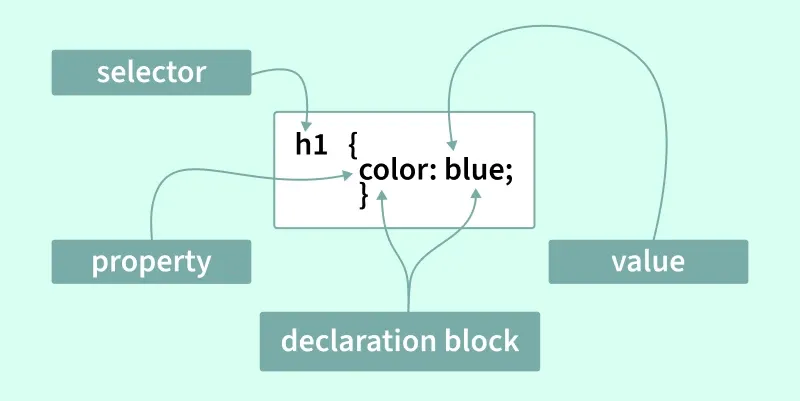
CSS syntax defines how CSS rules are written so that browsers can interpret and apply them to HTML elements. It is useful for styling and designing web pages efficiently.
It defines how styles are applied to HTML elements. It uses selectors to target elements. It consists of properties and values inside a declaration block. 👁 diagram_of_a_css_rule Selector : Targets the HTML element "h1" to apply styles. Declaration Block : Enclosed in curly braces { }, contains one or more declarations. Property : Specifies the style attribute, here "color" for text color. Value : Defines the property's setting, here "blue" for the text hue. Overall Structure : Forms a complete CSS rule: h1 { color: blue; }, styling h1 headings blue. h1: This selector targets all <h1> elements on the page. The style applied to <h1> will set the text color to blue and the font size to 24px. p: This selector targets all <p> elements. The text color will be green and the font size will be 16px. Declaration Block in CSS Syntax Each declaration consists of a property and a value, separated by a colon, and each declaration is followed by a semicolon:
1. Properties: Properties are the aspects of the selected elements you want to style (like color, width, height, etc.).
color: Defines the text color. background-color: Defines the background color of an element. font-size: Sets the size of the font. margin: Specifies the space around an element. padding: Defines the space between the element's content and its border. 2. Values: Values define the specifics of the property you want to apply, such as a color name, a number (e.g., 16px), or percentages (e.g., 50%).