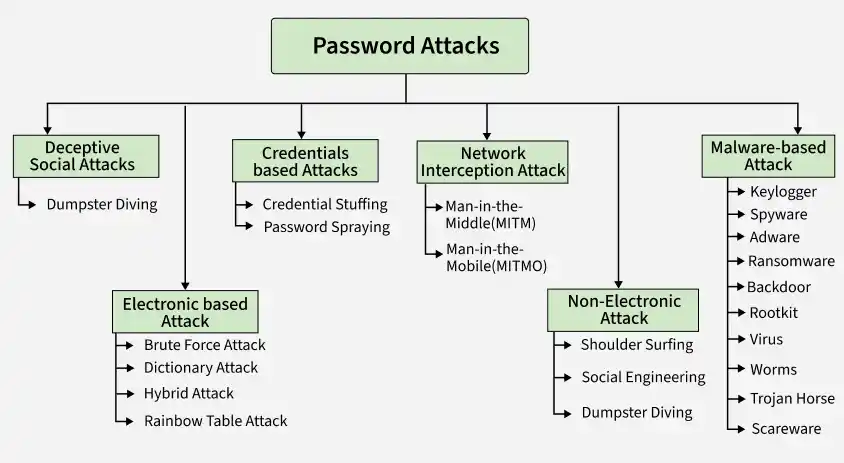
Password Attack (Password Cracking) occurs when attackers attempt to gain unauthorized access to accounts by guessing or stealing passwords using automated tools and systematic techniques to break authentication and access sensitive information.
Exploits weak, reused or easily guessable passwords.
Uses methods like brute force and dictionary-based attacks.
Targets user accounts to gain unauthorized access to data.
Suppose you create a LinkedIn account with an easy password like "pooja123" or your date of birth is 01/01/1983 and you use the same password for your Facebook and other accounts too. If a hacker cracks your LinkedIn password, they can instantly access your Facebook account and every other account using that with same password. This is why password reuse is extremely dangerous.
In this attack, attackers do not require advanced technical skills or hacking tools. Instead, they rely on observation, deception and human weaknesses to obtain confidential and sensitive information.
Shoulder surfing: An attacker observes a person entering passwords or sensitive information by looking over their shoulder or using devices such as cameras or binoculars.
Social Engineering: Attackers manipulate trust and human behavior to trick victims into revealing passwords or confidential information by impersonating trusted individuals or creating urgency.
Dumpster Diving: Attackers search discarded documents, notes or other materials to find passwords, login credentials or sensitive information.
2. Electronic Password Cracking Attacks
These attacks leverage computational power and automated tools to systematically guess or crack passwords.
Brute Force Attack: Attackers try numerous password combinations until the correct one is found. Weak passwords are especially vulnerable to this method.
Dictionary Attack: Uses lists of common passwords, words and leaked credentials to guess passwords quickly.
Hybrid Attack: Combines dictionary attacks with brute force techniques by adding numbers, symbols or variations to common words.
Rainbow Table Attack: Uses precomputed hash tables to crack encrypted passwords and recover the original password values.
3. Credential-Based Attacks
These attacks exploit stolen or leaked credentials from previous data breaches.
Credential Stuffing: Attackers use stolen username-password pairs from previous breaches to access accounts where users have reused the same credentials.
Password Spraying: Attackers try a few common passwords across many accounts to avoid account lockouts and gain unauthorized access.
4. Network Interception Attacks
These attacks intercept passwords during transmission over networks via internet connected devices.
Man-in-the-Middle (MITM) Attack: Attackers intercept communication between a user and a legitimate service to steal credentials or redirect victims to fake websites, often on unsecured networks.
Man-in-the-Mobile (MITMO) Attack: Attackers compromise a mobile device through malicious apps or files to steal sensitive information and send it to the attacker.
5. Deceptive Social Attacks
These attacks use psychological manipulation and impersonation to steal credentials.
Phishing Attack: Attackers impersonate trusted organizations through emails, messages or calls to trick users into revealing passwords or other sensitive information on fake websites.
6. Malware-Based Attacks
These attacks use malicious software to capture passwords, sensitive and confidential information directly from devices.
Keylogger Attack: Records keystrokes to capture usernames, passwords and other sensitive information.
Spyware: Secretly monitors user activity and steals personal data, passwords and browsing information.
Adware: Displays unwanted ads and may redirect users to malicious websites.
Ransomware: Encrypts or locks data and demands payment to restore access.
Backdoor: Allows attackers to bypass authentication and gain unauthorized system access.
Rootkit: Hides malicious activities and provides attackers with persistent access to a system.
Virus: Attaches to files and spreads through user actions, potentially damaging data and systems.
Worms: Self-replicating malware that spreads across networks without user interaction.
Trojan Horse: Malicious software disguised as a legitimate application to steal data or compromise systems.
Scareware: Uses fake security warnings to trick users into installing malware or revealing sensitive information.
Best Practices to Protect Your Passwords
Create Strong Passwords: Use at least 12 characters with a mix of letters, numbers and symbols.
Avoid Password Reuse: Use a unique password for every account.
Enable MFA: Add an extra verification step to improve account security.
Change Passwords Regularly: Update passwords periodically, especially for important accounts.
Use a Password Manager: Store and generate strong passwords securely.
Follow Additional Security Measures: Never share passwords, avoid storing them in plain text and change default passwords immediately.
Note: A strong password is long, complex and unique never reused across multiple accounts. Combined with multi-factor authentication and regular password updates, you can significantly reduce your risk of falling victim to password attacks.