|
VOOZH | about |
|
VOOZH | about |
The Exponential Distribution is one of the most commonly used probability distributions in statistics and data science. It is widely used to model the time or space between events in a Poisson process. In simple terms, it describes how long you have to wait before something happens, like a bus arriving or a customer calling a help center.
For example, if buses arrive at a bus stop every 15 minutes on average, the time you wait for the next bus can be modelled using an exponential distribution.
The probability density function of the exponential distribution is:
Where:
The cumulative distribution function gives the probability that the event occurs within time :
The exponential distribution is memory-less, which means:
This property tells us that the probability of waiting longer does not depend on how long you've already waited. This is unique to the exponential distribution.
Suppose calls come into a customer support center at an average rate of 2 per minute. What is the probability that you wait more than 30 seconds for the next call?
Solution:
So, there is about a 36.79% chance that the next call comes after 30 seconds.
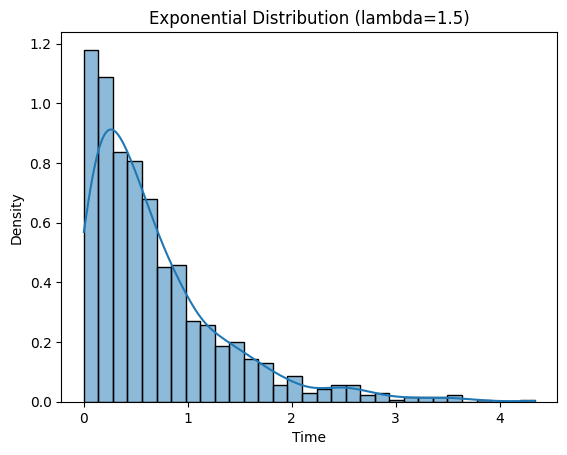
Before its implementation we should have some basic knowledge about numpy, matplotlib and seaborn.
Output:
Note: The exponential distribution is closely related to the Poisson distribution. If events occur following a Poisson process with rate , then the time between events is exponentially distributed with parameter .