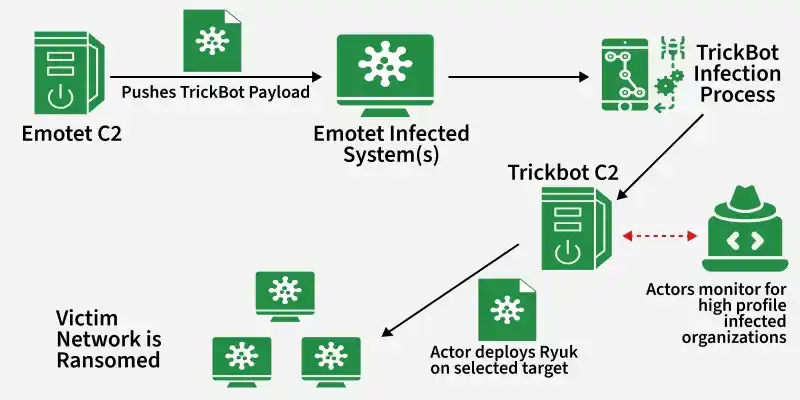
Modern cyberattacks are no longer isolated incidents-they are carefully orchestrated, multi-stage operations designed to maximize impact. Rather than relying on a single piece of malware, attackers now deploy a chain of specialized tools, each performing a distinct role in the intrusion lifecycle.
Malware Staging: Emotet establishes foothold and drops additional payloads
Lateral Movement & Recon: TrickBot spreads, steals credentials, maps network
Privilege Escalation: Attackers gain higher-level access
Ransomware Execution: Ryuk encrypts systems and demands ransom
Background Context
Malware supply chain was operated by cybercriminal partnerships rather than a single threat group, demonstrating the rise of malware-as-a-service (MaaS) models .Between 2018 and 2021, many public and private sector organizations (especially in healthcare, finance, education and manufacturing) experienced coordinated ransomware incidents involving the following sequence:
Emotet: Acted as the initial loader, entering systems via phishing.
TrickBot: Used for credential theft, reconnaissance and network propagation.
Ryuk:Ransomware was the final payload used to encrypt and extort.
The attack typically begins with a phishing email crafted to appear legitimate-often impersonating invoices, shipping notifications or trusted business communications. These emails frequently include malicious Microsoft Word or Excel attachments that prompt users to enable macros. Once macros are enabled, Emotet is executed.
Objective: Establish initial access and persistence.
Activity: Emotet downloaded additional payloads and communicated with its Command and Control (C2) servers over HTTPS.
Result: The attacker gained a foothold within the victim network.
2. Secondary Infection: TrickBot
After gaining a foothold, Emotet deploys TrickBot, a modular malware platform designed for credential theft and network reconnaissance.
Objective: To expand access within the network and prepare for lateral movement.
Activity: TrickBot extracted credentials from web browsers, Windows accounts and Active Directory, while conducting SMB enumeration to map shared drives and identify high-value targets.
Result: The attackers successfully escalated privileges, ultimately gaining domain-level control across the organization’s network.
3. Final Payload: Ryuk Ransomware
Once TrickBot completed its reconnaissance and credential theft, the attackers deployed Ryuk ransomware across the compromised network.
Objective: To encrypt critical systems and extort the organization for financial gain.
Activity: Ryuk used a hybrid encryption scheme, employing AES for file encryption and RSA for securing encryption keys, while appending the “.RYUK” extension to all encrypted files.
Result: The attack caused a complete operational shutdown, with a ransom note demanding millions in Bitcoin for decryption keys and data restoration.
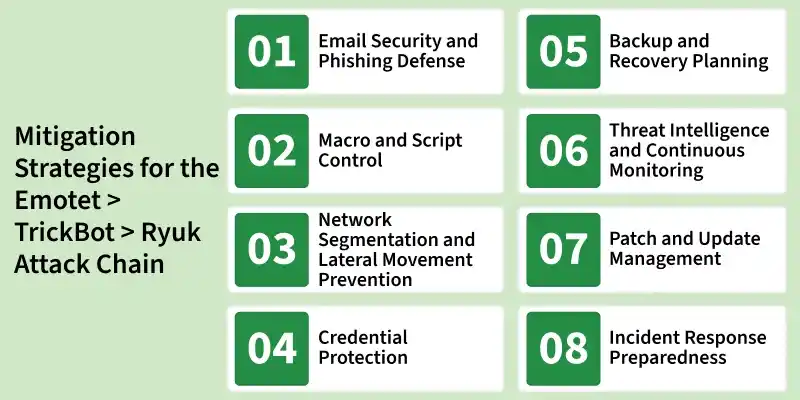
Mitigation Strategies for the Emotet > TrickBot > Ryuk Attack Chain
There are several layers of mitigation strategies to defend against the Emotet > TrickBot > Ryuk attack chain: