|
VOOZH | about |
|
VOOZH | about |
Social engineering is a type of cyber attack where hackers trick people into sharing sensitive information like passwords, bank details, or personal data. Instead of breaking into systems, attackers manipulate human emotions such as trust, fear, or curiosity to gain access.
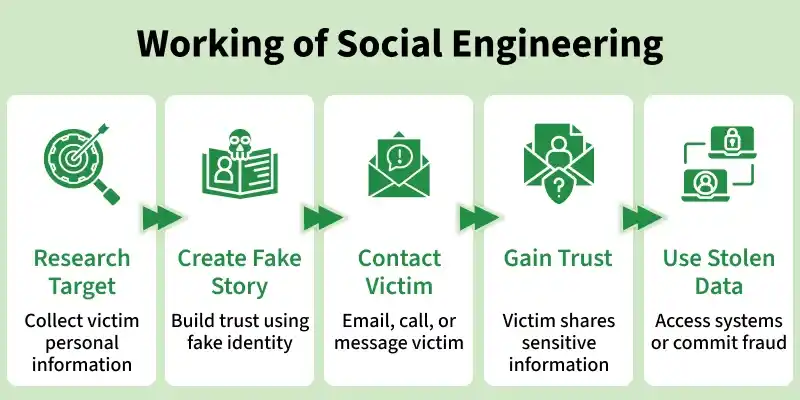
While social engineering attacks don't follow a fixed strategy, as attackers often adapt their tactics based on the victim, situation, and context, there are certain common elements that most social engineers employ. These key factors include:
Before launching a social engineering attack, the attacker spends time gathering information. This phase is critical to the success of the attack. The attacker may collect publicly available information about the target through:
This information helps the attacker craft a believable and tailored message, increasing the likelihood of success.
The attacker develops a pretext, story designed to gain the trust of the victim. For example:
The goal is to exploit the victim's natural tendency to trust familiar sources, especially in a work or personal context.
After the pretext is established, the attacker engages with the victim. The attack may take different forms:
Once the victim responds, the attacker exploits the trust established through the pretext. This could involve:
After successfully obtaining the desired information or access, the attacker can:
Social engineers are often skilled at erasing signs of their presence. After exploiting the victim, they may:
This stage ensures the attacker remains undetected for a longer period, allowing them to continue exploiting the situation or sell the data they have stolen.
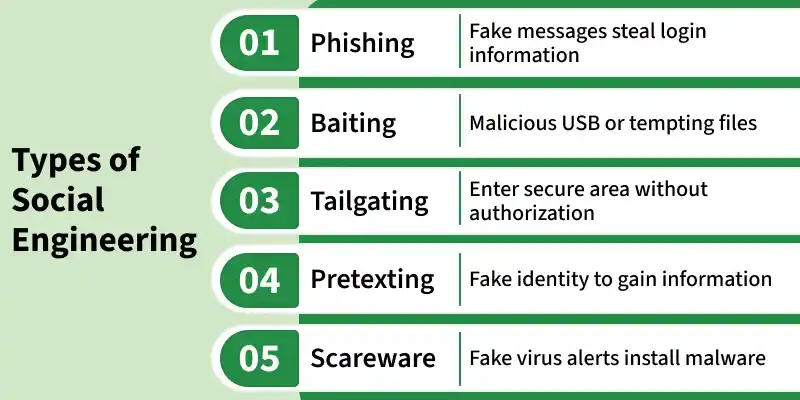
There are many different types of social engineering attacks, each of which uses a unique approach to exploit human weaknesses and gain access to sensitive information. Here are some of the types of attacks, include:
Phishing is a type of social engineering attack that involves sending an email or message that appears to be from a legitimate source, such as a bank, in an attempt to trick the recipient into revealing their login credentials or other sensitive information.
Baiting is a type of social engineering attack that involves leaving a tempting item, such as a USB drive, in a public place in the hope that someone will pick it up and plug it into their computer. The USB drive is then used to infect the computer with malware.
Tailgating is a type of social engineering attack that involves following an authorized individual into a secure area, such as a building or data center, without proper authorization.
Pretexting is a type of social engineering attack that involves creating a false identity or situation in order to trick an individual into revealing sensitive information. For example, an attacker might pretend to be a customer service representative in order to trick an individual into giving them their login credentials.
Scareware is when the victim is sent false messages claiming their system is infected with a malware, or outdated, suggesting them to download softwares to resolve the issue. Downloading the software would lead to the attackers gaining access to the system.
Social engineering attacks rely on manipulating human psychology rather than exploiting technical vulnerabilities, making it important for individuals to remain vigilant and proactive. Below are some strategies to adopt by an individual to prevent from falling victim to these attacks:
Phishing emails often appear legitimate but contain malicious links or attachments designed to steal personal information or install malware. Always be cautious when receiving unsolicited emails, especially those requesting sensitive data or action.
Multi-factor authentication (MFA) adds an extra layer of security by requiring more than just a password. This reduces the risk of unauthorized access, even if your password is compromised.
Cyber attackers often use enticing offers to lure victims into clicking malicious links or downloading infected files. Be cautious of "too good to be true" deals.
Social engineering attacks can have severe consequences for organizations, as they exploit human behavior and manipulate individuals into divulging sensitive information or performing actions that compromise security. The impact of a successful social engineering attack can range from financial losses and data breaches to long-term reputational damage. This losses include:
Competitors may utilize social engineering procedures to take touchy data, for example, advancement plans and advertising systems of an objective organization, which can result in a financial misfortune to the objective organization.
For an association, altruism is significant for drawing in clients. Social engineering assaults may harm that altruism by releasing touchy hierarchical information.
Privacy is a major concern, especially for big organizations. If an organization is unable to maintain the privacy of its stakeholders or customers, then people can lose trust in the company and may discontinue the business association with the organization. Consequently, the organization could face losses.
Terrorism and anti-social elements pose a threat to an organization’s assets- people and property. Terrorists may use social engineering techniques to make blueprints of their targets to infiltrate their targets.
Lawsuits and arbitration result in negative publicity for an organization and affects the business’s performance.
Social engineering attacks can result in a loss of goodwill. Lawsuits and arbitration may force a temporary or permanent closure of an organization and its business activities.