|
VOOZH | about |
|
VOOZH | about |
When the plain text is encrypted and decrypted using the same key, it is known as symmetric encryption. It is also known as "shared-key" or "private-key" encryption. It ensures confidentiality by ensuring only authorized parties with the key can access the original data.
The key is a piece of a shared secret between the two parties involved, hence it is 'shared-key' and is kept secret, hence the name 'private-key' is justified.
From key generation to decryption, multiple steps are involved when symmetric encryption is applied. These are the steps involved in sharing a message securely over the network using the symmetric encryption technique.
👁 symmetric_encryptionThe first step involves selecting a private key. A secure key is generated using algorithms like PBKDF2 (Password-Based Key Derivation Function 2) or hardware random number generators. This key must be securely shared or transferred over the network for future use.
Example: A 256-bit AES key: 3A7F2B4E... (32-byte hexadecimal string).
In this step, the original message (plain text) is transformed into unreadable text (ciphertext) ,and the plaintext is processed in blocks or streams using an encryption algorithm and the secret key.
Example: AES-256 in CBC (Cipher Block Chaining) mode encrypts a 128-bit block of plaintext with the key and an initialization vector (IV) to produce ciphertext.
The encrypted message (ciphertext) is then sent over the network. Even if intercepted, it remains unreadable to the attacker unless they have access to the shared secret key and the algorithm used for encryption.
In the final step, the recipient uses the same secret key and a reverse encryption algorithm to convert the cipher text back into the original message (plain text).
While symmetric encryption is widely valued for its speed and efficiency, it also comes with several challenges regarding the storing and sharing of the key, here are the following causes:
Due to its speed and efficiency, Symmetric encryption is widely used for securing communications. Some of the most common use-cases of symmetric encryption includes:
Here are some most uses real-life examples of SymmetricEncryption:
When you join a WPA2-PSK Wi-Fi network, the shared passphrase (pre-shared key) is used during the 4-way handshake to derive session keys. Those session keys (e.g., PTK/GTK) are then used by both the client and the router to encrypt and decrypt all wireless traffic. In short: both endpoints derive and use the same symmetric key material to protect data in transit.
BitLocker uses a symmetric Full Volume Encryption Key (FVEK) to encrypt and decrypt disk data. The FVEK is itself protected (wrapped) by a Volume Master Key (VMK) and stored/protected by a TPM, PIN, USB key, or password depending on configuration. Because the same FVEK is used for encryption and decryption of the volume, this is an example of symmetric encryption.
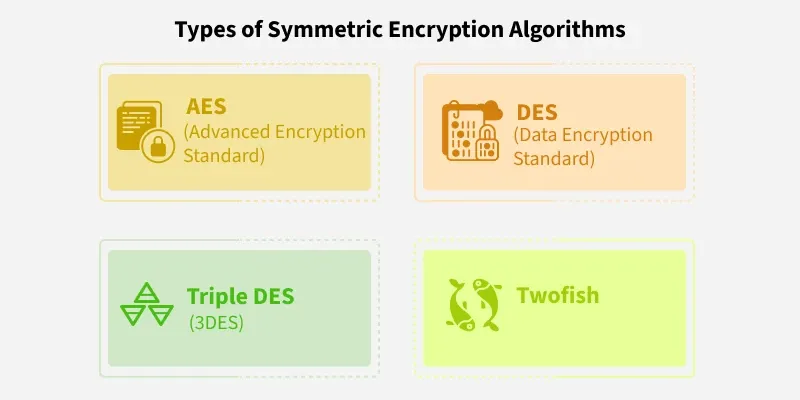
Symmetric encryption has various types, depending on their features, strengths and effectiveness. Some of the most popular symmetric encryption algorithms includes:
| Algorithm | Description | Key Features |
|---|---|---|
| AES (Advanced Encryption Standard) | Widely adopted symmetric encryption standard endorsed by NIST for national and industrial use. | Available in 128-bit, 192-bit, and 256-bit key sizes. High performance and security. |
| DES (Data Encryption Standard) | Formerly popular, now obsolete due to vulnerability to brute-force attacks. | 56-bit key size. Superseded by more secure alternatives like AES and 3DES. |
| Triple DES (3DES) | Improved version of DES, applies DES three times to each data block. | Stronger than DES, but slower and less efficient than AES. |
| Blowfish | Block cipher designed as an alternative to DES, known for speed and effectiveness in many applications. | 64-bit block size. Flexible key lengths up to 448 bits. |
| Twofish | Successor to Blowfish and finalist in AES competition. Offers robust security and flexibility. | 128-bit block size. Key sizes up to 256 bits. |