|
VOOZH | about |
|
VOOZH | about |
Variance is a number that tells us how spread out the values in a data set are from the mean (average). It shows whether the numbers are close to the average or far away from it.
The following image depicts the variance in a normal distribution, illustrating how data points are spread around the mean (μ).
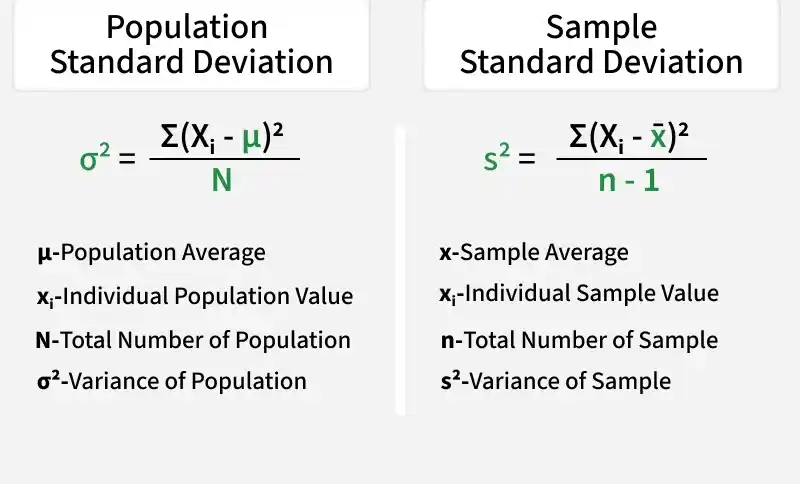
The formula used for calculating the Variance is discussed in the image below:
In general, variance means population standard variance. The steps to calculate the variance of a given set of values are,
(Variance = Sum of Squared Differences / Number of Observations)
We can define the variance of the given data in two types,
Population variance is used to find the spread of the given population. The population is defined as a group of people and all the people in that group are part of the population. It tells us about how the population of a group varies with respect to the mean population.
When we want to find how each data point in a given population varies or is spread out, then we use the population variance. It is used to give the squared distance of each data point from the population mean.
Population Variance Formula
The formula for population variance is written as,
where,
Population variance is mainly used when the entire population's data is available for analysis.
Example: Find the Population variance of the data [5, 7, 9, 10, 14, 15].
Solution:
Mean = (5 + 7 + 9 + 10 + 14 + 15) / 6 = 10
Value of
5 (5 - 10)2 25 7 (7 - 10)2 9 9 (9 - 10)2 1 10 (10 - 10)2 0 14
(14 - 10)2
16
15
(15 - 10)2
25
Variance = ( 25 + 9 + 1 + 0 + 16 + 25) / 6 = 76/6 = 12.67
Thus, the variance of the data is 12.67
If the population data is very large, it becomes difficult to calculate the population variance of the data set. In that case, we take a sample of data from the given dataset and find the variance of that dataset, which is called sample variance.
While calculating the sample mean, we make sure to calculate the sample mean, i.e., the mean of the sample data set, not the population mean. We can define the sample variance as the mean of the squares of the differences between the sample data points and the sample mean.
Sample Variance Formula
The formula of the Sample variance is given by,
where,
Sample variance is typically used when working with data from a sample to infer properties about
Example: Find the Sample variance of the data {4, 6, 8, 10}
Solution:
Mean = (4 + 6 + 8 + 10) / 4 = 7
Value of
4 (4 - 7)2 9 6 (6 - 7)2 1 8 (8 - 7)2 1 10 (10 - 7)2 9 Variance = (9 + 1 + 1 + 9) / (4 - 1) = 20/3
Thus, the variance of the data is 20/3
The variance for a data set is denoted by the symbol σ2. The formula for calculating variance differs slightly for grouped and ungrouped data.
For grouped data, the variance formula is discussed below,
- Sample Variance Formula for Grouped Data (s2) = ∑ f(mi - x̄)2/(n-1)
- Population Variance Formula for Grouped Data(σ2) = ∑ f(mi - x̄)2/N
where,
For grouped data mean is calculated as,
Mean = ∑ (fixi) / ∑ fi
For ungrouped data, the variance formula is discussed below,
- Sample Variance Formula for Ungrouped Data (s2) = ∑ (xi - x̄)2/(n-1)
- Population Variance Formula for Ungrouped Data (σ2) = ∑ (xi - x̄)2/N
where x̄ is the mean of the ungrouped data.
Variance and Standard Deviation both are measures of the central tendency that is used to tell us about the extent to which the values of the data set deviate with respect to the central or the mean value of the data set.
There is a definite relationship between Variance and Standard Deviation for any given data set.
Variance = (Standard Deviation)2
Variance is defined as the square of the standard deviation, i.e., taking the square of the standard deviation for any group of data gives us the variance of that data set.
Variance is defined using the symbol σ2, whereas σ is used to define the Standard Deviation of the data set. Variance of the data set is expressed in squared units, while the standard deviation of the data set is expressed in a unit similar to the mean of the data set.
Binomial Distribution is the discrete probability distribution that tells us the number of positive outcomes in a binomial experiment performed n times. The outcome of the binomial experiment is 0 or 1, i.e., either positive or negative.
In the binomial experiment of n trials and where the probability of each trial is given by p, then the variance of the binomial distribution is given using,
σ2 = np (1 - p) where 'np' is defined as the mean of the values of the binomial distribution.
where 'np’ is defined as the mean of the values of the binomial distribution.
Poisson Distribution is defined as a discrete probability distribution that is used to define the probability of the 'n' number of events occurring within the 'x' period. The mean in the Poisson distribution is defined by the symbol λ.
In the Poisson Distribution, the mean and the variance of the given data set are equal. The variance of the Poisson distribution is given using the formula,
σ2 = λ
In a uniform distribution, the probability distribution of data is continuous. The outcome in these experiments lies in the range between a specific upper bound and a specific lower bound, and thus these distributions are also called Rectangular Distributions.
If the upper bound or the maximum bound is “b” and the lower bound or the minimum bound is “a” then the variance of the uniform distribution is calculated using the formula,
The mean of the uniform distribution is given using the formula,
Mean = (b + a) / 2
where,
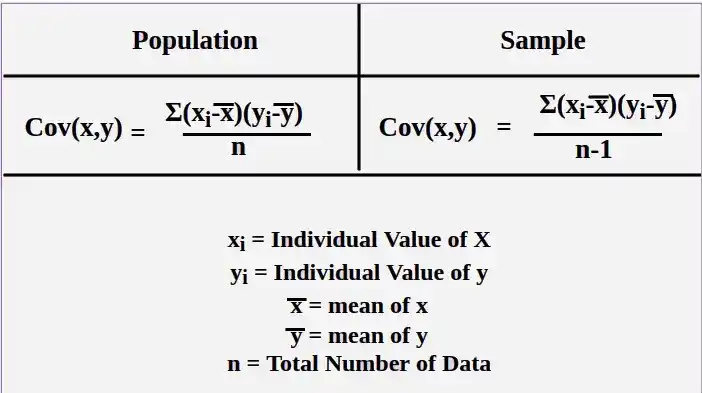
Variance of the data set defines the volatility of all the values of the data set with respect to the mean value of the data set. Covariance tells us how the random variables are related to each other and it tells us how the change in one variable affects the change in other variables.
Covariance can be positive or negative, the positive covariance signifies that both variables are moving in the same direction with respect to the mean value whereas, negative covariance signifies that both variables are moving in opposite directions with respect to the mean value.
Variance is widely used in Mathematics, Statistics, and other branches of science for a variety of purposes. Variance has various properties that are widely used for solving various problems. Some of the basic properties of the variance are,
For any constant 'c'
Var(x + c) = Var(x)
where x is a random variableVar(cx) = c2․Var(x)
where x is a random variable
Also, if a and b are constant values and x is a random variable, then,
Var(ax + b) = a2․Var(x)
For independent variables x1, x2, x3...,xn we know that,
Var(x1 + x2 +……+ xn) = Var(x1) + Var(x2) +……..+Var(xn)
Example 1: Calculate the variance of the sample data: 7, 11, 15, 19, 24.
We have the data, 7, 11, 15, 19, 24
Find mean of the data.
x̄ = (7 + 11 + 15 + 19 + 24)/5
= 76/5
= 15.2Using the formula for variance we get,
s2 = ∑ (xi - x̄)2/(n - 1)
= (67.24 + 17.64 + 0.04 + 14.44 + 77.44)/(5 - 1)
= 176.8/4
= 44.2
Example 2: Calculate the number of observations if the variance of the dataset is 12 and the sum of squared differences of data from the mean is 156.
We have,
(xi - x̄)2 = 156
σ2 = 12Using the formula for variance we get,
σ2 = ∑ (xi - x̄)2/n
12 = 156/n
12n = 156
n = 156/ 12
n = 13
Example 3: Calculate the variance for the given data
xi | fi |
|---|---|
| 10 | 1 |
| 4 | 3 |
| 6 | 5 |
| 8 | 1 |
xi
fi
fixi
(xi - x̄)
(xi - x̄)2
fi(xi - x̄)2
10 1 10 4 16 16 4 3 12 -2 4 12 6 5 30 0 0 0 8 1 8 2 4 4 Mean (x̄) = ∑(fi xi)/∑(fi)
= (10×1 + 4×3 + 6×5 + 8×1)/(1+3+5+1)
= 60/10 = 6n = ∑(fi) = 1+3+5+1 = 10
Now,
σ2 = (∑in fi(xi - x̄)2/n)
= (16 + 12 + 0 +4)/10
= 3.2Variance(σ2) = 3.2
Example 4: Find the variance of the following data table
Class | Frequency |
|---|---|
| 0-10 | 3 |
| 10-20 | 6 |
| 20-30 | 4 |
| 30-40 | 2 |
| 40-50 | 1 |
Class
Xi
fi
f×Xi
Xi - μ
(Xi - μ)2
f×(Xi - μ)2
0-10
5
3
15
-15
225
675
10-20
15
6
90
-5
25
150
20-30
25
4
100
5
25
100
30-40
35
2
70
15
225
450
40-50
45
1
45
25
625
625
Total
16
320
2000
Mean (μ) = ∑(fi xi)/∑(fi)
= 320/16 = 20σ2 = (∑in fi(xi - μ)2/n)
= [(2000)/(16)]
= (125)The variance of given data set is 125.