|
VOOZH | about |
|
VOOZH | about |
The word Statistics is derived from the Greek word 'Statistique,' the Latin word 'Status,' the Italian word 'Statista,' and the German word 'Statistic.' Statistics is defined as the study, collection, analysis, interpretation, and organization of data for different ultimate objectives. Statistics help a user in gathering and analyzing huge numerical data easily and efficiently. Statistics can be easily defined in two senses: Plural Sense and Singular Sense.
In a plural sense, Statistics means a systematic collection of numerical figures and facts for a specified purpose in a field of study. The major characteristics of statistics in the plural sense are:
Also Read:
In a singular sense, Statistics means collecting, presenting, analyzing, and interpreting the numerical data for the study. Different stages of the statistics study are:
Economics means the study of how human beings and society employ scarce resources with alternate uses to manufacture different services and goods to satisfy their wants and then distribute them among different sections of society for consumption purposes.
Statistics plays a major role in economics. Statistics helps in the study of market structure and understand the different economic problems. After a better understanding of the economic problems, statistics also help in solving those issues by formulating appropriate economic policies. Every economics branch uses statistics to prove different economic theories. One can also establish a mathematical relationship with the help of statistics. Economists can present the facts of economics precisely. They can also determine the cause-and-effect relationship between different data sets.
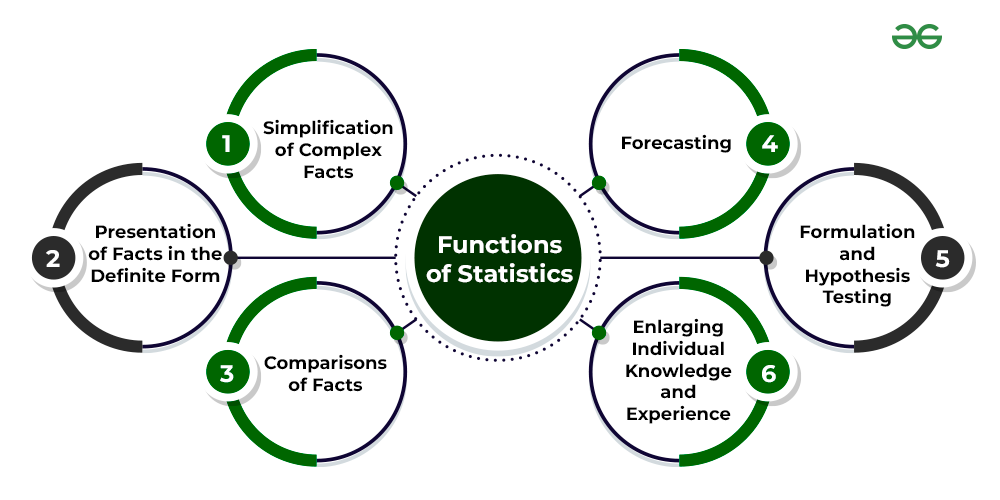
1. Simplification of Complex Facts: The study of mass and complex data is difficult to understand. A layman cannot understand the complex terms and information presented in the analysis and results of the study. Therefore, different statistical methods help an economist or user in presenting complex data in an understandable and simple form.
2. Presentation of Facts in the Definite Form: Statistics helps preset the facts of data using figures in their true form. Presenting qualitative facts about data instead of quantitative figures can not present the data effectively. For example, saying that the literacy rate has increased by 5% over the past two years is better than simply saying that the literacy rate is increasing.
3. Comparisons of Facts: Comparing the facts and figures for the pre-determined purpose is an essential function of statistics. It is because absolute figures can not convey a better concrete meaning. Therefore, the relationship between two data sets or groups can be compared through different statistical methods such as ratios, averages, percentages, rates, etc.
4. Forecasting: Uncertainty and risk in business can be found in abundance. Therefore, organizations and the economy as well have to forecast the future to prepare themselves for any kind of change. Proper and accurate forecasting helps in reducing uncertainty. For this purpose, one can use different statistical tools such as time series analysis, interpolation, etc., as they can help make a projection of the future.
5. Formulation and Hypothesis Testing: Testing a hypothesis means testing a fake scenario to understand the results of its formulation. Therefore, different statistical tools and methods help an economist in formulating and testing the hypothesis.
6. Enlarging Individual Knowledge and Experience: An individual can widen their horizon using statistics while going through different procedures of statistics. Statistics also enlarge the thinking and reasoning power of an individual and ultimately help them reach a rational conclusion.
1. Ignores the Qualitative Aspect: Statistics does not consider aspects that can not be expressed in quantitative terms. One has to convert the qualitative aspects like kindness, honesty, care, health, intelligence, etc., into quantitative terms to study.
2. Does not Deal with Individual Terms: As the definition of statistics suggests, it only deals with the aggregate of facts and does not consider individual items. For example, it does not consider the marks of one student but will consider the marks of a class.
3. Requires only Uniform and Homogeneous Data: An economist can not perform a statistical study if the data gathered is not homogeneous.
4. Can Be Misused: If the methods of statistics are not used by an expert, trained, specialized, and unbiased person, there are huge chances of misuse and inaccurate results. A biased individual can transform the data according to their needs and purpose.
5. Results are True only on Average: In statistics, a result is true only on average. It means that if we say that the average mark of a class of 50 students is 60, it does not mean that every student has the same marks. One student might have 30 or 40 marks.