|
VOOZH | about |
|
VOOZH | about |
180-degree angle is an angle formed when two lines or rays extend in opposing directions from a common point, producing a perfectly straight line. It is also called a straight angle.
In this article, we will learn about 180-degree angles, how to measure 180-degree angles, properties of 180-degree angles along with a few examples based on it.
Table of Content
180-degree angle, also known as a straight angle, is the result of two lines or rays extending from a common point in opposing directions to produce an exact straight line.
👁 Straight-Angle-PictureIt appears as a straight line without any bends or curves. A 180-degree angle is the biggest angle that may be created in Euclidean geometry because its measure is exactly 180 degrees.
180 degree angle is defined as an angle that is created when two rays, lines, or line segments extend in opposite directions from a single endpoint, called the vertex, to produce a straight line.
The measure of a 180-degree angle is precisely 180 degrees, indicating a half-circle.
180-degree angle is called a straight angle because of its ability to form a straight line. Straight angle refers to the fact that it does not bend or deviate, forming a complete half-circle or a full turn.
180 degree angle is made up of rays or lines that are aligned in opposing directions forming a straight line, hence it is called a straight angle.
Also Check, Types of Angle
Using a compass to draw a 180-degree angle is a simple procedure. Here's a detailed step by step process:
Steps to draw a 180 degree angle using a protractor are illustrated below:
Properties of a 180 degree angle are:
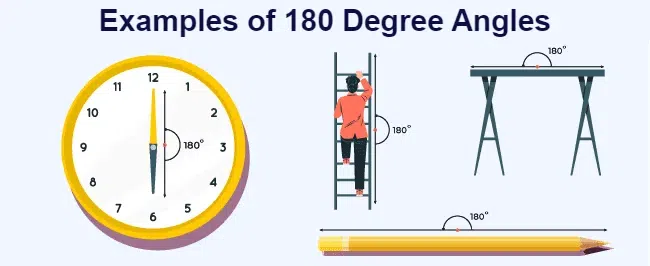
Some real-life examples of 180 Degree Angle found in our surrounding includes:
Read More,
Example 1: If we divide a straight angle into two parts such that one of the angle measure 100°. Find the measure of other angle.
Solution:
Given:
Measure of one angle = 100°
Sum of adjacent angles of a straight line is always 180°
Therefore, Measure of another angle = 180° - 100° = 80°
So, the measure of other angle is 80°.
Example 2: If two angles are supplementary, and one of them measures 120 degrees, what is the measure of the other angle
Solution:
Supplementary angles add up to 180°.
Let one angle be x°
Given:
Measure of one angle = 120°
Measure of the other angle + 120° = 180 °
Measure of the other angle = 180° - 120°
Measure of the other angle = 60°
So, the measure of the other angle is 60°.