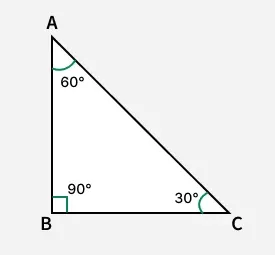
A 30-60-90 triangle is a special type of right triangle with one angle measuring 30°, another 60°, and the third angle (the right angle) measuring 90°. The 30-60-90 triangle is called a special right triangle as the angles of this triangle are in a unique ratio of 1:2:3. Here, a right triangle means being any triangle that contains a 90° angle.
The below figure represents the 30-60-90 triangle with ∠A = 60°, ∠B = 90°and ∠C = 30°. The 30-60-90 is pronounced as "thirty - sixty - ninety".
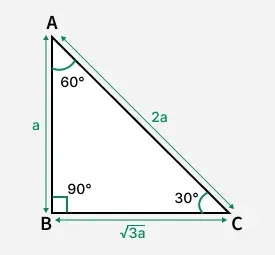
A 30°–60°–90° triangle is a special type of right triangle with fixed angle measures. In the below-given 30-60-90 triangle ABC, ∠ C = 30°,∠ A = 60°, and ∠ B = 90°. We can understand the relationship between each of the sides from the following definitions:
The side opposite to the angle 30° holds the smallest value and let it be "a" cm. Another side representing opposite to the opposite angle of 60° holds the moderate value, and it is "a√3" cm. Lastly, the side opposite to the angle 90° holds the largest value, and it is "2a" cm.
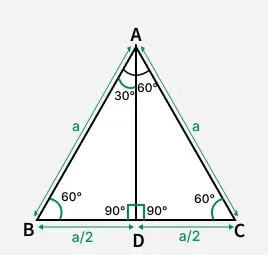
Let's first consider the equilateral triangle (all sides being equal and making an angle of 60° at vertices) as shown in the figure. If we draw a line from one of the vertexes (say A) to the other side (say BC). Then the other side i.e., BC is divided into 2 equal halves (each part with a/2) and makes an angle of 90°. Let the dividing point or the midpoint of BC be D. Due to the line that is drawn the angle at the vertex A which is 60° will also be divided equally and each part holds 30°.
Now look at the half part of the figure which is triangle ABD, it resembles a 30-60-90 triangle with sides AB = a cm, BD = a/2 cm, AD = unknown (say x cm)
To find the value of AD let's use the Pythagoras theorem, which states that "In a right-angled triangle, the square of the hypotenuse side (longest side) is equal to the sum of squares of the other two sides“, from the figure AB is the hypotenuse, BD and AD are other 2 sides.
Therefore,
AB2 = BD2 + AD2
a2 = (a/2)2 + x2
x2 = a2 - (a/2)2
x = √3a/2 cm (AD)
The ratio of the sides that are opposite to the angles 30-60-90 will be a/2: √3a/2: a ⇒ 1:√3:2 (taking as common and neglecting it and multiplying with 2)
This ratio 1:√3:2 is known as the 30-60-90 formula
30-60-90 Triangle Rule
A 30-60-90 triangle is a special right triangle with angles of 30°, 60°, and 90°. The sides of such a triangle always follow the ratio:
Shortest side (opposite 30°) : Side opposite 60° : Hypotenuse = 1 : √3 : 2
How to Find the Sides
Below is a table showing how to calculate all sides if you know any one side:
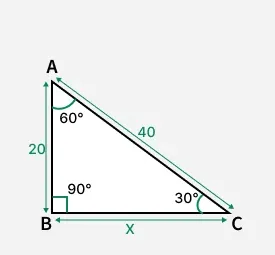
To find the third side i.e., x from the 30-60-90 formula 1:√3:2 x ⇒ √3a
x ⇒ 20 × √3 cm.
x = 20√3cm
Question 2: The shortest side of the 30-60-90 is 40cm, find the area of the triangle?
Solution:
In a 30-60-90 triangle, the sides are in a specific ratio. The side opposite the 30-degree angle is half the length of the hypotenuse, and the side opposite the 60-degree angle is √3/2 times the length of the hypotenuse.
Given that the shortest side is 40 cm, we can use this information to find the lengths of the other sides.
Let ( x ) be the length of the shortest side (opposite the 30-degree angle), then the lengths of the other sides are:
- The length of the medium side (opposite the 60-degree angle) is x√3
- The length of the longest side (the hypotenuse) is ( 2x ).
We're given that the shortest side is 40 cm. So, ( x = 40 ) cm.
- The length of the medium side is 40√3 cm.
- The length of the longest side (hypotenuse) is ( 2 x 40 = 80 ) cm.
Now, to find the area of the triangle, we can use the formula:
Area = 1/2 x base x height
In a 30-60-90 triangle, the base (shortest side) is opposite the 30-degree angle, and the height is opposite the 60-degree angle.
So, the area is: Area = 1/2 x 40 x 40√3 Area = 20 x 40√3 Area = 800√3
Thus, the area of the triangle is 800√3 square centimeters.
Question 3: The longest side of the 30-60-90 is 120cm, find the area of the triangle?
Solution:
Given the longest side is 120cm i.e., 2a = 120 cm. Short leg : Long leg : Hypotenuse= 1 : √3 :2 Let a be the shorter leg Therefore, a = 60 cm. The longer leg is = a√3 = 60√3 The area of the triangle is A = (1/2) × b × h = (1/2) × 60 × 60√3 = 1800√3 cm2
Therefore Area = 1800√3 cm2
Question 4: The moderate side of the 30-60-90 is 12√3cm, find the area of the triangle?
Solution:
Given the moderate side is 120cm i.e., a√3 = 12√3 cm. Therefore, a = 12 cm. The hypoteuse is 2x The area of the triangle is A = (1/2) × b × h = (1/2) × 12 × 12√3 = 72√3 cm2
Therefore Area = 72√3 cm2
Question 5: The shortest side of the triangle is 90 cm, find the longest side?
Solution:
Given the shortest side of 30-60-90 is 90 cm. From the 30-60-90 formula the shortest and longest sides are in the ratio 1 : 2 ⇒ x : 2x Given x = 90 2x = ?
Therefore, 2x = 2 × 90 = 180 cm.
Question 6: The longest side of the triangle is 20cm, find the intermediate side length?
Solution:
Given the longest side of 30-60-90 is 20 cm. From 30-60-90 formula the longest and intermediate sides are in the ratio 2:√3 ⇒ 2x :√3 x Given 2x = 20 x = 10