|
VOOZH | about |
|
VOOZH | about |
ANOVA (Analysis of Variance) is a statistical method used to determine whether there are significant differences between the means of three or more independent groups by analyzing the variability within each group and between the groups. It helps in testing the null hypothesis that all group means are equal.
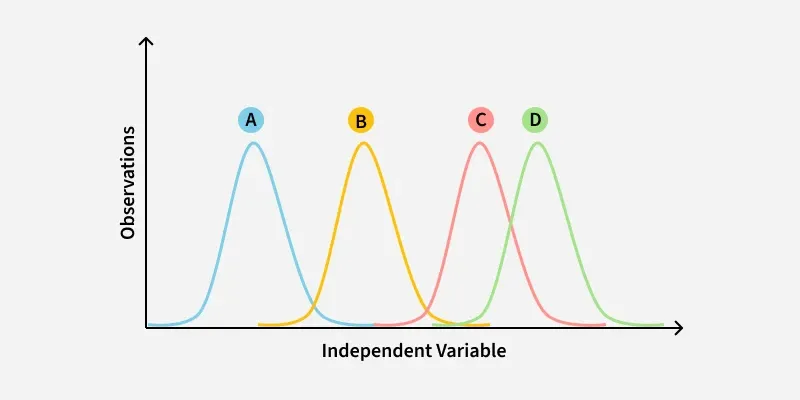
It does this by comparing two types of variation: (F-statistics)
If the between-group differences are significantly larger than within-group variation, ANOVA tells us: At least one group is truly different. Otherwise, it concludes: The differences are likely due to random chance.
For example:
Compare test scores of students taught with 3 methods (Traditional, Online, Hybrid). ANOVA is used to determine if at least one teaching method yields significantly different average scores.
The ANOVA formula is made up of numerous parts. The best way to tackle an ANOVA test problem is to organize the formulae inside an ANOVA table.
Here's a general structure of an ANOVA table:
where,
These must be validated before analysis:
ANOVA is robust to minor violations of normality and homoscedasticity with balanced sample sizes.
Let's explore calculating ANOVA for the scenario:
Compare plant growth under 3 fertilizers (A, B, C):
SSB (Sum of Squares Between Groups): Accounts for variation due to the treatment or independent variable.
SSE (Sum of Squares Error or Within Groups): Accounts for variation within groups (random error or residuals).SST (Total Sum of Squares): Accounts for total variation from overall mean.
SST = SSB + SSW
SSB = 3(11 − 8)2 + 3(8 − 8)2 + 3(5 − 8)2 = 3(9) + 3(0) + 3(9) = 54
SSE:
SSW = 2 + 2 + 2 = 6
SST = 54 + 6 = 60
df1 (Between Groups) = k - 1, where k is number of groups.
df2 (Within Groups) = N - k, where N is the total observations.
df3 (Total) = N - 1.
MSB (Mean Square Between Groups) = SSB / df1.
MSE (Mean Square Error) = SSE / df2.
The F-statistic is calculated as the ratio of MSB to MSE:
The p-value is used to decide whether differences among groups are statistically significant. When the p-value is smaller than the significance level (α), the null hypothesis is rejected.
If F > Fcritical → p < 0.05 : Null Hypothesis Rejected
Use the F-distribution table or software with: Numerator df1 = 2 , Denominator df2 = 6, α=0.05
Critical F-value, Fcritical: 5.14 (From F-distribution table)
F > Fcritical : 27 > 5.14 → p < 0.05; Reject null hypothesis
An ANOVA test can be classified as either one-way or two-way based on the number of independent variables involved.
This test is used to see if there is a variation in the mean values of three or more groups. Such a test is used where the data set has only one independent variable. If the test statistic exceeds the critical value, the null hypothesis is rejected, and the averages of at least two different groups are statistically significant.
Two independent variables are used in the two-way ANOVA. A two-way ANOVA test is used to determine the main effect of each independent variable and whether there is an interaction effect. Each factor is examined independently to determine the main effect, as in a one-way ANOVA. Furthermore, all components are analyzed at the same time to test the interaction impact.
Example 1: Three different kinds of food are tested on three groups of rats for 5 weeks. The objective is to check the difference in mean weight(in grams) of the rats per week. Apply one-way ANOVA using a 0.05 significance level to the following data:
| Food I | Food II | Food III |
|---|---|---|
| 8 | 4 | 11 |
| 12 | 5 | 8 |
| 19 | 4 | 7 |
| 8 | 6 | 13 |
| 6 | 9 | 7 |
| 11 | 7 | 9 |
Solution:
H0: μ1= μ2=μ3
H1: The means are not equalSince, X̄1 = 5, X̄2 = 9, X̄3 = 10
Total mean = X̄ = 8
- SSB = 6(5 - 8)2 + 6(9 - 8)2 + 6(10 - 8)2 = 84
- SSE = 68
- MSB = SSB/df1 = 42
- MSE = SSE/df2 = 4.53
- f = MSB/MSE = 42/4.53 = 9.33
Since f > F, the null hypothesis stands rejected.
Example 2: Calculate the ANOVA coefficient for the following data:
| Plant | Number | Average span | s |
|---|---|---|---|
| Hibiscus | 5 | 12 | 2 |
| Marigold | 5 | 16 | 1 |
| Rose | 5 | 20 | 4 |
Solution:
Plant n x s s2 Hibiscus 5 12 2 4 Marigold 5 16 1 1 Rose 5 20 4 16 p = 3
n = 5
N = 15
x̄ = 16SST = Σn(x−x̄)2
- SST= 5(12 − 16)2 + 5(16 − 16)2 + 11(20 − 16)2 = 160
- MST = SST/p-1 = 160/3-1 = 80
- SSE = ∑ (n−1) = 4 (4 + 1) + 4(16) = 84
- MSE = 7
- F = MST/MSE = 80/7
- F = 11.429
Example 3: The following data show the number of worms quarantined from the GI areas of four groups of muskrats in a carbon tetrachloride anthelmintic study. Conduct a two-way ANOVA test.
| I | II | III | IV |
|---|---|---|---|
| 338 | 412 | 124 | 389 |
| 324 | 387 | 353 | 432 |
| 268 | 400 | 469 | 255 |
| 147 | 233 | 222 | 133 |
| 309 | 212 | 111 | 265 |
Solution:
Source of Variation Sum of Squares Degrees of Freedom Mean Square Between the groups 62111.6 8 9078.067 Within the groups 98787.8 16 4567.89 Total 167771.4 24 Since F = MST / MSE
= 9.4062 / 3.66
F = 2.57
Example 4: Enlist the results in APA format after performing ANOVA on the following data set:
Solution:
- Variance of first set = (10.45)2 = 109.2
- Variance of second set = (12.76)2 = 162.82
- Variance of third set = (11.47)2 = 131.56
MSerror = {109.2 + 162.82 + 131.56} / {3}
= 134.53MSbetween = (17.62)(30) = 528.75
F = MSbetween / MSerror
= 528.75 / 134.53
F = 4.86APA writeup: F(2, 87)=3.93, p >=0.01, η2=0.08.
Question 1. Method A = {80, 85, 90, 87}, Method B = {75, 78, 72, 74}, and Method C = {88, 85, 90, 92} are given. State the null and alternative hypotheses for performing a One-Way ANOVA test.
Question 2. Calculate the F-statistic for the given data using One-Way ANOVA. Group 1 = {5, 6, 7, 8}, Group 2 = {4, 5, 6, 5}, and Group 3 = {7, 7, 6, 8}.
Question 3. Interpret the significance of the p-value for the interaction effect in a Two-Way ANOVA, where the p-value for the interaction effect is 0.02 and the significance level (α\alphaα) is 0.05.
Question 4. Group A = {10, 12, 14, 13}, Group B = {15, 17, 16, 18}, and Group C = {20, 22, 21, 23} are given. Interpret the p-value of the ANOVA test and explain whether the null hypothesis is rejected, where F-statistic = 4.86 and p-value = 0.01.
Answer:-
- Null Hypothesis (H₀): μ₁ = μ₂ = μ₃ (The means of all groups are equal). Alternative Hypothesis (H₁): At least one mean is different.
- F-statistic = 4.58.
- If the p-value (0.02) is less than the significance level (0.05), reject the null hypothesis and conclude that there is a significant interaction effect.
- Since the p-value (0.01) is less than 0.05 and the F-statistic is significant, we reject the null hypothesis, indicating a significant difference between the group means.