|
VOOZH | about |
|
VOOZH | about |
Determinants are a powerful mathematical tool with a wide range of applications in different fields. Here are the main applications of determinants:
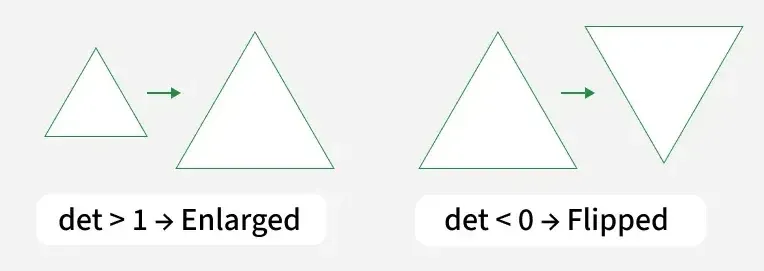
Computer Graphics: Used to perform geometric transformations such as scaling, rotation, and reflection in 2D and 3D graphics.
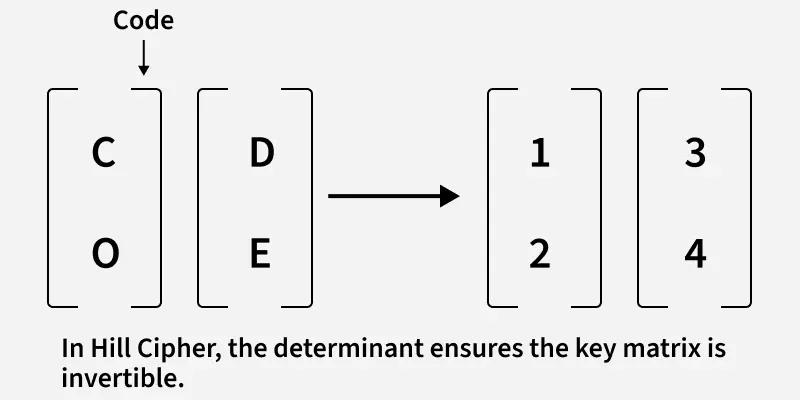
Cryptography: Ensure that encryption matrices are invertible in techniques like the Hill Cipher.
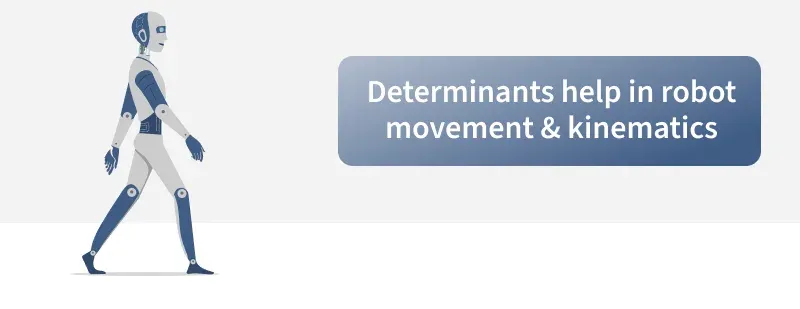
Robotics and Control Systems: Applied in robot kinematics to check if transformation matrices are invertible, ensuring precise control over robotic arms.
Physics and Engineering: Used to solve systems of linear equations in areas such as structural analysis, circuit analysis, and mechanical vibrations.
Data Science and Machine Learning: Used in multivariate statistical analysis, especially in probability density functions of the Gaussian distribution.
Computer Vision: Used in image transformation and perspective correction.
Network Analysis: In graph theory, determinants of certain matrices (like Laplacian matrices) are used to determine network properties such as the number of spanning trees in a network.
Structural Analysis: Engineers use determinants to solve equilibrium equations in structures like bridges, buildings, and towers.
Economics and Business: Used in solving systems of economic equations in input-output analysis.
Signal Processing: Determinants assist in solving systems of equations in signal transformation and filtering.