|
VOOZH | about |
|
VOOZH | about |
In geometry, an asymptote is a straight line that approaches a curve on the graph and tends to meet the curve at infinity. An asymptote is a line that a graph of a function approaches but never touches or crosses as it extends towards infinity or a specific point. Asymptotes help to describe the behaviour of functions, particularly their end behaviour and behaviour near undefined points.
In this article, we have covered the asymptote definition, types, formulas, examples and others in detail.
Table of Content
An asymptote is a line being approached by a curve but never touching the curve. Curve and its asymptote have a unique relationship where they travel parallel to one another yet never cross at any point other than infinity. In addition, although they run closely together, they are still apart from each other.
There are three types of Asymptotes that are:
A horizontal asymptote is a horizontal line y=cy=c where the function f(x)f(x) approaches as xx goes to ∞∞ or −∞−∞. It represents the value that the function gets closer to but never actually reaches as xx becomes very large or very small.
Example: For the function f(x) = 1/x, the horizontal asymptote is y = 0.
A vertical asymptote is a vertical line x=c where the function f(x) approaches ∞ or −∞ as x approaches c. It represents the value of x at which the function becomes unbounded (heads towards infinity).
Example: For the function f(x) = 1/(x−2), the vertical asymptote is x = 2.
An oblique asymptote is a diagonal line that the graph of the function approaches as xx goes to ∞∞ or −∞−∞. This occurs when the degree of the numerator is one more than the degree of the denominator in a rational function.
Example: For the function f(x) = (2x2 + 3x + 1)/x, the oblique asymptote is y = 2x.
Various asympote formulas are:
Let's learn about them,
Horizontal asymptotes are located where the curve approaches a constant value b as x approaches infinity (or negative infinity).
If f (x) = (axm +...)/(bxn +..) is a curve, its horizontal asymptotes are as follows:
A vertical asymptote is located when the curve shifts in the direction of infinity when x approaches a constant value c from the right or left.
So, to find the vertical asymptote of a function, its denominator must be equated to zero, as a function is undefined when its denominator is zero.
An oblique asymptote occurs when the curve travels in the direction of the line y = mx + b while x also goes towards infinity in any direction.
Consider the function f(x) = p(x)/q(x), with p(x) and q(x) being polynomials. The given function will have an oblique asymptote only if the degree of the numerator is greater than the denominator.
We get f(x) = {a(x) + r(x)}/q(x) by performing polynomial division on the given function, where a(x) is the quotient and r(x) is the reminder. Now, the oblique asymptote of the given function is a(x).
A hyperbola has a pair of asymptotes having an equation x2/a2 - y2/b2 = 0.
Now, the equations of asymptotes are
Equation of Asymptotes: y = (b/a) x and y = -(b/a) x
Equation of Pair of Asymptotes: x2/a2 - y2/b2 = 0
Various differences between Horizontal and Vertical Asymptotes are added in the table below:
Aspect | Horizontal Asymptote | Vertical Asymptote |
|---|---|---|
Definition | Line y = c where the function approaches as x→±∞ | Line x = c where the function becomes unbounded as x→c |
Equation | y = c | x = c |
Direction Approached | As x goes to ∞ or -∞ | As x approaches a specific value c |
Behavior | Function y approaches a constant value c | Function y grows without bound (to ±∞) |
Example Function | f(x) = 3/x (Horizontal asymptote at y = 0) | f(x) = 1/(x-1) (Vertical asymptote at x = 1) |
Visual Representation | Horizontal line on the graph that the function approaches | Vertical line on the graph that the function approaches |
Problem 1: If the equation of a hyperbola is x2/196 - y2/225 = 1, then find its asymptotes.
Solution:
Given,
Equation of hyperbola is x2/196 - y2/225 = 1
If the equation of a hyperbola is x2/a2 - y2/b2 = 1, then the equation of its pair of asymptotes is x2/a2 - y2/b2 = 0
So, now the equation of the pair of asymptotes is x2/196 - y2/225 = 0
⇒ x2/(14)2 - y2/(15)2 = 0
⇒ (x/14 - y/15) (x/14 + y/15) = 0
⇒ (x/14 - y/15) = 0 and (x/14 + y/15) = 0
⇒ 15x - 14y = 0 and 15x + 14y = 0
Thus, the asymptotes of the given hyperbola are 15x - 14y = 0 and 15x + 14y = 0.
Problem 2: Find the vertical asymptotes for f(x) = 3x2 + 1/25x2 - 36.
Solution:
Given,
Equation of curve f(x) = 3x2 + 1/25x2 - 36
We know that a vertical asymptote occurs when the curve tends to infinity.
So, the denominator should be equated to zero.
⇒ 25x2 - 36 = 0
⇒ (5x)2 - 62 = 0
⇒ (5x + 6) (5x - 6) = 0
⇒ x = -6/5 and x = 6/5
Hence, the vertical asymptotes are x = -6/5 and x = 6/5.
Problem 3: If the equation of a hyperbola is x2/64 - y2/4 = 0, then find its asymptotes.
Solution:
Given,
Equation of hyperbola is x2/64 - y2/4 = 1
If the equation of a hyperbola is x2/a2 - y2/b2 = 1, then the equation of its pair of asymptotes is x2/a2 - y2/b2 = 0
So, now the equation of the pair of asymptotes is x2/64 - y2/4 = 0
⇒ x2/(8)2 - y2/(2)2 = 0
⇒ (x/8 - y/2) (x/8 + y/2) = 0
⇒ (x/8 - y/2) = 0 and (x/8 + y/2) = 0
⇒ 2x - 8y = 0 and 2x + 8y = 0
Thus, the asymptotes of the given hyperbola are 2x - 8y = 0 and 2x + 8y = 0.
Problem 4: Find the vertical asymptote of the curve f(x) = 5x2 - 4x + 1/x2 - 5x + 6.
Solution:
Given,
Equation of curve f(x) = 5x2 - 4x + 1/x2 - 5x + 6
We know that a vertical asymptote occurs when the curve tends to infinity.
So, the denominator should be equated to zero.
⇒ x2 - 5x + 6 = 0
⇒ x2 - 2x - 3x + 6 = 0
⇒ (x - 2) (x - 3) = 0
⇒ x = 2 or x = 3
Hence, the vertical asymptotes are x = 2 and x = 3
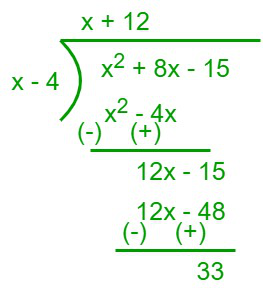
Problem 5: Find the oblique asymptote of the curve f(x) = x2 + 8x - 15/x - 4
Solution:
Given,
Equation of curve f(x) = x2 + 8x - 15/x - 4
Degree of the numerator is greater than denominator, so oblique asymptotes exits.
Therefore, f(x) = x2 + 8x - 15/x - 4 = (x + 12) + 33/(x - 4)
Hence, the oblique asymptote is y = x + 12.
Problem 6: What is the horizontal asymptote of the curve f(x) = x2 - 6x + 7/4x2 - 3?
Solution:
Given,
Equation of curve f(x) = x2 - 6x + 7/4x2 - 3
Since, degree of both numerator and denominator is equal, a horizontal asymptote exits.
To find, horizontal asymptote, divide both numerator and denominator with x
f(x) = (x2 - 6x + 7/(x2)/(4x2 - 3)/(x2)
f(x) = (1 - 6/x + 7/x2)/(4 - 3/x2)
Now,
limx⇢∞ f(x)
= limx⇢∞ (1 - 6/x + 7/x2)/(4 - 3/x2)
= (1 - 0 + 0)/(4 - 0) = 1/4
Hence, horizontal asymptote is y = 1/4