|
VOOZH | about |
|
VOOZH | about |
The axis of symmetry is an imaginary line that divides a shape into two perfect mirror-image halves. Different shapes have different numbers of symmetry axes: a square has four, a rectangle has two, a circle has infinitely many, and a parallelogram has none. In general, a regular polygon with n sides has n axes of symmetry.
The axes of symmetry of a pentagon are shown below:
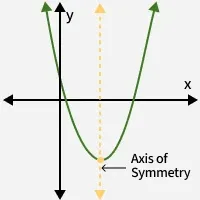
👁 ImageFor a parabola with an equation of the form ax²2 + bx + c, the axis of symmetry is
x = −b/2a
where a and b are the coefficients of x2 and x, respectively, and c is the constant.
The vertex of parabola is the only point from where the axis of symmetry passes. A vertical parabola's quadratic equation is y = ax2 + bx + c
The parabola is unaffected by the constant term 'c.'
Consider the equation y = ax2 + bx.
The axis of symmetry is the midpoint of its two x-intercepts. To find the x-intercept, substitute y = 0.
⇒ x(ax + b) = 0
⇒ x = 0 or, x = -b/a
Using the mid- point formula, we have:
⇒ x =
⇒ x = -b/2a
Hence proved.
Question 1. Find the axis of symmetry of the parabola y = x²2 − 4x + 8.
Solution:
Given: y = x2 − 4x + 8
Compare the given equation to the standard form ax2 + bx + c.
⇒ a = 1, b = −4, c = 8
Axis of symmetry = −b/2a
= −(−4)/2(1)
⇒x = 2
Question 2. Find the axis of symmetry of the parabola y = 4x2.
Solution:
Given: y = 4x2
Compare the given equation to the standard form ax2 + bx + c.
⇒ a = 4, b = 0, c = 0
Axis of symmetry = −b/2a
= 0/2(4)
⇒ x = 0
Question 3. Find the axis of symmetry of the parabola y = 7x2.
Solution:
Given: y = 7x2
Compare the given equation to the standard form ax2 + bx + c.
⇒ a = 7, b = 0, c = 0
Axis of symmetry = −b/2a
= 0/2(7)
⇒ x = 0
Question 4. Find the axis of symmetry of a parabola y = x²2 + 8x − 3.
Solution:
Given: y = x2 + 8x − 3
Compare the given equation to the standard form ax2 + bx + c.
⇒ a = 1, b = 8, c = –3
Axis of symmetry = −b/2a
= –8/2(1)
⇒ x = –4
Question 5. Find the axis of symmetry of the parabola y = 2x2 + 12x.
Solution:
Given: y = 2x2 + 12x
Compare the given equation to the standard form ax2 + bx + c.
⇒ a = 2, b = 12, c = 0Axis of symmetry = −b/2a
= −12/2(2)
⇒ x = −3
Question 6. Find the axis of symmetry of the parabola y = 3x2 − 6x + 5.
Solution:
Given: y = x2 − 6x + 5
Compare the given equation to the standard form ax2 + bx + c.
⇒ a = 1, b = −6, c = 5Axis of symmetry = −b/2a
= −(−6)/2(3)
⇒ x = 1
Question 7. Find the axis of symmetry of the parabola y = 9x2.
Solution:
Given: y = 9x2
Compare the given equation to the standard form ax2 + bx + c.
⇒ a = 9, b = 0, c = 0Axis of symmetry = −b/2a
= 0/2(9)
⇒ x = 0
Problem 1: Find the axis of symmetry for the parabola given by the equation y = 2x + 4x + 1.
Problem 2: Determine the axis of symmetry for the parabola described by y = −3x + 6x − 2.
Problem 3: Identify the axis of symmetry for the quadratic function y = x² − 8x + 15.
Problem 4: What is the axis of symmetry for the parabola y = −x + 10x − 25?
Problem 5: Find the axis of symmetry for the equation y = 4x − 16x + 7.