|
VOOZH | about |
|
VOOZH | about |
Thales' theorem is one of the most fundamental theorems in geometry that relates the parts of the length of sides of triangles. The other name of the Thales theorem is the Basic Proportionality Theorem or BPT.
BPT states that if a line is parallel to a side of a triangle that intersects the other sides into two distinct points, then the line divides those sides in proportion.
Thales's Theorem or Basic Proportionality Theorem (BPT) states that if a line is drawn parallel to one side of a triangle intersecting the other two sides in distinct points, then the other two sides are divided in the same ratio.
Let's prove the Basic Proportionality Theorem.
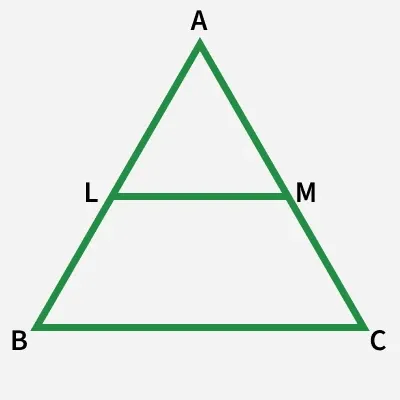
Given: Let us suppose we have a triangle ABC, if we draw a line LM parallel to side BC.
To Proof:
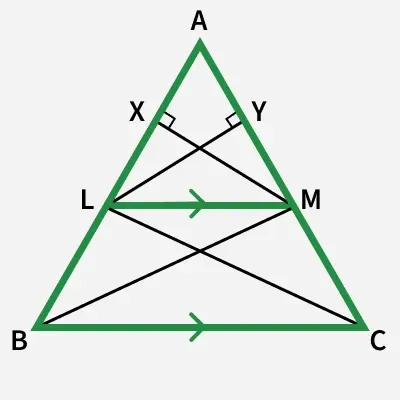
To prove the required result, construct the following lines in the given figure:
Since, area of triangle=
Area of ALM=
Area of LBM=
Area of ALM=
Area of LMC=
Ratio of area of ALM and LBM:
. . .(1)
Ratio of area of ALM and LMC:
. . .(2)
According to the property of triangles, the triangles on the same base and between same parallel lines have equal areas.
Therefore, LBM and LMC have equal areas.
i.e., area of LBM = area of LMC. . .(3)
From equations (1),(2), and (3) we can conclude:
[Hence Proved]
Mid Point theorem states that, "If the line is drawn from one of the midpoints of the side of a triangle parallel to the second, then it always intersects the third side at the midpoint as well."
The Converse of the Basic Proportionality Theorem (BPT) or Thales's Theorem states that if a line intersects two sides of a triangle and divides the sides proportionally, then the line is parallel to the third side of the triangle.
Let's prove the converse of the Basic Proportionality Theorem or converse of Thales Theorem is given as follows:
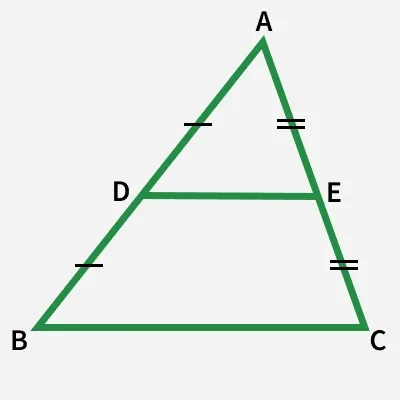
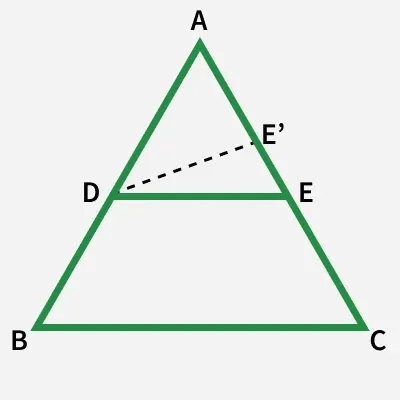
Given: Let us consider a triangle ABC with D and E two points on the side AB and AC such that AD/BD = AE/CE . . .(i).
To Prove: DE∥BC
To prove the converse of BPT, draw a line DE'∥BC.
Now, as DE'∥BC in triangle ABC,
Thus, by using the Basic proportionality theorem,
AD/BD = AE'/CE' . . .(ii)
Using equations (i) and (ii), we get
AE/CE = AE'/CE'
Add 1 to both sides of the equation,
AE/CE + 1 = AE'/CE' + 1
⇒ (AE+CE)/CE = (AE'+CE')/CE'
⇒ AC/CE = AC/CE'
⇒ CE = CE'
This can only be possible if E and E' are coincident.
Thus, E and E' are the same points.
As, DE∥BC
So, DE∥BC [Hence Proved]
Example 1: In ΔPQR, X and Y are points on the sides PQ and PR respectively such that XY|| QR. If PX/XQ = 2/5 and PR = 10 cm find PY.
Solution:
In the given triangle PQR, X and Y are points on the sides PQ and PR respectively such that XY || QR.
By the Basic Proportionality Theorem, we have:
PX/XQ = PY/YR
⇒ PX/XQ = PY/(PR-PY)
Given that PX/XQ = 2/5, we can substitute for PX/XQ:
2/5 = PY/(PR-PY)
⇒ 2/5 = PY/(10-PY)
⇒ 2/5 = PY/(10-PY)
⇒ 2(10 - PY) = 5PY
⇒ 20 - 2PY = 5PY
⇒ 7PY = 20
⇒ PY = 20 /7
Hence, the length of PY is 20/7 cm.
Example 2: In ΔPQR, X and Y are points on the sides PQ and PR respectively such that XY|| QR. If PX = x − 7 , XQ = x + 3 , PY = 2x and YR = 2x −1 , find the value of x.
Solution:
In the given triangle PQR, X and Y are points on the sides PQ and PR respectively such that XY || QR.
By the Basic Proportionality Theorem, we have:
PX/XQ = PY/YR
⇒ (x - 7)/(x + 3) = 2x/(2x - 1)
⇒ (x - 7)(2x - 1) = 2x(x + 3)
⇒ 2x2 - x - 14x + 7 = 2x2 + 6x
⇒ 2x2 - 15x + 7 = 2x2 + 6x
Subtract 2x2 from both sides:
- 15 x + 7 = 6x
Bring terms together:
7 = 6x + 15
7 = 21 x
x = 7/21
x = 1/3
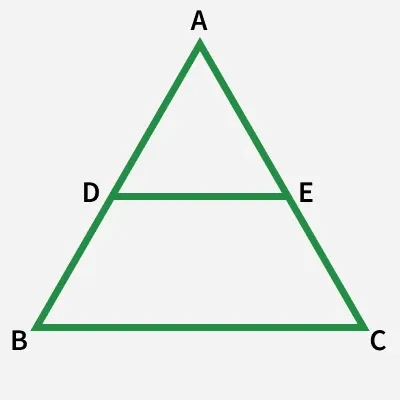
Example 3: In an ∆ABC, sides AB and AC are intersected by a line at D and E respectively, which is parallel to side BC. Prove that AD/AB = AE/AC.
Solution:
Given: DE || BC. So, AD/DB = AE/EC
or By interchanging the ratios as => DB/AD = EC/AE
Now, add 1 on both sides
(DB/AD) + 1 = (EC/AE) + 1
⇒ (DB + AD)/AD = (EC + AE)/AE
⇒ AB/AD = AC/ AE
If we interchange the ratios again, we get
AD/AB = AE/AC [Hence Proved]
Example 4: In triangle ABC, where DE is a line drawn from the midpoint of AB and ends midpoint of AC at E. AD/DB = AE/EC and ∠ADE = ∠ACB. Then prove ABC is an isosceles triangle.
Solution:
Given: AD/DB = AE/EC
By the converse of the basic proportionality theorem, we get => DE || BC
According to question; ∠ADE = ∠ACB
Hence, ∠ABC = ∠ACB
The side opposite to equal angles is also equal to AB = AC
Hence, ABC is an isosceles triangle.
Question 1: In triangle ABC, a line DE is drawn parallel to BC and intersects AB at D and AC at E. If AD = 3 cm, DB = 2 cm, and AE = 4.5 cm, find the length of EC.
Question 2: In triangle XYZ, line LM is parallel to YZ, intersecting XY at L and XZ at M. If XL = 5cm, LY = 10 cm, and XM = 8 cm, find the length of MZ.
Question 3: In triangle DEF, line GH is parallel to EF and intersects DE at G and DF at H. If DG = 6 cm, GE = 9 cm, and DH = 8 cm, find the length of HF.