|
VOOZH | about |
|
VOOZH | about |
Algebra is one of the fundamental branches of mathematics that deals with symbols, variables, and the rules for manipulating these symbols. It helps us represent unknown values using letters (called variables) and form equations to solve real-life and mathematical problems.
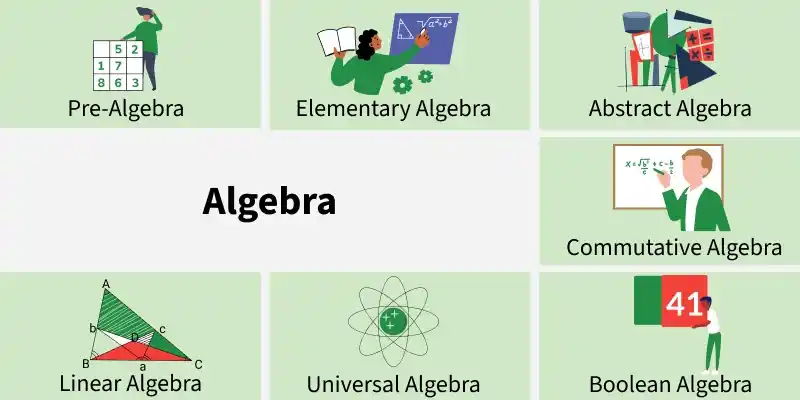
Algebra is divided into several important branches, each focusing on different concepts and applications:
Pre-algebra is the foundation of algebra, introducing inverses basic arithmetic concepts and the idea of variables. It covers order of operations, simple equations, and the formation of algebraic expressions. It also helps convert real-life problems into mathematical form, preparing students for advanced algebra.
Example: Solve 2 + 3 × 4
Solution:
Using BODMAS rule:
= 2 + 12
= 14
Elementary Algebra, also known as Algebra 1, is the branch of mathematics that introduces the use of variables (such as x and y) to represent numbers and focuses on forming, simplifying, and solving algebraic expressions and equations.
Equations are classified based on the degree of the variable into:
Example: Solve 2x + 5 = 13
Solution:
2x = 8
x = 4This example shows how a variable represents an unknown number and how algebra is used to find its value.
Abstract Algebra, is the branch of mathematics that studies algebraic structures such as groups, rings, and fields by focusing on their general properties (like associativity, identity, and distributive laws) rather than specific numbers.
Instead of calculating values, it studies how operations behave inside a structured system.
Example: Find 3 + 4 (mod 5).
Solution:
Step 1: Normal addition
3 + 4 = 7Step 2: Divide 7 by 5
7 ÷ 5 = 1 remainder 2Step 3: Take remainder
3 + 4 ≡ 2 (mod 5)
Universal Algebra is the branch of mathematics that studies algebraic structures in a very general way. Instead of studying groups, rings, or fields separately, it studies the common rules and properties of operations, such as associativity, commutativity, and identity, that apply to all algebraic systems. It focuses on understanding how operations work in general, rather than working with specific numbers or solving particular equations.
Example: Let S = {1, 2, 3} with a binary operation * defined by a * b = a for all a, b in S. Check whether the operation * is associative.
Solution:
We need to verify whether (a * b) * c = a * (b * c)
So,
LHS = (a * b) * c
= a * c
= aRHS = a * (b * c)
= a * b
= aSince LHS = RHS,
the operation * is associative.
Linear Algebra, is the branch of algebra that studies linear equations, vectors, matrices, and vector spaces. It focuses on solving systems of linear equations and understanding how linear transformations work in mathematical spaces.
It is widely used in mathematics, engineering, computer science, physics, and data science.
Example: Solve the following system of linear equations:
2x + y = 7
x − y = 1
Solution:
Add both equations:
(2x + y) + (x − y) = 7 + 1
3x = 8
x = 8/3Substitute x = 8/3 into second equation:
x − y = 1
8/3 − y = 1
y = 8/3 − 1
y = 5/3
Commutative Algebra is the branch of algebra that studies commutative rings (where a × b = b × a) and their ideals. It mainly focuses on polynomial rings and algebraic number systems, and it forms the foundation of algebraic geometry and number theory.
Example: Show that multiplication in the polynomial ring ℝ[x] is commutative by verifying:
(x + 2)(x − 3) = (x − 3)(x + 2)
Solution:
Expand left side:
(x + 2)(x − 3)
= x² − 3x + 2x − 6
= x² − x − 6Expand right side:
(x − 3)(x + 2)
= x² + 2x − 3x − 6
= x² − x − 6Since both sides are equal,
(x + 2)(x − 3) = (x − 3)(x + 2)
Therefore, multiplication is commutative in ℝ[x].
Boolean Algebra, is the branch of algebra that deals with binary values (0 and 1) and logical operations. It is widely used in digital circuits, logic design, and computer science. In Boolean Algebra, 0 represents False, and 1 represents True.