|
VOOZH | about |
|
VOOZH | about |
Solution:
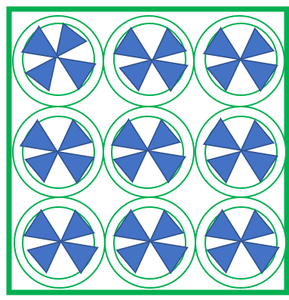
Side of square=6*Radius
=6*7
=42 cm
Area of shaded region=Area of square - Area of 9 circles
=side*side - 9πr2
=42*42 - 9*22/7*7*7
=1764-1386
=378 cm2
The area of the remaining portion of the handkerchief =378 cm2
👁 Image
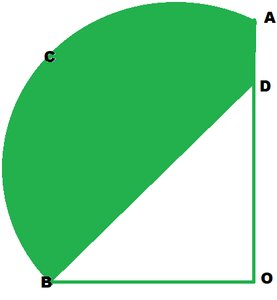
(i) quadrant OACB, (ii) shaded region.
Solution:
(i) Area of shaded region=Area of quadrant
=1/4πr2
=1/4*22/7*3.5*3.5
=38.5/4
=9.625 cm2
(ii) Area of shaded region=Area of quadrant -Area of ∆BOD
=9.625-1/2*BO*OD
=9.625-1/2*3.5*2
=9.625-3.5
=6.125 cm2
👁 Image
Solution:
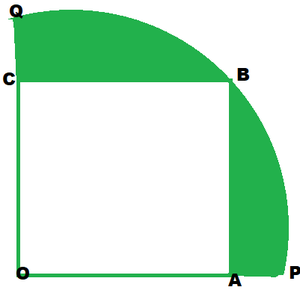
By Pythagoras theorem,
OB2=DA2+AB2
BO2=(20)2+(20)2
OB2=400+400
OB2=800
OB=√800
OB=√(2*2*2*2*5*5)
OB=2*2*5√2
OB=20√2
Area of shaded region=Area of quadrant -Area of square
=1/4πr2 - side*side
=1/4*3.14*20√2*20√2-20*20
=1/4*3.14*800-400
=1*3.14
=22cm2
=1/4*3.14
The area of shaded region is =1/4*3.14
👁 Image
Solution:
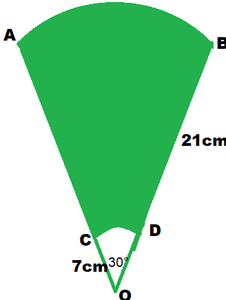
Area of shaded region=Area of sector AOB-Area of sector COD
=θ/(360°) πR2-θ/(360°) πr2
=θ/(360°) π[R2-r2]
=30°/360*22/7[(21)2-(7)2]
=1/12*22/7*28*14
=308/3cm2
=102.66cm2
The area of shaded region 102.66cm2
👁 Image
Solution:
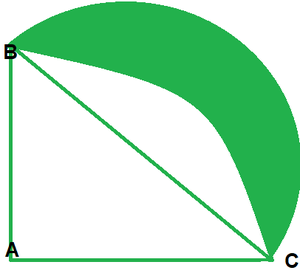
Area of segment=Area of quadrant -Area of ∆BAC
=1/4πr2-1/2*AC*AB
=1/4*22/7*14*14-1/2*14*14
=11*14-98
=154-98
=56 cm2
Semicircle R=?
In rt. ∆BAC, By Pythagoras theorem,
BC2=AB2+BC2
BC2= (14)2+(14)2
BC=√((14)2+(14)2)
BC=√((14)2[1+1] )
BC=14√2
∴Diameter of semicircle=14√2cm
then radius R of semicircle=14√2/2=7√2cm
Area of semicircle =1/2πR2
=1/2*22/7*7√2*7√2
=22*7
=154 cm2
Area of shaded region=Area of semicircle-Area of segment
=154-56 cm2
=98 cm2
The area of shaded region is =98cm2
👁 Image
Solution:
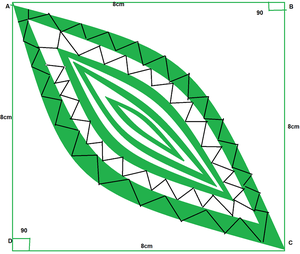
Area of design=Area of 2 quadrant -Area of square
=2*1/4πr2-side*side
=1/2*22/7*8*8-8*8
=704/7-64
=100.57-64
=36.57cm2
Area designed region in figure is 36.57cm2
👁 Image
Exercise 8.1 introduces the fundamental concepts of trigonometric ratios in right-angled triangles. It covers the definitions and calculations of sine, cosine, tangent, cosecant, secant, and cotangent for acute angles. Students learn to identify the opposite, adjacent, and hypotenuse sides relative to a given angle in a right triangle, and use these to compute the six trigonometric ratios. The exercise also explores the relationships between these ratios and their values for specific angles (0°, 30°, 45°, 60°, and 90°).