|
VOOZH | about |
|
VOOZH | about |
Solution:
Given:
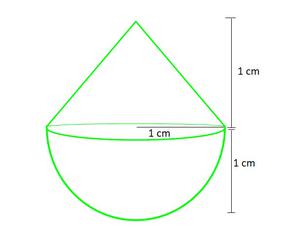
Height of cone (h)= 1 cm
Radius of hemisphere (r) = 1 cm
👁 ImageTotal Volume = Volume of cone + Volume of Hemisphere
= πr2h + πr3
= πr2(h+2r)
= × π × 1 × 1 × (1+2)
= π cm3
Solution:
Given:
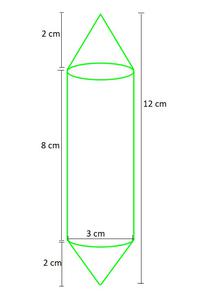
Radius of cone and cylinder (r) = cm
Height of cone (h) = 2 cm
Height of cylinder (H) = 12- (2+2) = 8 cm
👁 ImageTotal Volume = Volume of two cones + Volume of cylinder
= πr2h + πr2h + πr2H
= πr2h + πr2H
= πr2(()h+H)
= (taking π=)
=
=
= 66 cm3
Solution:
Given,
For 1 gulab jamun,
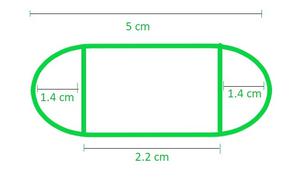
Height of cylindrical part (H)= 5-(2.8) = 2.2 cm
Radius of cylindrical and hemispherical part (r)= = 1.4 cm
👁 ImageTotal Volume of one gulab jamun = Volume of two Hemisphere + Volume of cylinder
= πr3 + πr3 + πr2H
= πr2 (r + H)
= (taking π=)
= 25.05 cm3
Hence, volume of 45 gulab jamun = 45 × Volume of 1 gulab jamun
= 45 × 25.05
= 1127.28 cm3
As, gulab jamun contains sugar syrup up to about 30% of its volume
Sugar syrup in 45 gulab jamun = 30% of its total volume
= × 1127.28
=
= 338.184 cm3
Solution:
Given:
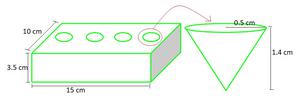
Length of cuboid (l) = 15 cm
Breadth of cuboid (b) = 10 cm
Height of cuboid (h) = 3.5 cm
Radius of conical part (r) = 0.5 cm
Height of conical part (H) = 1.4 cm
👁 ImageTotal Volume wood in the entire stand = Volume of Cuboid - Volume of four conical part
= (l × b × h) - 4 × (πr2H)
= (15 × 10 × 3.5) - (4 × × 0.5 × 0.5 × 1.4) (taking π=)
= 525 - (1.466)
= 523.5333 cm3
Solution:
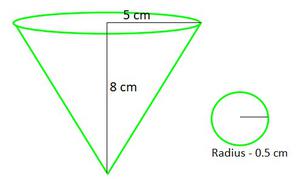
Given:
Height of cone (h) = 8 cm
Radius of cone (r) = 5 cm
Radius of sphere (R)= 0.5 cm
Let, No. of sphere in cone = n
👁 ImageVolume of water = Volume of cone
= πr2h
= × π × 5 × 5 × 8
= cm3
Volume of water flows out = (total volume of water)
=
= cm3
Hence, the volume of n spheres = cm3
Volume of each sphere = πr3
= × π × 0.5 × 0.5 ×0.5
= cm3
Hence, n =
n =
n = 100 spheres
Solution:
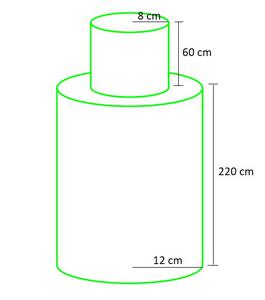
Given:
Height of large cylinder (H)= 220 cm
Radius of large cylinder (R)= = 12 cm
Height of small cylinder (h)= 60 cm
Radius of small cylinder (r)= 8 cm
👁 ImageTotal Volume = Volume of large cylinder + Volume of small cylinder
= πR2H + πr2h
= π (R2H + r2h)
= 3.14 × ((12 × 12 × 220) + (8 × 8 × 60)) (taking π=3.14)
= 3.14 (31680 + 3840)
= 111532.8 cm3
As given, Mass of 1cm3 = 8 g
Mass for 111532.8 cm3 = 8 × 111532.8 g
= 892,262.4 grams
= 892.2624 kg
Solution:
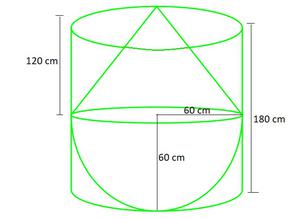
Given:
Height of cylinder (H)= 180 cm
Height of cone (h)= 180 - 60 = 120 cm
Radius of cone, cylinder and hemisphere (r) = 60 cm
👁 ImageVolume of water left in the cylinder = Volume of cylinder - (Volume of cone + Volume of hemisphere)
= πr2H - (πr2h + πr3)
= πr2 (H - h + r)
= (taking π=)
= × 60 × 60 × (100)
= 1131428.571 cm3
= 1.131 m3
Hence, the volume of water left in the cylinder = 1.131 m3
Solution:
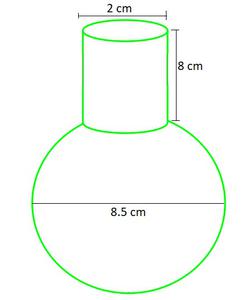
Given:
Height of cylinder (h)= 8 cm
Radius of cylinder (r) = 2/2 = 1 cm
Radius of sphere (R) = cm
👁 ImageAmount of water it can hold = Total Volume of this vessel
= Volume of cylinder + Volume of sphere
= πr2h + πR3
=
= 8π + 102.35π
= 110.35π (taking π=3.14)
= 346.499 cm3
Volume measured by child = 345 cm3, which is INCORRECT
Correct volume = 346.5 cm3
Exercise 13.2 focuses on the surface area and volume of spheres and hemispheres. It covers calculating the surface area (curved and total) and volume of these three-dimensional shapes. Students learn to apply formulas for surface area and volume in various real-life scenarios, including composite shapes involving hemispheres combined with cylinders or cones. The problems often require conversions between different units of measurement and understanding the relationship between radius and diameter.