|
VOOZH | about |
|
VOOZH | about |
Solution:
Given values:
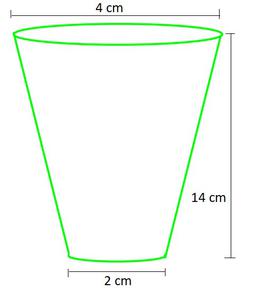
Height of frustum (h) = 14 cm
Radius of larger circle end (R) = = 2 cm
Radius of smaller circle end (r)= = 1 cm
👁 ImageCapacity of frustum-shaped glass = Volume of Frustum
= πh (r2 + R2 + rR)
= × π × 14 ((1 × 1) + (2 × 2) × (2 × 1))
= × 14 × 7 (taking π=)
=
= 102.67 cm3
Hence, the capacity of frustum-shaped glass = 102.67 cm3
Solution:
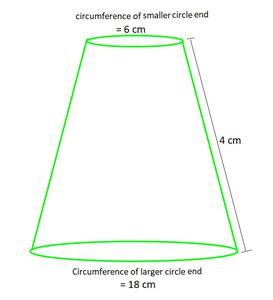
Slant height of frustum (l) = 4 cm
Let radius of smaller circle end = r
Let radius of larger circle end = R
👁 ImageCircumference of circle = 2π × (radius of circle)
Circumference of larger circle = 2πR
18 cm2 = 2πR
R =
R = cm
Circumference of smaller circle = 2πr
6 cm2 = 2πr
r =
r = cm
Now, as curve surface area of frustum = π (r+R) l
= π × () × 4
= 12 × 4 (Taking π common and canceling it)
= 48cm2
Hence, the curved surface area of the frustum = 48cm2
Solution:
Given values:
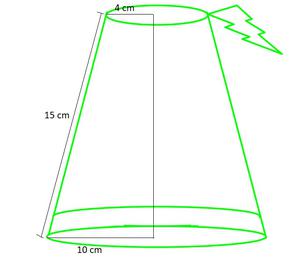
Slant height of frustum (l)= 15 cm
Let radius of smaller circle end (r) = 4 cm
Let radius of larger circle end (R) = 10 cm
👁 ImageArea of material used for making it = Curve surface area + area of upper base
= (π(r+R)l) + (πr2)
= π ((r+R)l + r2) (Taking π common)
= π ((4+10) × 15 + (4 × 4))
= × (226) (Taking π = )
= 710.286 cm2
Hence, the area of material used for making it = 710.286 cm2
Solution:
Given values:
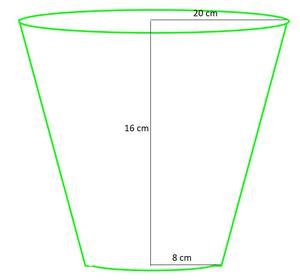
Height of frustum (h)= 16 cm
Let radius of smaller circle end (r) = 8 cm
Let radius of larger circle end (R) = 20 cm
👁 ImageThe amount of milk to fill the container = Volume of frustum
= πh (r2 + R2 + rR)
= × 3.14 × 16 (8×8 + 20×20 + 8×20) (Taking π=3.14)
= × 3.14 × 16 × (624)
= 10449.92 cm3
Cost of 1 litre milk = ₹ 20
And as, 1 m3 = 1000 cm3 = 1 litre
10449.92 cm3 = () ×10449.92 litres
cost of 10449.92 cm3 = () × 20
= ₹ 208.998
Now, metal sheet used to make the container = Curve surface area + area of lower base
= (π(r+R)l) + (πr2)
= π ((r+R)l + r2) (Taking π common)
= π ((20+8) × (√(162+(20-8)2)) + (8 × 8)) (Slant height (l) = √(h2+(R-r)2))
= 3.14 × (28 × √400 + 64) (Taking π = 3.14)
= 3.14 × (624)
= 1959.36 cm2
Hence, the metal sheet used to make the container = 1959.36 cm2
As, cost of 100 cm2= ₹ 8
1959.36 cm2 = (8/100) × 1959.36
= ₹156.748
Hence, the cost of the milk which can completely fill the container = ₹ 208.998
and, the cost of metal sheet used to make the container = ₹156.748
Solution:
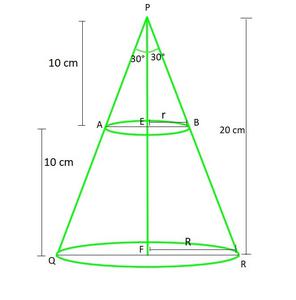
As the angle is cut into two equal parts, the height gets half too.
Let radius of smaller circle end = r
Let radius of larger circle end = R
👁 ImageIn ∆PFR and ∆PEB
tan ∝ =
tan 30° =
R =
r =
and as height of frustum = 10 cm
So according to the question,
Frustum is converted to cylindrical wire having diameter cm
Volume of Frustum = Volume of Cylinder
Volume of Frustum = πh (r2 + R2 + rR)
=
=
=
= cm3 .............................(1)
Volume of Cylinder = π(radius)2H
= π()2H .....................(2)
As (1) = (2) , then
7000π / 9 = 1/3 π(1/(16×2))2H
H = (cancel π from both side)
H = 796444.443 cm
H = 7964.44 m
Hence, the length of the wire = 7964.44 m
Exercise 13.4 focuses on the concept of frustums of cones. It covers calculating the surface area and volume of frustums, which are formed when a cone is cut by a plane parallel to its base. Students learn to apply formulas for the lateral surface area, total surface area, and volume of frustums. The problems involve real-life applications and require understanding the relationship between the dimensions of the original cone and the resulting frustum.