|
VOOZH | about |
|
VOOZH | about |
(i) a prime number
(ii) a number lying between 2 and 6
(iii) an odd number.
Solution:
Here, total number of possible outcomes = 6
1 2 3 4 5 6 (i) P(E) = Probability of getting a prime number.
Prime numbers = {2,3,5}
P(E) = ................... (From Theorem 1)
(ii) P(E) = Probability of getting a number between 2 and 6.
Numbers between 2 and 6 = {3,4,5}
P(E) = ................... (From Theorem 1)
(iii) P(E) = Probability of getting an odd number.
Odd numbers = {1,3,5}
P(E) = ................... (From Theorem 1)
(i) a king of red color
(ii) a face card
(iii) a red face card
(iv) the jack of hearts
(v) a spade
(vi) the queen of diamonds
Solution:
Here, total number of possible outcomes = 52
(i) P(E) = Probability of getting a king of red colour.
Number king of red colour = 2
P(E) = ................... (From Theorem 1)
(ii) P(E) = Probability of getting a face card.
Number face cards = 12
P(E) = ................... (From Theorem 1)
(iii) P(E) = Probability of getting a red face card.
Number red face cards = 6
P(E) = ................... (From Theorem 1)
(iv) P(E) = Probability of getting the jack of hearts.
Number of jack of hearts = 1
P(E) = ................... (From Theorem 1)
(v) P(E) = Probability of getting a queen of diamond.
Number of queen of diamonds = 1
P(E) = ................... (From Theorem 1)
(i) What is the probability that the card is the queen?
(ii) If the queen is drawn and put aside, what is the probability that the second card picked up is
(a) an ace?
(b) a queen?
Solution:
Here, total numbers of cards = 5
(i) P(E) = Probability of getting a queen.
P(E) = ................... (From Theorem 1)
(ii) When the queen is put aside, then Here, total numbers of remaining cards = 4
(a) P(E) = Probability of getting an ace.
P(E) = ................... (From Theorem 1)
(b) P(E) = Probability of getting a queen.
P(E) == 0 ................... (From Theorem 1)
Solution:
Number of deflective pens = 12
Number of good pens = 132
Total number of pens = 12+132 = 144
Hence, total number of possible outcomes = 144
P(E) = Probability of getting a good pen.
P(E) = ................... (From Theorem 1)
Solution:
(i) Numbers of defective bulbs = 4
The total numbers of bulbs = 20
Hence, total number of possible outcomes = 20
P(E) = Probability of getting a defective bulb
P(E) = ................... (From Theorem 1)
(ii) As a non-defective bulb is drawn, then the total numbers of bulbs left are 19
Hence, the total numbers of outcomes = 19
Numbers of non-defective bulbs = 19-4 = 15
P(E) = Probability of getting a non-defective bulb
P(E) = ................... (From Theorem 1)
(i) a two-digit number
(ii) a perfect square number
(iii) a number divisible by 5.
Solution:
The total numbers of discs (outcomes) = 90
(i) Total number of discs having two-digit numbers = 81
(As 1 to 9 are single digit numbers)
P(E) = Probability of getting a two digit-number
P(E) = ................... (From Theorem 1)
(ii) Total numbers of perfect square number = 9
{1, 4, 9, 16, 25, 36, 49, 64 and 81}
P(E) = Probability of getting a perfect square
P(E) = ................... (From Theorem 1)
(iii) Total numbers which are divisible by 5 = 18
{5, 10, 15, 20, 25, 30, 35, 40, 45, 50, 55, 60, 65, 70, 75, 80, 85 and 90}
P(E) = Probability of getting a number divisible by 5.
P(E) = ................... (From Theorem 1)
| A | B | C | D | E | A |
(i) A?
(ii) D?
Solution:
The total numbers of outcomes = 6
(i) P(E) = Probability of getting A
Total number of 'A' in dice = 2
P(E) = ................... (From Theorem 1)
(ii) P(E) = Probability of getting D
Total number of 'D' in dice = 1
P(E) = ................... (From Theorem 1)
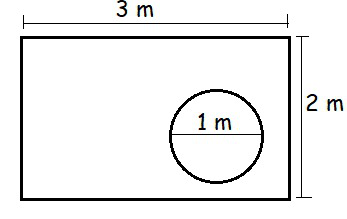
Solution:
Here, the area of the rectangle is the possible outcome and,
The area of the circle will be the favourable outcome.
So, the area of the rectangle = (length × breadth) = (3×2) = 6 m2
and, the area of the circle = πr2 = π(½)2 = π/4 m2
P(E) = The probability that die will land inside the circle
P(E) =
(i) She will buy it?
(ii) She will not buy it?
Solution:
Number of defective pens = 20
Total number of pens (outcomes)= 144
(i) P(E) = The probability that she will buy = The probability of getting a good pens
Number of good pens = 144-20 = 124
P(E) = ................... (From Theorem 1)
(ii) P(E) = The probability that she will not buy = The probability of getting a defective pens
P(E) = ................... (From Theorem 1)
(i) Complete the following table:
(ii) A student argues that ‘there are 11 possible outcomes 2, 3, 4, 5, 6, 7, 8, 9, 10, 11 and 12. Therefore, each of them has a probability 1/11. Do you agree with this argument? Justify your answer.
Solution:
When two dices are thrown, then the total outcomes = 36
(1,1) (1,2) (1,3) (1,4) (1,5) (1,6) (2,1) (2,2) (2,3) (2,4) (2,5) (2,6) (3,1) (3,2) (3,3) (3,4) (3,5) (3,6) (4,1) (4,2) (4,3) (4,4) (4,5) (4,6) (5,1) (5,2) (5,3) (5,4) (5,5) (5,6) (6,1) (6,2) (6,3) (6,4) (6,5) (6,6) (i) P(E) = Probability of having sum as 2 = (Given)
Sample space is (1,1)
P(E) = Probability of having sum as 3
Sample space are (1,2) and (2,1)
P(E) =
P(E) = Probability of having sum as 4
Sample space are (1,3), (3,1), and (2,2)
P(E) =
P(E) = Probability of having sum as 5
Sample space are (1,4), (4,1), (2,3), and (3,2)
P(E) =
P(E) = Probability of having sum as 6
Sample space are (1,5), (5,1), (2,4), (4,2), and (3,3)
P(E) =
P(E) = Probability of having sum as 7
Sample space are (1,6), (6,1), (5,2), (2,5), (4,3), and (3,4)
P(E) =
P(E) = Probability of having sum as 8
Sample space are (2,6), (6,2), (3,5), (5,3), and (4,4)
P(E) =
P(E) = Probability of having sum as 9
Sample space are (3,6), (6,3), (4,5), and (5,4)
P(E) =
P(E) = Probability of having sum as 10
Sample space are (4,6), (6,4), and (5,5)
P(E) =
P(E) = Probability of having sum as 11
Sample space are (5,6), and (6,5)
P(E) =
P(E) = Probability of having sum as 12
Sample space is (6,6)
P(E) =
(ii) The argument is not correct as it contradicts the verified solution in (i) that the number of all possible outcomes is 36 and not 11.
Solution:
The total number of outcomes = 8, as follows
HHH HHT HTT HTH THT THH TTH TTT Total outcomes in which Hanif will lose the game = 6
HHT HTT HTH THT THH TTH P(E) = The probability that he will lose
P(E) =
(i) 5 will not come up either time?
(ii) 5 will come up at least once?
[Hint: Throwing a die twice and throwing two dice simultaneously are treated as the same experiment]
Solution:
When two dices are thrown, then the total outcomes = 36
(1,1) (1,2) (1,3) (1,4) (1,5) (1,6) (2,1) (2,2) (2,3) (2,4) (2,5) (2,6) (3,1) (3,2) (3,3) (3,4) (3,5) (3,6) (4,1) (4,2) (4,3) (4,4) (4,5) (4,6) (5,1) (5,2) (5,3) (5,4) (5,5) (5,6) (6,1) (6,2) (6,3) (6,4) (6,5) (6,6) (i) P(E) = Probability that 5 will not come up either time
5 will not come up either time = (36-11) = 25
P(E) = ....................(From Theorem 1)
(ii) P(E) = Probability that 5 will not come up at least once
P(E) = .....................(From Theorem 1)
(i) If two coins are tossed simultaneously there are three possible outcomes—two heads, two tails, or one of each. Therefore, for each of these outcomes, the probability is 1/3.
(ii) If a die is thrown, there are two possible outcomes—an odd number or an even number. Therefore, the probability of getting an odd number is 1/2.
Solution:
(i) The total number of outcomes = 4, as follows
HH HT TH TT So, P (getting two heads) = 1/4
P (getting two tails) = 1/4
and, P (getting one of the each) =
Hence, this statement is INCORRECT.
(ii) Total outcomes = 6
1 2 3 4 5 6 P(Odd) = Probability of getting an odd number.
Odd numbers = {1,3,5}
P(Odd) = ..................(I). (From Theorem 1)
From (I) we conclude that,
The probability of getting an odd number is 1/2.
Hence, this statement is CORRECT.
Exercise 15.1 | Set 2 of NCERT Class 10 Chapter 15 on Probability focuses on empirical probability. The problems involve real-life scenarios and large sample sizes, requiring students to calculate probabilities based on given frequency distributions. This set emphasizes the practical application of probability concepts, helping students understand how probability is used to analyze and interpret data from surveys, experiments, and observations in various fields.